
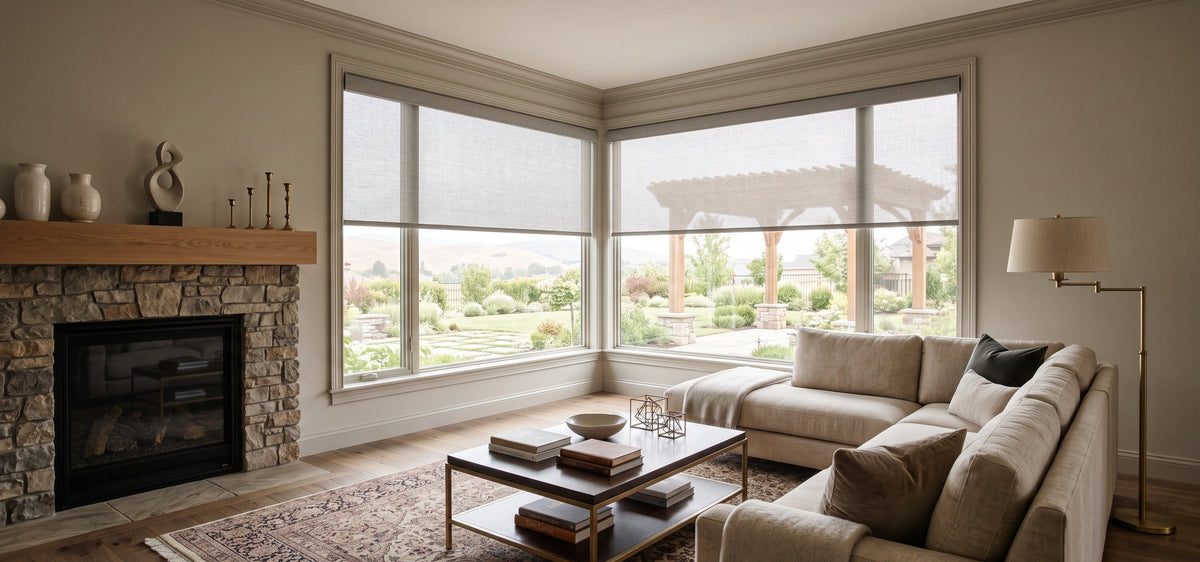

The number printed on a sunscreen fabric, 1%, 3%, or 5%, is its openness factor: the proportion of open space in the weave. It determines how much daylight passes through, how much glare is controlled, and how clearly you can see out.
A lower number means a tighter weave, a darker room, stronger daytime privacy, and a more limited view. A higher number does the opposite.
The difficulty lies in matching a level to a specific window. The same fabric performs differently in a north-facing bedroom than in a west-facing living room, and both room use and window orientation shape the right choice.
Choosing an openness level is a trade-off among daylight, glare control, daytime privacy, and view. No single level maximizes all four, so identifying which one takes priority effectively settles the decision.

What does openness mean on a sunscreen shade?
Openness is the percentage of open space in the woven fabric, and it governs light transmission, glare control, and view clarity at the same time.
A lower openness blocks more direct sunlight, keeps the room dimmer, limits the outward view, and provides stronger daytime privacy.
A higher openness admits more daylight, preserves a view closer to an uncovered window, and offers weaker control over glare and solar heat.
The U.S. Department of Energy notes in its guide to energy efficient window coverings that a greater openness factor reduces protection against glare and solar heat gain while increasing visibility and light transmission.
Lower is not automatically better. The right level depends on which problem the window needs to solve first.
The SmartWings sunscreen series is offered in 1%, 3%, and 5%. Motorized roller shades start at $159.99, and a hardwired sunscreen series is available for windows with a nearby power source.
How do 1%, 3%, and 5% compare?
Each level shifts the same four factors in a predictable direction.
|
Factor |
1% |
3% |
5% |
|
Daylight admitted |
Lowest |
Moderate |
Highest of the three |
|
Glare control |
Strongest |
Strong |
Moderate |
|
Daytime privacy |
Strongest |
Strong |
Moderate |
|
View to the outside |
Most limited |
Partial |
Clearest of the three |
|
Solar heat control |
Strongest |
Strong |
Moderate |
1% openness has the tightest weave in the series. Shapes outside read as outlines rather than detail, and the room takes on a noticeably calmer, dimmer quality with the shade lowered. It suits rooms where screens, direct afternoon sun, or ground-floor exposure are the deciding concerns.
3% openness keeps most of the glare control while loosening the weave enough to make out movement and general shapes outside. It is the middle position for spaces that need sustained comfort without feeling closed in.
5% openness is the most broadly usable of the three. The view stays legible, the room stays bright, and glare is reduced enough for ordinary daytime use in living areas.

Which openness level fits your room?
Start with how the room is used, then check which direction the window faces.
|
Room or location |
Suggested level |
Reasoning |
|
Living room, dining room |
5% |
Preserves daylight and view while controlling everyday glare |
|
Home office, monitor workstation |
3% |
Reduces screen reflection without dimming the room |
|
West-facing rooms, media spaces |
1% or 3% |
Low-angle afternoon sun calls for a tighter weave |
|
North-facing or softly lit rooms |
5% |
Glare pressure is limited, so openness protects the view |
|
Kitchen, breakfast area |
5% |
Daylight leads; drop to 3% if the space heats up late in the day |
Living and dining rooms. 5% is the default because these rooms are used across the whole day and rarely have a single dominant light problem. Watch for a sofa or dining table that sits directly in front of a west-facing window, which usually justifies 3% instead.
Home offices. 3% handles monitor reflection while keeping the room comfortable for reading and video calls. If the desk faces direct afternoon sun rather than sitting beside it, 1% is the safer specification. Related setup considerations are covered in the home office shade guide.
Bedrooms. Sunscreen fabric manages daytime light and privacy, not sleep darkness. Pair it with a blackout layer if the room needs to be dark in the morning, as explained in the light filtering versus blackout guide.
Kitchens and breakfast areas. Brightness usually takes priority, so 5% works well. Watch for west-facing kitchens, where late-day heat builds quickly and 3% is more comfortable.
Large windows and window walls. Openness has a stronger effect as glass area grows, so a level that feels correct on a standard window can feel too open across a full wall. Sizing and configuration for these spans are covered in the large picture window guide.

How does window orientation change the choice?
Orientation often outweighs room type, because it determines the angle and duration of direct sun.
West-facing windows take low, direct sun through the afternoon, producing the strongest glare and heat load of any exposure. Start at 1% or 3%. The same pattern applies to insulation choices, which is why cellular shades are frequently specified in west-facing rooms.
South-facing windows receive steady sun for much of the day at a higher angle. 3% holds up well across changing conditions.
East-facing windows get strong morning sun that fades by midday. 3% to 5% is usually sufficient, depending on whether the room is used in the morning.
North-facing windows receive even, indirect light. 5% preserves the view and brightness without giving up meaningful comfort.
A single openness level across an entire home rarely produces consistent results, because two windows in the same house can face entirely different conditions.

How does fabric color change what you see?
At the same openness level, a dark fabric and a light fabric behave like two different products.
Darker fabrics absorb incoming light, which sharpens the view through the shade. They suit windows where the outlook is the priority.
Lighter fabrics reflect more sunlight and keep the room cooler, but the view reads hazier and less defined.
Openness and color are separate decisions. Openness sets how much light and privacy you get, color sets how the view and heat behave at that level.
Comparing fabric samples against the actual window is more reliable than judging from photographs, since both weave and color shift with the light in the room.
Do sunscreen shades give privacy at night?
They do not. Sunscreen fabric provides daytime privacy only.
During the day the exterior is brighter than the interior, so the weave keeps sightlines out. After dark that relationship reverses, and interior lighting makes shapes and movement visible from outside at any openness level.
Night privacy requires a second layer. A common configuration uses a sunscreen shade for daytime glare and heat, with blackout roller shades lowered in the evening.
This is also why bedrooms are rarely specified with sunscreen fabric alone, regardless of how low the openness level goes.
How does motorization change which openness you pick?
It replaces a full-day compromise with a schedule, which makes a lower openness level practical.
A manual shade holds one state at a time. To avoid a room that stays dim, many homeowners select a higher openness than the window actually needs, and the shade then underperforms during the hours that matter most.
A motorized shade works by time of day. A 1% or 3% fabric can lower through the strongest afternoon hours and raise the rest of the day, so daylight and glare control stop competing with each other.
Schedules, sunrise and sunset triggers, and scene control all handle this without daily input, which matters most on west-facing windows and on windows that are difficult to reach.
SmartWings motorized shades work with Apple Home, Amazon Alexa, Google Home, and Home Assistant. Matter setups require a Thread Border Router such as a HomePod mini or Apple TV.
For independent technical coverage, 9to5Mac reported on the PoE Matter over Ethernet shade line, and Matter Alpha published a hands-on review of the shades. Further coverage is collected on the reviews page.
The difference between the two Matter connection types is covered in the Matter over Ethernet versus Matter over Thread comparison.

What should you check before ordering?
Three checks prevent most openness-related regrets.
Compare samples in the room itself. Hold candidate levels against the window at the hour the room is hardest to use, not at midday. A 3% and a 5% look similar in a sample book and behave differently at four in the afternoon.
Confirm the mount and measurements first. Openness controls light through the fabric, while edge gaps depend on mounting. Measuring guidance is available on the window measuring page.
Decide the power source alongside the fabric. Battery, hardwired, and PoE options each suit different windows, and hard-to-reach windows are simpler to live with on continuous power. Overall configuration and pricing factors are broken down in the motorized shade cost guide.
What mistakes should you avoid?
The most common one is selecting a level from a sample book without accounting for window orientation.
Using one openness level throughout the home. It simplifies ordering and leaves both the west-facing and the shaded rooms poorly served.
Expecting night privacy from a single sunscreen layer. That falls outside what the fabric does, and a second layer is the working solution.
Choosing a higher openness for screen-heavy rooms. 5% often fails to control reflection in offices and media spaces, where a step down performs noticeably better.
Treating color and openness as the same decision. One sets light and privacy, the other sets view clarity and heat behavior, and they need to be judged separately.
Are indoor sunscreen shades the same as outdoor shades?
They are related products that solve the problem at different points.
Indoor sunscreen shades manage light after it has entered the room, controlling glare, preserving the view, and providing daytime privacy.
Outdoor shades intercept sunlight before it reaches the glass, which suits patios, porches, and exposed façades. They block more UV rays and offer relatively better privacy for outdoor spaces.
Outdoor shades are also offered in 1%, 3%, and 5%, but the fabric is built with ventilation in mind, so every level remains partially light-transmitting. Selection by outdoor scenario is covered in the guide to outdoor coverings for heat and UV.
FAQ About Sunscreen Shade Openness
Q1: Which openness level is the most widely used?
5%. It balances daylight, view, and glare control well enough for living rooms, dining rooms, and kitchens. All three levels in the SmartWings sunscreen series are made to the measurements of the window.
Q2: Which level suits a west-facing window?
1% or 3%. Afternoon sun arrives at a low angle and reaches deep into the room, so a tighter weave is needed. Scheduling the shade to lower during peak hours works better than leaving one level in place all day.
Q3: For monitor glare in a home office, is 3% or 5% the better choice?
Start with 3%. It cuts reflection while keeping the room bright enough to work in. If the desk faces strong afternoon sun directly, 1% is the safer call, as outlined in the home office shade guide.
Q4: How should I choose between a dark and a light fabric?
It depends on the priority. Dark fabric gives a clearer view out, light fabric reflects more heat. The difference is significant at the same openness level, so compare fabric samples at the window before ordering.
Q5: Will people see in at night?
Yes, once interior lights are on. Sunscreen fabric covers daytime privacy only, and evening privacy comes from a second layer such as blackout roller shades.
Q6: Do outdoor shades use the same openness levels as indoor shades?
The levels are labeled the same way, but outdoor shades stop sunlight before it reaches the glass, block more UV rays, and offer relatively better privacy. Their fabric is designed with ventilation, so every level stays partially light-transmitting.


