
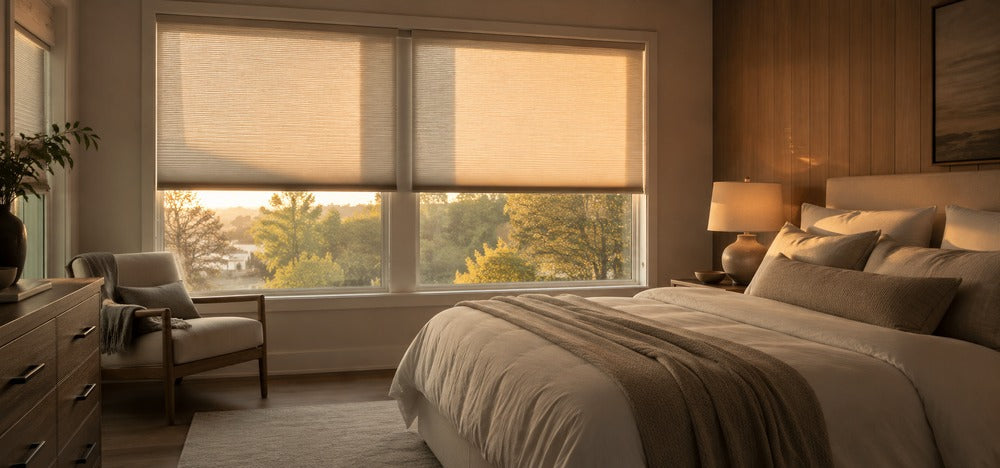

Cellular shades get their name from the honeycomb-shaped cells in the fabric — a structure that forms a barrier of trapped air at the window.
That barrier helps rooms in direct sun stay better insulated against heat and cold, and paired with blackout fabric, it also helps a bedroom stay darker for more restful sleep.
That maps neatly onto the two most common window frustrations: a west-facing room that overheats, and a bedroom that lets light in.
Here's how to choose for each.

Why West-Facing Rooms Run Hot
The heat in a west-facing room isn't just about strong sun.
In the afternoon the sun drops to a low angle and shines almost straight through the glass, and heat builds up indoors through the window.
An ordinary sheer or roller shade blocks the light but not the heat coming through the glass — which is why the room still feels stuffy with the shade down.
A cellular shade works differently because of its cross-section.
The fabric folds into rows of honeycomb cells that form a layer of trapped air between the glass and the room, slowing the heat moving inward.
For windows that take harsh western sun, there are also double-cell versions (a honeycomb within a honeycomb) that add a second air pocket for more insulation.
For how that structure works, see SmartWings' guide to how cellular shades insulate your windows.

Insulating a West-Facing Room
Once you know where the heat comes from, the setup is clearer.
Choose a more insulating build.
Tighter, multi-layer cells make a thicker air barrier and block more heat — for rooms with harsh western sun, a double-cell build is worth prioritizing.
When picking fabric, a lighter, more reflective color facing the street bounces some of the sun back out rather than absorbing it.
Match that build to a model.
SmartWings' Nowa cellular shades use a 1.77" honeycomb construction and offer a Double Cell option for extra insulation — a good fit for harsh western exposure.
They come in both blackout and light filtering fabric, so you can match the room to darkness or just heat relief.
Let it follow the sun.
A west-facing room is a strong case for motorized scheduling — set the shade to lower during the strongest afternoon sun so heat is kept out even when no one's home, then raise in the evening.
That kind of consistent, automatic shading is hard to keep up by hand.

Bedrooms: Blocking Light Leaks for Better Sleep
When a bedroom won't get dark enough, the first instinct is a thicker shade — but the light is usually leaking in around the edges.
Blackout fabric stops most of the light, but as long as there's any clearance around the shade, morning light and street lamps can find their way in.
Even the gap between the valance and the fabric — around 3/16 inch (5 mm) — is barely noticeable by day, yet for light-sensitive sleepers that thin line can be enough to wake you.
Getting a bedroom genuinely dark takes both the fabric and the mount:
Start with a blackout cellular shade.
A blackout build uses opaque fabric to cut light significantly and bring the room closer to fully dark, and its insulating structure keeps summer nights less stuffy too.
Use an outside mount to close the edge gaps.
Mounting the shade outside the frame, extending a few inches past it on each side, covers the side and top gaps an inside mount leaves — getting closer to full darkness, which is well worth it in a bedroom.
For how to decide, see the inside vs outside mount guide.
Schedule it so you're not closing shades at night.
Set the shade to close at sunset and open at sunrise, so you don't wake to adjust it and your routine stays steadier.
For more on efficiency and scheduling, see SmartWings' energy-efficient motorized cellular shade guide.

Choosing by Need: Models and Pricing
The two rooms call for different priorities — match yours below:
Your situation |
Direction |
Model to consider |
From |
West room, mainly blocking heat |
Double-cell blackout |
$185 |
|
Bedroom, mainly for darkness |
Blackout cellular + outside mount |
$185 |
|
Living room / study, keeping light |
Light filtering cellular |
$179 |
Prices are starting points and depend on size, fabric, and motor options. To see the fabric in person first, order cellular fabric samples for $3.50 and hold them against your own window.
If you're unsure which suits your west-facing room or bedroom, or want to plan light, heat, and insulation together, reach out to the SmartWings team — and for matching shades across rooms, the room-by-room window treatment guide can help.
FAQ About Cellular Shades for Heat and Sleep
Q1: Can cellular shades really make a west-facing room cooler?
Yes. The honeycomb cells form an air barrier at the window that slows heat coming through the glass. For windows with harsh western sun, a double-cell build insulates more.
Q2: How can a west-facing room block heat but keep some daylight?
Choose a light filtering cellular shade. The fabric softens harsh western sun into diffused daylight instead of darkening the room, while the honeycomb cells still trap an insulating air layer against afternoon heat.
Q3: Why does my blackout cellular shade still let light in?
Usually it's edge leakage. Even a well-fitted shade has small clearances — the gap between the valance and the fabric is around 3/16 inch (5 mm) — letting a thin line of light through. An outside mount that covers past the frame reduces it noticeably.
Q4: Inside or outside mount for a bedroom?
For darkness, an outside mount extending a few inches past the frame gets closer to fully dark — it covers the side and top gaps that an inside mount leaves around the shade.
Q5: Can cellular shades be motorized and scheduled?
Yes. SmartWings motorized cellular shades run through smart home platforms, voice, or remote, and can be set to close at sunset and open at sunrise — handy for automatic afternoon shading in a west-facing room.
Q6: How much do cellular shades for these rooms cost?
SmartWings light filtering cellular shades start at $179 and blackout at $185, with the final price depending on size, fabric, and motor configuration.


