
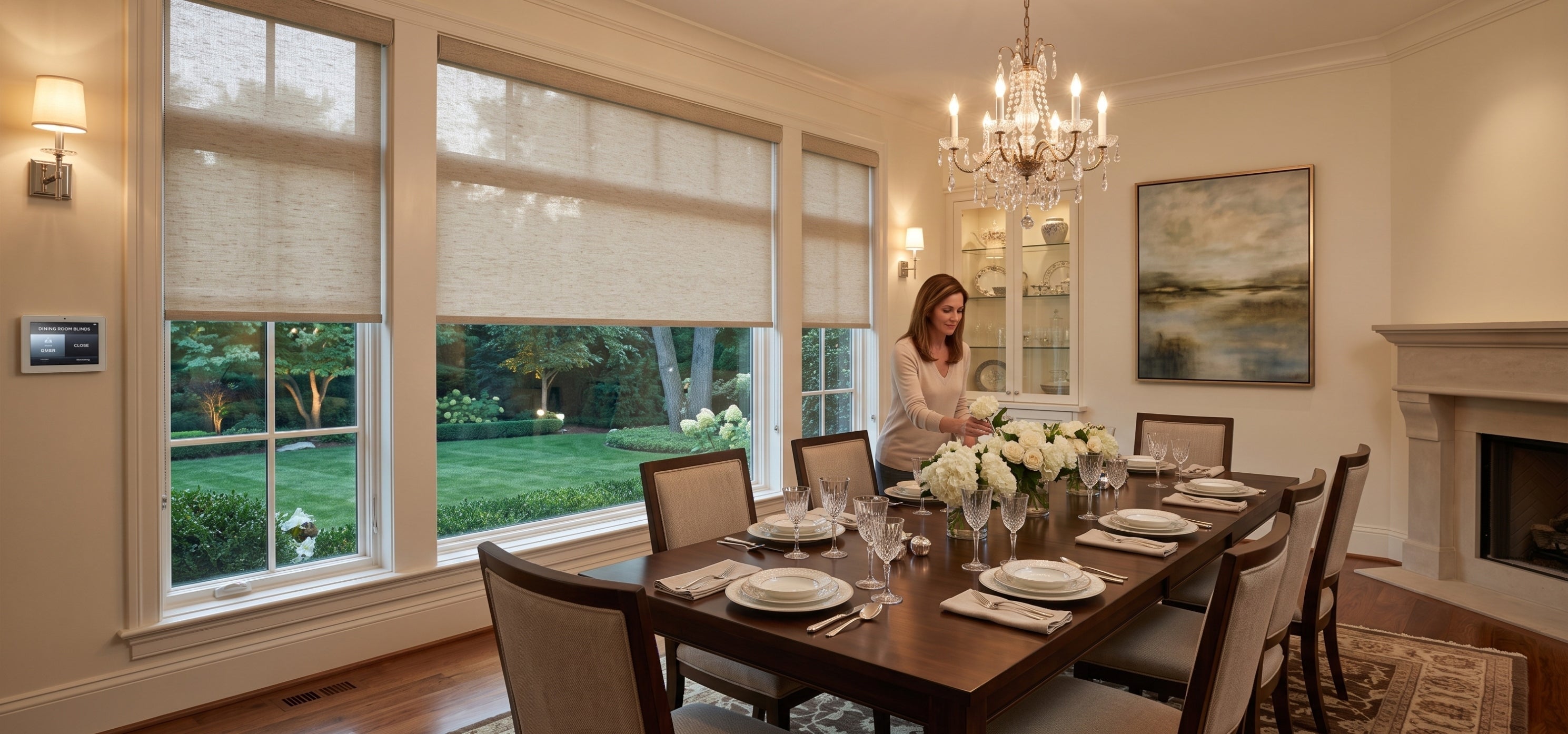

Motorized blackout roller shades are a single panel of blackout fabric on a roller tube that substantially reduces the light coming into a room, creating a darker space for bedrooms, nurseries, and media rooms. With a motor, they raise and lower without pulling, and can run on a schedule or by voice.
Many people assume a shade's darkness comes down to fabric alone, but it doesn't. How much light a blackout roller shade blocks is the combined result of the fabric, the mounting, and how the edges are handled.
SmartWings motorized blackout roller shades are fully motorized and cordless, made to your window's measurements, and start at $159.99. This guide walks through those three layers, then the fabric options, room-by-room setups, and smart control.

The Three Layers That Shape Blackout Performance
How well a blackout roller shade blocks light isn't decided by fabric alone. It's the result of the fabric, the mounting, and the edge treatment together. You can choose the right combination across these three layers based on how dark you need the room.
Layer one, fabric opacity. Blackout fabric usually has a coating or a dense weave that blocks most of the light passing through the panel. This is the foundation, but it only covers the panel itself.
Layer two, mounting. Often light doesn't come through the fabric but leaks through the gaps between the shade and the frame. An inside mount leaves more of a gap, while an outside mount covers past the opening and leaks less.
Layer three, side channels. To close the side gaps further, you can add side channels that let the edges of the shade sit inside a groove along the frame, which is the step to take when you need the strongest blackout.
Each layer addresses a different source of light leakage:
Layer |
Leakage it addresses |
Who it's for |
Blackout fabric |
Light through the panel |
The baseline for any blackout need |
Outside mount |
Gaps at the sides and top of the shade |
Rooms that need darkness for sleep or media |
Side channels |
Remaining leakage at the side edges |
Bedrooms and media rooms needing the strongest blackout |
Most rooms are dark enough with the first two layers. Only when you need the strongest possible blackout do you add the third.

How to Choose the Fabric
Beyond opacity, choosing a blackout fabric also comes down to color, texture, and practicality. A few points to know before you pick.
Opacity and color. A common misconception is that darker means more blackout. In fact opacity is determined mainly by the fabric's coating and weave, not by how dark the color is. Both light and dark blackout fabrics aim to substantially reduce incoming light. Color is more about the look: lighter shades reflect more heat and feel brighter, while darker ones feel calmer with a stronger sense of blockout.
Material and texture. Different weaves give different looks. A plain weave reads clean and simple, while a linen-textured fabric has more grain and warmth, so choose by your room's style.
UV coating. SmartWings blackout fabrics carry a UV coating that reduces UV while blocking light, helping protect furniture and flooring from fading.
Care. Blackout fabric is smooth and durable. Dust it with a dry cloth or a vacuum's soft brush, and spot-clean marks with a slightly damp cloth, with no need for frequent washing.
If a single window needs soft light by day and darkness at night, one blackout shade can't do both, so look at dual roller shades, which put a light-filtering and a blackout layer on the same window.

SmartWings Blackout Roller Shade Fabrics
SmartWings blackout roller shades come in several fabric collections with different looks, so you can match one to your interior.
Essential: A plain-weave basic that's clean and simple with versatile colors, at home in most modern interiors and the safest starting point.
Linen: A linen texture with warm brown tones, natural and soft, suited to modern minimalist and lightly vintage spaces.
Safari: Multi-toned threads in a light-to-dark gradient with more dimensional texture, for a room that wants a bit of design character.
Eclipse: A dark-toned fabric that feels calm and grounded, suited to bedrooms and media rooms where you want a quiet atmosphere.
Each collection comes in several colors, so it's worth ordering swatches to check the real look against your room's light and furniture before ordering.

Power and Smart Control
Power and smart control on blackout roller shades work the same as on other motorized roller shades, so choose by your window.
There are three power options: battery is wire-free and recharges every 4 to 6 months, which fits most rooms; hardwired gives continuous power with no charging, for large or high windows; and PoE carries power and data on a single network cable, for new construction and renovations.
For smart control, the shades are compatible with Apple Home, Alexa, Google Home, and Home Assistant (connecting through Matter over Thread requires a Thread Border Router, such as a HomePod mini). Scheduling is the most useful feature for a bedroom: the shade lowers on its own at night and rises in the morning, with nothing to do by hand. For setup, see the motorized window blinds smart home guide.
Recommended Setups by Room
Different rooms need different levels of blackout. These setups are easy to follow.
Primary bedroom: A mid-to-dark blackout fabric with an outside mount. The outside mount gives the darkness you need for sleep, paired with scheduling to open and close automatically. Add side channels if you need stronger blackout or face a bright street.
Nursery: A blackout fabric with an outside mount and a cordless motor. The cordless design has no hanging cord, which is safer for babies, and scheduling makes nap-time darkening easy.
Media room: A dark blackout fabric such as Eclipse with an outside mount, plus side channels. All three layers together keep screen glare and edge leakage to a minimum.
Study or a living room that only sometimes needs darkening: A blackout fabric with an inside mount is enough. These rooms are mostly about daylight and only occasionally need darkness, so the inside mount looks cleaner and side channels aren't necessary

How to Choose Your SmartWings Blackout Roller Shades
Start by deciding how many layers a room needs: an outside mount is enough for a normal bedroom, while media rooms and demanding bedrooms add side channels. Pick the fabric by style from Essential, Linen, Safari, or Eclipse, choose battery or hardwired power by your window, and add smart scheduling if you want it hands-off.
SmartWings blackout roller shades are all made to your window's measurements, start at $159.99, and let you configure fabric, color, and motor. Browse the roller shades collection, or compare other types in all products.
FAQ About SmartWings Motorized Blackout Roller Shades
Q1: How dark can a blackout roller shade make a room?
Blackout fabric blocks most incoming light for a noticeably darker space. The actual result also depends on mounting: an outside mount leaks less than an inside mount, and side channels close the side gaps further.
Q2: Does a darker color mean more blackout?
No. Opacity comes mainly from the fabric's coating and weave, not the color. Both light and dark blackout fabrics substantially reduce incoming light, while color mostly affects the look and how much heat is reflected.
Q3: How are blackout and light-filtering roller shades different?
Blackout roller shades substantially reduce incoming light, suited to bedrooms, nurseries, and media rooms. Light-filtering shades let soft daylight through while keeping privacy, suited to living rooms, kitchens, and dining areas. Choose by the room's light needs.
Q4: Do I need side channels?
It depends. An outside mount is usually dark enough for a normal bedroom. Only media rooms or bedrooms needing the strongest blackout benefit from side channels to close the remaining side gaps.
Q5: Can blackout roller shades be motorized and voice-controlled?
Yes. SmartWings blackout roller shades are compatible with Apple Home, Alexa, and Google Home (connecting through Matter over Thread needs a Thread Border Router), with voice, scheduling, and remote control.
Q6: Which power option is best for blackout roller shades?
Battery is wire-free and recharges every 4 to 6 months, fine for most rooms. Hardwired and PoE give continuous power with no charging, suited to large or high windows and to new construction or renovations.
Q7: Are blackout roller shades good for a nursery?
Yes. They create a darker space for naps and nighttime, and the SmartWings cordless design has no hanging cord, which is safer for babies. They can also open and close on a schedule.


