
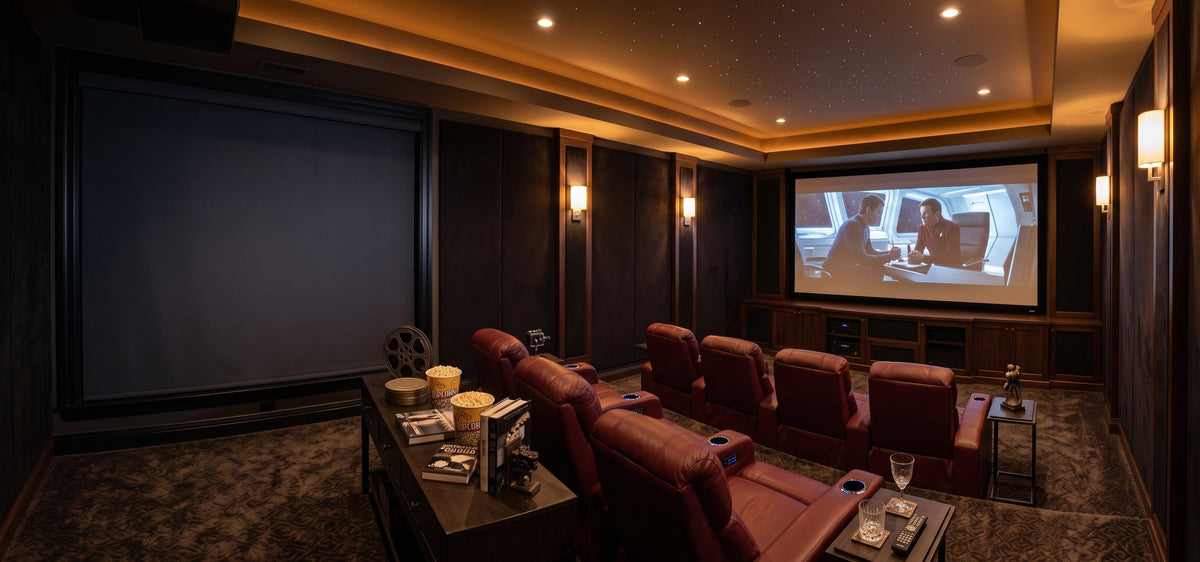

Choosing window shades for a home theater comes down to three requirements:
Daylight on the screen — keeping sunlight off the display and out of the viewers' line of sight
Light around the edges of the panel — the bright outline that remains even when the fabric itself is opaque
Operation — moving the shades between the room's different uses without interrupting anything
Each points to a different decision. The first is about fabric, the second about mounting and fit, the third about how the shades are scheduled. A room that gets one right and the other two wrong still disappoints.
This guide takes them in the order they cause problems.

Where Media Room Glare Comes From
The light washing out a picture is rarely hitting the screen directly. It lands on a pale wall, a coffee table, or a polished floor first, then reflects onto the screen from an angle that is easy to miss when planning the room.
Which window matters depends on where it sits relative to the seating:
|
Window position |
Effect |
What to specify |
|
Behind the seating |
Reflects into viewers' eyes and onto the screen |
Blackout fabric, outside mount |
|
Beside the seating |
Casts a moving band across the lower screen |
Blackout fabric |
|
Beside or behind the screen |
Backlights the display and flattens contrast |
Blackout fabric |
|
Facing the screen wall |
Reflects off the screen surface |
Blackout fabric, closed during viewing |
|
Adjoining room, door open |
Adds ambient light |
Solar or light filtering fabric |
The window behind the seating is the one most often left uncovered, and it usually causes the most trouble.

How Dark the Room Needs to Be
The common assumption is that darker is always better. Display manufacturers and most home cinema installers take a different view.
A small, controlled light source behind the screen reduces eye fatigue and makes dark scenes read better by giving the eye a reference point. A room with no light at all is harder to watch for two hours, not easier.
That changes what the shades need to do:
The goal is controlling daylight, not sealing the room
Blackout fabric on the windows, combined with low bias lighting behind the screen, works better than trying to remove every light source
The room's light level should be adjustable, not fixed at one extreme
Which Fabric to Specify
Two SmartWings fabrics suit a dedicated viewing room, and they are chosen on what else the room has to deal with.
Blackout roller shades, from $159.99 in Vinyl and $179.99 in Linen or Essential — a flat opaque panel, the straightforward choice where light is the only issue
Blackout cellular shades, from $185.00 — the honeycomb cells hold a layer of air against the glass and slow heat transfer, which matters in a room holding electronics that already generate their own
Fabric selection by room is covered in best blackout blinds for bedrooms, living rooms, and home theaters. Fabric samples are $3.50, and a blackout weave reads differently against a real window than on a screen.

Light Around the Edges of the Panel
This is where most media rooms fall short. The fabric is opaque, and there is still a bright outline around the window.
Blackout describes the fabric. It says nothing about the gap between the panel and the frame, and an inside-mounted shade leaves a narrow strip down each side as a matter of structure.
Outside mount places the brackets on the wall or trim above the opening, so the panel extends past the frame instead of sitting within it. For a media room this is the standard choice
Made to measure means the overlap is calculated for the specific opening. SmartWings builds each panel to the window it will be installed on
One realistic expectation: a shade reduces edge light considerably, but a room with windows will not perform identically to a windowless basement cinema. The two mounting types are compared in inside vs outside mount.

Motor Noise During Playback
A shade that is audible over dialogue tends to stop being used.
The answer is scheduling rather than hardware. Shades should complete their movement before the room is in use rather than partway through, and one continuous movement is quieter than several small corrections. Any motorized shade is audible to some degree in a silent room, and what motorized shades actually sound like covers what to expect.

Rooms That Serve Two Purposes
Most media rooms are living rooms for the rest of the week, and specifying only for viewing makes the room less pleasant the other six days. Two fabrics on the same window solve it.
|
Mode |
Solar shade |
Blackout shade |
Result |
|
Daytime, normal use |
Lowered |
Up |
Glare reduced, view retained |
|
Viewing |
Down |
Down |
Daylight controlled |
|
Intermission |
Down |
Down |
Room lighting raised, shades unchanged |
|
Evening, not viewing |
Up |
Up |
Room reads as a living room |
SmartWings offers the Aventus solar fabric in 1%, 3%, and 5% openness, from $169.99 — a tighter weave cuts more glare, an opener one keeps more of the view. Both fabrics run on the same motor platform, so each mode above is set as a single scene rather than operated shade by shade.
FAQ About Home Theater Window Treatments
Q1: Why is there still light around my blackout shade?
Blackout refers to the fabric, not the fit. An inside mount leaves a gap down each side, while an outside-mounted, made-to-measure panel extends past the opening. The difference is set out in inside vs outside mount.
Q2: Should a home theater be completely dark?
Most installers say no. A low light source behind the screen reduces eye strain and improves how dark scenes read. The shades handle daylight; room lighting handles the rest.
Q3: Which window should I cover first?
The one behind the seating. It reflects into viewers' eyes as well as onto the screen, and it is the window most often left uncovered.
Q4: Roller or cellular for a media room?
Both come in blackout. SmartWings blackout roller shades start at $159.99; blackout cellular shades start at $185.00 and slow heat transfer through the glass, which suits a room full of electronics.
Q5: What works in a room that is only sometimes a media room?
Two fabrics on the same window — a solar shade for daytime glare and a blackout shade for viewing. Both run on the same SmartWings motor platform, so each mode is set as one scene.


