
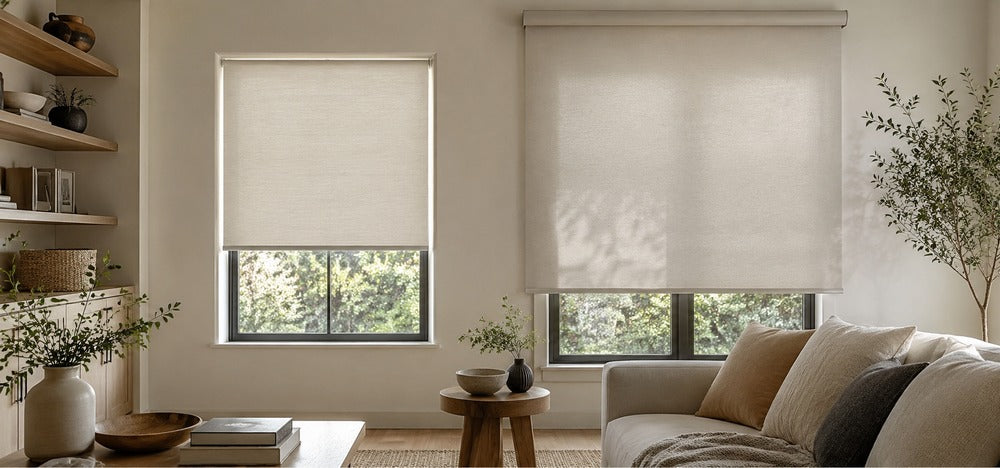

Mount a shade on the wall outside the frame, covering the whole window, and it looks and behaves quite differently from one tucked inside the recess. Outside mount sits on the wall beyond the frame — blocking light more fully, making windows look taller, and handling the kind of irregular or shallow-framed windows that an inside mount simply can't.
A lot of people get stuck deciding between the two before they order, but the choice is more straightforward than it seems. It comes down to what your windows are like and what matters most to you.
This guide sorts that out: whether outside mount is right for your windows, and how to choose the shade that fits.

Inside vs Outside Mount: What's the Difference
An inside mount fits the shade into the recess inside the window frame. The shade sits flush with the opening, leaves the frame itself visible, and doesn't take up any of the surrounding wall.
An outside mount works the other way. It's installed on the wall outside the frame and covers the entire opening, so the shade is wider and taller than the window itself. It hides the frame, but in exchange you get fuller coverage and far more room to adjust how the window looks.
Neither one is better across the board.
The difference comes down to what you care about more — keeping the clean lines of the frame on show, or covering the whole window along with the edges where light tends to slip through. Once that's clear, the rest of the decision falls into place.
If you're still weighing which shade suits which room, SmartWings' room-by-room selection guide can help you think it through.

When Outside Mount Is the Right Choice
If your windows fall into any of the situations below, an outside mount is usually the easier call.
Your window recess is too shallow for an inside mount. Some frames simply aren't deep enough to hold the headrail and motor housing of an inside-mounted shade. An outside mount installs on the wall instead, free of any depth limit — so you don't have to give up the style you want just to fit the recess.
Light control is a priority. An outside mount covers the area around the frame, sealing off the edge gaps where light most easily leaks in.
That makes it especially welcome in bedrooms and media rooms that need to get genuinely dark.
SmartWings blackout roller shades (from $159.99) block light more effectively as an outside mount than inside — a real help for daytime sleepers, shift workers, or anyone sensitive to light.

Your older home has windows that aren't quite square.
In homes with some age to them, frames are often slightly out of true.
An inside mount tends to exaggerate that unevenness, while an outside mount covers the irregular trim and angles, for a much cleaner look.
You want the window to feel larger and taller.
Mount the shade a little higher above the frame and a little wider on each side, and the window reads as taller and broader — lifting the sense of height and space in the whole room.
It's a useful trick for bright living rooms or any space you'd like to feel more open.
When an Inside Mount Makes More Sense
Outside mount isn't the answer for everything. In a few situations, an inside mount is the better choice.
You want to show off beautiful trim.
If your windows are framed with handsome wood molding or custom casing, an outside mount covers it completely — a shame if that detail is part of the room's character. Here, an inside mount keeps it on display.
There isn't enough wall above or beside the window.
An outside mount needs a stretch of flat, unobstructed wall above and on either side of the frame to anchor the brackets.
If the window butts up against a corner, a cabinet, or another window, there may not be room — worth confirming before you measure.
Furniture or artwork sits close by. Because the shade extends past the frame, it can run into nearby furniture, shelving, or wall art when lowered. It's worth picturing the shade fully down to make sure it won't clash with anything next to it.

Why Outside Mount Pairs Well with Motorization
There's one thing about outside mount that's easy to overlook: it usually sits higher than an inside mount, up on the wall above the frame.
The extra height often improves light and coverage, but it also raises the question of how easily you can reach the shade day to day.
That's exactly where motorized control comes in handy.
SmartWings motorized roller shades don't rely on a pull cord, so they raise and lower easily no matter how high they're installed, and you can operate them through smart home platforms like Apple Home, Google Home, and Alexa, by voice, or with a remote — which makes everyday use a lot more convenient.
Motorization also lets an outside mount's light-blocking strengths come through more fully.
You can set the shades to close automatically at sunset and open at sunrise, so a west-facing room shuts out the stronger afternoon sun on its own, or have them shift to different positions through the day without you adjusting them by hand each time.
Which Shades Work Well for Outside Mount
Once you've settled on an outside mount, the next step is picking the right shade. SmartWings offers several types that work nicely as an outside mount, and you can choose by what each room needs.
Blackout roller shades — For bedrooms and media rooms that need to get fully dark, blackout roller shades (from $159.99) are a common pick. The compact roller mechanism suits wall mounting, and as an outside mount it covers the edge gaps around the frame for more thorough light blocking.
Light filtering roller shades — For living rooms and dining rooms that want to keep natural light while holding on to some privacy, light filtering roller shades are a good match.
An outside mount lets the fabric cover the whole window, so daytime light comes through while the view in is screened off.
Cellular shades — West-facing rooms and spaces with higher insulation needs suit cellular shades (from $179). Covering the area around the frame improves their insulating performance, which helps block heat in summer and hold warmth in winter.

For more specific outside mount pairings and pricing by room and need, SmartWings' outside mount product recommendation guide lays out the options for bedrooms, living rooms, media rooms, west-facing windows, and more.
Once you've chosen a style, note that measuring and installing an outside mount differs a little from an inside mount — the complete outside mount installation guide walks through the measuring methods and installation steps in full.
If you're still undecided between inside and outside mount, or you have irregular, oversized, or extra-tall windows that call for a custom approach, reach out to the SmartWings team for a recommendation based on your specific windows.
FAQ About Outside Mount Blinds
Q1: Does an outside mount really block light better than an inside mount?
By covering the area around the frame, an outside mount reduces the edge gaps where light leaks in, so it usually has the advantage on light control. As an outside mount, SmartWings blackout roller shades bring bedrooms and media rooms closer to a fully dark environment.
Q2: Outside mounts sit high — are they awkward to operate?
A manual shade mounted high up can be hard to reach, but SmartWings motorized roller shades are controlled through smart home platforms, voice, or a remote, so the installation height has little bearing on daily use — they raise and lower easily however high they sit.
Q3: Can my windows take an outside mount?
As long as there's enough flat wall above and beside the frame to anchor the brackets, most windows can. SmartWings makes shades to your exact measurements, so irregular or shallow-framed windows can be accommodated too.
Q4: How much larger than the window should an outside mount be?
Because it covers the frame plus the surrounding wall, an outside mount is sized larger than the window itself, with some extra added on each side to minimize light gaps. SmartWings roller and cellular shades are made to the measurements you provide, and how much overlap to allow can be worked out when you order.
Q5: Which types of shades can be outside mounted?
SmartWings blackout roller shades, light filtering roller shades, and cellular shades are all available as outside mounts. The roller mechanism is compact and well suited to wall mounting, while cellular shades insulate better once they cover the area around the frame — you can choose based on what each room needs.
Q6: Is an outside mount more expensive than an inside mount?
An outside mount uses a bit more material since it's larger, but SmartWings roller shades start at $159.99 and cellular shades at $179, with inside and outside mounts in the same pricing structure. The final price depends mainly on size and the fabric and motor options you choose.
Q7: Can outside-mounted motorized shades connect to a smart home?
Yes. SmartWings motorized outside mount shades use the Matter protocol and work with platforms like Apple Home, Google Home, and Alexa. Windows mounted high up are especially good candidates for smart control, with options to close at sunset and open at sunrise.


