
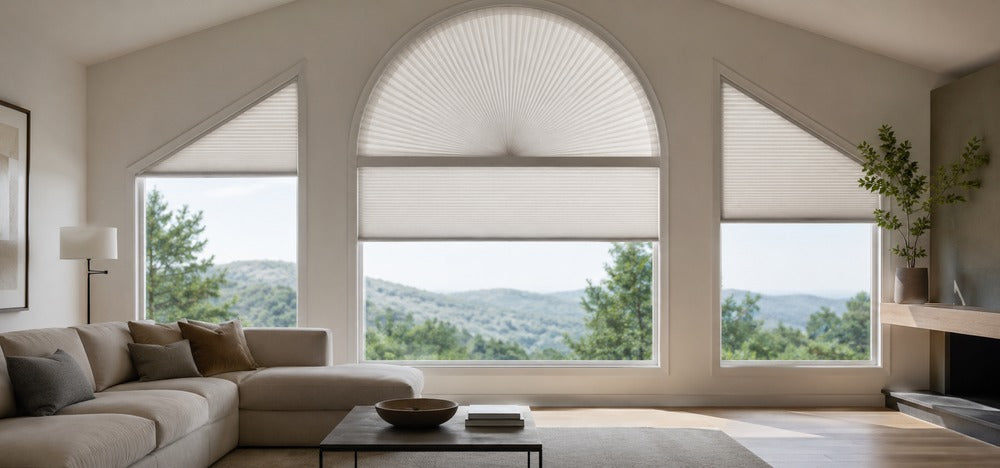

Arched, trapezoid, and angled windows are often the standout feature of a home — distinctive lines, plenty of natural light, and usually the visual focal point of a room.
But as good as they look, they turn tricky the moment you need light control, insulation, or privacy. Off-the-shelf shades won't fit, the afternoon glare still gets in, and cold air still slips through in winter. Specialty windows almost always call for a custom solution that keeps the shape intact while solving these everyday problems.
Here's how to approach each type of specialty window, shape by shape.

Arched Windows
The graceful curve of an arched window is the whole point — the goal is to follow that curve, not flatten it.
SmartWings arched cellular shades are custom-cut to the radius of your arch, hugging the upper curve.
You can choose a fixed version that stays in the arched position year-round, softening harsh direct sun while letting gentle light through, and pair it with an operable shade on the rectangular section below for flexible light and privacy control.
The honeycomb fabric helps in its own right: the multi-layer cell structure improves insulation, blocking heat in summer and holding warmth in winter. For more on how that works, see how cellular shades insulate your windows.
Trapezoid & Slanted Windows
Trapezoid and slant-top windows are common in attics, vaulted spaces, and modern homes. The sloped edge looks striking but makes even, symmetrical coverage difficult.
SmartWings trapezoid cellular shades are made to the angle of your window's slope, rising and lowering along the slanted line rather than leaving an awkward triangular gap.
The honeycomb fabric can be cut to follow the slope, preserving the shape while giving you practical light control.
Because these windows often sit high up, a precise fit to the slope matters even more — a small mismatch shows up as gaps and light leaks far more than it would on a standard window.
Specialty windows are frequently large windows too, so if yours is an oversized slant-top or vaulted window, the thinking in our guide to covering big picture windows is worth a read.

Angled Windows
Triangular and slant-top windows with sharp corners have real visual drama, but they tend to suffer from glare and poor thermal performance.
Honeycomb fabric is flexible yet structured, so it adapts fairly well to angled shapes while adding the bonus of insulation.
That said, angled windows vary widely in shape, so for exactly which angles can be made and how they're cut, it's best to send your window's shape and measurements to the SmartWings team for a solution tailored to your specific window.
Why Specialty Windows Pair So Well with Motorization
Specialty windows share one common headache: they're often mounted high on a wall, over a stairwell, or under a sloped ceiling — out of arm's reach, and not safe to get at with a ladder.
This is where motorized control earns its place. SmartWings motorized cellular shades don't rely on a pull cord, so they raise and lower easily however high they sit, and you can operate them through smart home platforms like Apple Home, Google Home, and Alexa, by voice, or with a remote — no climbing required, which is reassuring in homes with kids or older family members.
Motorization also makes day-to-day use easier. You can set the shades to open at sunrise and close at sunset, so a slant-top window blocks the stronger afternoon sun on its own, and have them shift positions through the day without you climbing up to adjust them.
For what to look at when choosing motorized shades, see our motorized shade buyer's guide.

Two Things to Settle Before You Buy
Get the measurements exactly right. Specialty windows are far less forgiving on sizing than standard ones — a small error in angle or radius leaves gaps and light leaks.
It's best to measure carefully against the official guidance, or have a professional measure on site, to get a snug fit. SmartWings offers a specialty window measuring guide to work from.
Decide whether you need it to move. Some specialty windows — especially those that are there for the shape and don't need full light blocking — can take a fixed shade that stays in place, usually at a friendlier price. If you need to adjust light or lower the shade fully, choose an operable version.
To compare what suits different rooms, our room-by-room window treatment guide can help you think it through.
If your specialty window is an unusual shape or oversized, or you're unsure whether to go fixed or operable, reach out to the SmartWings team for a recommendation based on your specific window.
FAQ About Specialty-Shaped Window Shades
Q1: Can you put shades on specialty-shaped windows?
Yes — specialty windows almost always need custom shades to fit the shape. SmartWings arched and trapezoid cellular shades are cut to your window's actual curve or angle, so windows that off-the-shelf shades won't fit can still be covered.
Q2: What shades work for trapezoid windows?
Trapezoid windows suit cellular shades made to the angle of the slope. SmartWings trapezoid cellular shades rise and lower along the slanted line, matching the shape while giving you light control and insulation.
Q3: How do you cover an arched window?
Use a cellular shade custom-cut to the curve. A fixed version softens direct sun year-round, while an operable shade on the section below handles light and privacy — keeping the arch's shape on show.
Q4: Can specialty-shaped shades be motorized?
Yes. SmartWings motorized cellular shades work on specialty windows and are controlled by smart home platform, voice, or remote. Since these windows often sit out of reach, motorized control is especially practical, with sunrise and sunset automation available.
Q5: How do I choose between a fixed and an operable specialty shade?
If the window is mainly about the shape and doesn't need full blackout, a fixed shade stays in place at a friendlier price. If you need to adjust light or lower it fully, choose an operable version — decide based on the room and your light-control needs.
Q6: Do specialty-shaped windows need to be measured differently?
Yes — they need more precise, shape-specific measurements than standard windows, since small errors in angle or radius leave visible gaps. Measuring against official guidance or having a professional measure on site is the safest route.
Q7: Are arched and trapezoid shades more expensive than standard shades?
Custom-shaped shades generally cost more than standard rectangular ones because they're cut to fit. SmartWings makes them to your measurements, so the final price depends on the size, shape, and the fabric and motor options you choose.


