
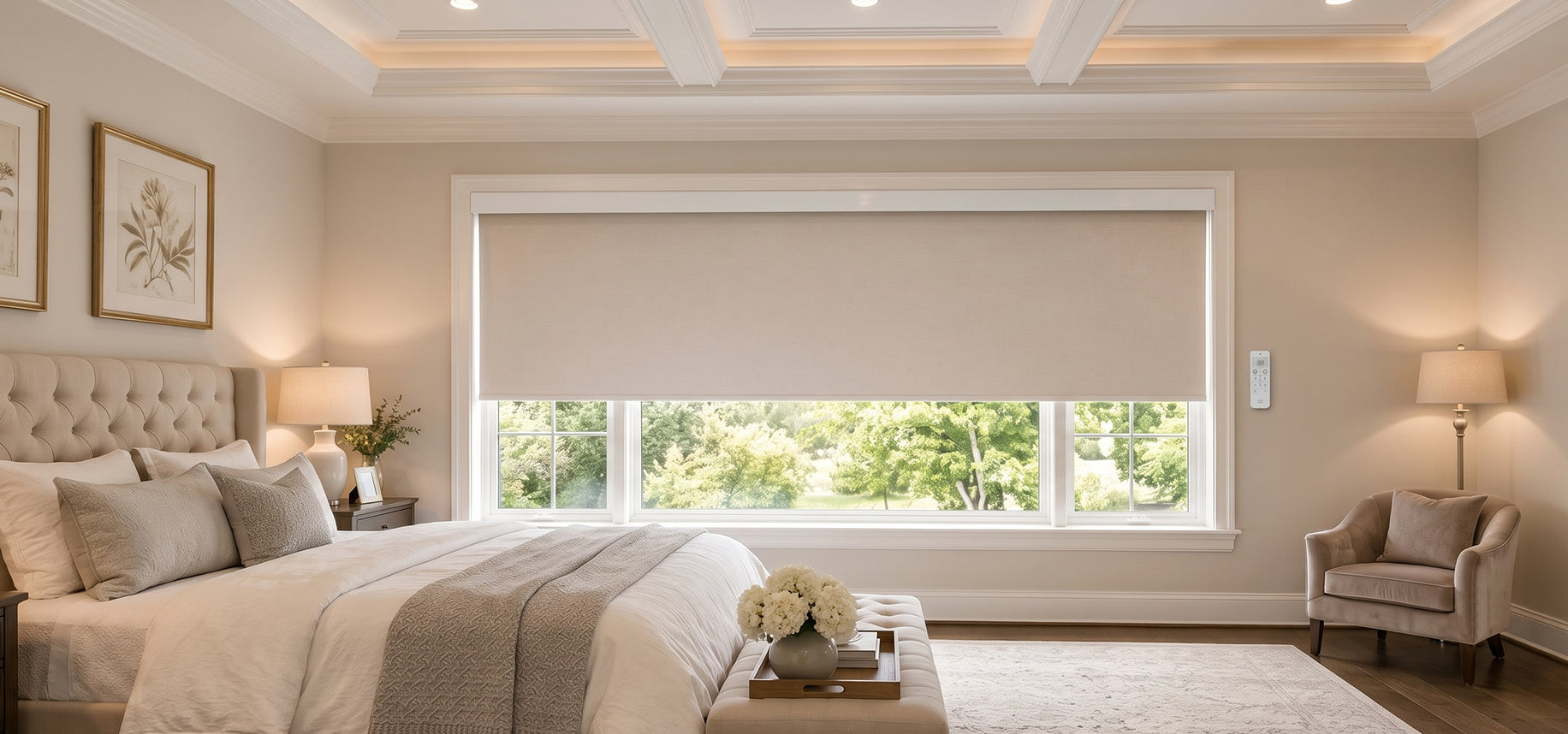

"How much is a motorized shade per window?" is usually the first question people ask when they start thinking about an upgrade.
There's no single sticker price. The same window can land at quite different totals depending on the fabric, configuration, and motor you choose — and many quotes out there hide a cost a lot of people forget to count: installation.
To budget accurately, you need two things clear: where the money actually goes, and which parts you control. This article breaks down every pricing factor for motorized shades, from the starting price to estimating a whole house.

A Quick Look at the Price Factors
The table below gives you the overview — the main factors and which way each one pushes the price — and the sections after it walk through each.
Price factor |
Effect on total |
What you control |
Window size |
Biggest factor; larger costs more |
Size to real need, not oversized |
Shade type |
Roller leaner, cellular/double cell higher |
Choose by room need |
Fabric |
Blackout and specialty cost more |
Basic fabric saves |
Valance / bottom bar |
Counts toward final price |
Basic styles save |
Motor / power source |
Battery, hardwired, PoE differ |
Choose by wiring situation |
Installation |
Self-install skips the pro fee |
SmartWings supports DIY |
Where SmartWings Pricing Starts
For a concrete reference point: SmartWings roller shades start at $159.99 (Vinyl model), and cellular shades start at $179.
Note that this is the price for a shade made to your window's measurements with the motor already included — not a shade you buy first and then pay separately to motorize.
Many retrofit kits add a motor module to an existing shade, which isn't always cheaper over time.
This starting price gives you a baseline: for your window, the final figure climbs from here, and how far depends on the factors below.

The Five Factors That Set the Price
The same window can come back with quotes hundreds of dollars apart. The difference comes mostly from these five.
1. Window size
The most direct factor. A larger window uses more fabric and more material such as a longer valance and bottom bar, so the price rises with it. A floor-to-ceiling living room window typically costs noticeably more than a small bedroom one.
So the first step in any estimate is measuring each window accurately, rather than applying one rough "average" price.
2. Shade type
Different shade types have different construction, and so different prices. Roller shades are simpler and relatively economical; cellular shades run higher for the honeycomb structure, with double cell above single cell; zebra shades sit in between.
Which one you pick isn't only a price question — it depends on the room, which the budget section below gets into.

3. Fabric
Within one shade type, the fabric grade moves the price. Basic fabrics are the most economical, while blackout fabrics, specialty weaves, and special colors cost more. For a bedroom or media room that needs blackout, budget for fabric above what a normal daylight room would need.

4. Valance and bottom bar
These two are the easiest to overlook, and they genuinely count toward the final price. The valance is the top piece that conceals the roller tube and motor; the bottom bar is the weighted rail at the base of the shade.
Different styles and materials for each carry different prices, so the same window costs more or less depending on whether you choose a basic or upgraded style.

5. Motor and power source
The motor is the heart of a motorized shade and a major part of the price. Battery, hardwired (DC/AC), and PoE options differ in cost, and which one fits depends on your home's wiring and how you'll use the shade — not simply on which is cheapest.
Put the five together and the conclusion is clear: the final price of a motorized shade depends on window size plus the combination of shade type, fabric, valance, bottom bar, and motor type — not size alone. Measuring is where an estimate starts, not where it ends.
For how the motors and features differ, see the motorized window shade features guide.

Don't Forget to Add (or Save) the Installation Cost
A big reason some quotes run high is a sizable professional installation fee built in — a pro comes to measure and install, often adding a hundred or two per window, which across a whole house is a real number.
SmartWings shades are designed to be self-installed: the brackets fix with screws and the valance snaps into place, so one person with basic tools can do it, and that professional fee drops away.
For a whole-house budget, what you save here often outweighs fussing over the price difference of the shade itself. For the steps, see the motorized window shades buyer's guide.
Two cases do call for extra wiring: an AC hardwired motor needs a licensed electrician for the power connection, and a PoE motor needs a spec-rated network cable (Cat5e/Cat6) and a PoE switch, best planned during the wiring stage of a new build or remodel. A battery model involves none of this and installs on your own.

Estimating a Whole House
What many people really want to know is roughly what the whole home will cost.
There's no exact figure — it depends on the number of windows, their sizes, and the configuration you choose — but the method is simple.
Count the windows you're covering, sort each by room need (basic roller for ordinary daylight windows, blackout for bedrooms, cellular for large or west-facing rooms), estimate up from the starting price of the matching shade type, and then, because you install it yourself, skip the professional installation fee.
A practical way to save: not every window needs the top configuration. Put the budget where it changes the experience most — large windows, high windows, west-facing rooms — and use basic options on ordinary small windows, which brings the whole-house total down.
How to Choose by Budget
Matching the factors to a budget, here's how to weigh it:
Budget first: Roller shade, battery motor, inside mount. The friendliest starting price, self-installed, no wiring, well-suited to a home you've already moved into.
Temperature first: Cellular shade, battery or hardwired. The extra insulating layer is worth more in west-facing rooms and big temperature swings, paying back in comfort and energy over time.
Whole-home, low-maintenance: For a new build or a home being renovated, plan a hardwired or PoE motor at the wiring stage for continuous power and low upkeep — a good fit when you're planning whole-home automation from the start.

Are Motorized Shades Worth It
Motorized costs more than manual, and whether it's worth it depends on what you value.
The value shows up day to day: one-touch raising and lowering on high and large windows, scheduling that manages light on its own, and a cordless design that's safer for homes with children and pets.
For a small window you open now and then, manual is fine; but for large windows, high windows, or whole-home automation, what motorization saves is the daily hassle and the repeated reach to a window.
To weigh it, see motorized vs traditional blinds.
FAQ About SmartWings Motorized Shade Pricing
Q1: Where does SmartWings motorized shade pricing start?
Roller shades start at $159.99 (Vinyl model) and cellular shades at $179. That's for a made-to-measure shade with the motor included; the final price varies with size and configuration.
Q2: Why do two same-size windows get different quotes?
Because price isn't only about size. Shade type, fabric, the valance, the bottom bar, and the motor type all count toward the final price, so the same window costs more or less by configuration.
Q3: Is the price set by window size alone?
Size is one main factor, but the final price also depends on shade type, fabric, valance, bottom bar, and motor type. Measuring is where an estimate starts, not the whole of it.
Q4: Does SmartWings pricing include installation?
SmartWings shades are made to be self-installed, so one person with basic tools can mount them and skip the professional fee. The exceptions are an AC hardwired motor, which needs a licensed electrician, and a PoE motor, which needs a spec cable and a PoE switch.
Q5: What does a whole house of motorized shades cost?
It depends on the number of windows, their sizes, and configuration, so there's no single figure. Count the windows, sort them by room need, estimate up from the matching shade's starting price, and save the professional install fee by mounting them yourself. Putting budget into large and west-facing windows stretches it furthest.
Q6: On a tight budget, which is most economical?
A roller shade with a battery motor is usually the friendliest: lowest starting price, self-installed, no wiring, good for a home you've moved into. Add a cellular shade only where you need temperature control.
Q7: It costs more than manual — is it worth it?
It depends on the window and the need. On large, high, or out-of-reach windows, one-touch control and scheduling save daily hassle, and cordless is safer; a small window you rarely adjust is fine manual. See motorized vs traditional blinds to weigh it.


