
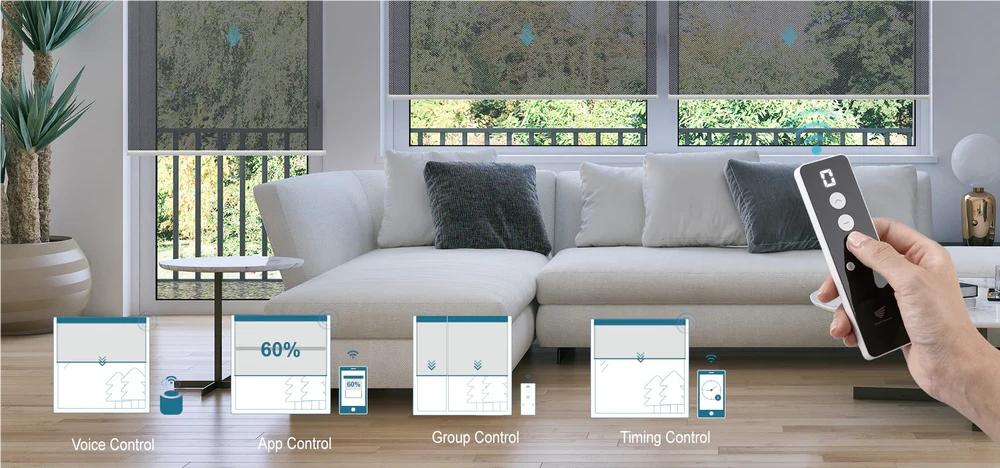

The question isn't whether motorized blinds are "better", it's whether the specific advantages align with your usage patterns and home automation goals.
For some households, motorization transforms window treatment from a daily chore to automated convenience. For others, the added cost and complexity outweigh practical benefits.
This guide examines real-world advantages and scenarios in which motorization delivers measurable value, versus situations where traditional blinds remain sufficient.
Automation: The Primary Value Proposition
Traditional Blinds:
Manual adjustment required for every change
Consistent operation requires daily habit maintenance
Limited by physical reach and effort
Motorized Blinds:
Scheduled operation eliminates manual intervention
Automated response to environmental conditions
Consistent execution without habit dependency
Practical Scenarios:
Morning Routine Consistency: The traditional approach requires remembering to open blinds each morning. Motorized blinds open automatically at set times, ensuring consistent natural light without daily action.
Evening Privacy: Manual blinds risk forgetting to close, compromising privacy. Automated closing at sunset ensures privacy without requiring conscious effort.
Vacation Mode: Motorized blinds can simulate occupancy patterns automatically. Traditional blinds remain static, advertising an empty home.
Smart Home Integration Value
Motorized blinds become components in larger automation scenarios, not just standalone devices.

Scene Integration Examples:
"Movie Mode"
Dims lights
Closes motorized blinds
Adjusts thermostat
Single command, multiple actions
"Leaving Home"
Locks doors
Closes blinds
Adjusts HVAC
Arms security system
"Good Morning"
Opens blinds gradually
Starts coffee maker
Adjusts thermostat
Plays the morning news
Traditional blinds cannot participate in these multi-device scenarios. You manually adjust blinds before or after activating the scene, breaking the automation flow.
SmartWings motorized blinds support the Matter protocol for cross-platform scene integration with Apple Home, Alexa, and Google Home.
Matter motors require a Thread Border Router (such as HomePod mini or Apple TV) for automation functionality.

Large or Difficult-to-Reach Windows
Physical Accessibility Benefits:
High Windows: Traditional blinds require ladders or extended cords. Motorized blinds provide consistent control regardless of height.
Wide Span Windows: Manual operation of wide blinds requires significant force and often results in uneven movement. Motors provide consistent, smooth operation across the full span.
Multiple Windows: Adjusting six traditional blinds daily requires 5-10 minutes. Motorized control handles all windows in seconds.
For large or hard-to-reach windows, consider SmartWings Roller Shades (starting at $159.99) which support oversized windows with reliable motor performance and custom sizing options.
Energy Efficiency Through Precision Control
Motorized blinds enable automated responses to environmental conditions that would be impractical to manage manually.
Heating Season Strategy:
- Open south-facing blinds during peak sunlight hours (solar gain)
- Close north-facing blinds to reduce heat loss
- Adjust automatically based on outdoor temperature
Cooling Season Strategy:
- Close blinds before peak heat arrives (prevents heat buildup)
- Open strategically for natural ventilation during cooler periods
- Coordinate with HVAC system for maximum efficiency
Manual Execution Challenge: These strategies require multiple daily adjustments timed to external conditions. Most users lack the consistency to implement manually. Motorization executes the strategy reliably without ongoing attention.
Practical Impact: SmartWings Cellular Shades ($179-$559) feature honeycomb insulation that traps air for thermal efficiency.
Combined with automated scheduling, they can reduce HVAC load by maintaining optimal window coverage throughout the day.

Lifestyle Compatibility Scenarios
Who Benefits Most:
Remote Workers: Frequent lighting adjustments throughout the workday become single-button operations rather than interruptions.
Elderly or Mobility-Limited: Eliminates physical requirement to reach windows. Voice control or app-based operation from any location.
Multi-Story Homes: Centralizes control of windows across multiple floors. No running upstairs to close bedroom blinds before leaving.
Tech-Forward Households: Natural extension of existing smart home ecosystem. Motorized blinds integrate with platforms already in use..
Situations Where Traditional Blinds Remain Sufficient
Motorization isn't universally superior. Traditional blinds still make sense in specific scenarios:
Single Small Window:
If you have one small bedroom window that you manually adjust once daily (open morning, close evening), motorization adds cost and complexity without a meaningful convenience benefit.
Consistent Manual Habit:
If you already maintain consistent blind adjustment habits and find the routine satisfying (some people enjoy the ritual), automation removes a habit you value rather than solving a problem.
Budget Priority:
Motorization costs $159-559 per window. For tight budgets or when outfitting many windows, traditional blinds at $30-100 per window allow better allocation of funds.
Rental Properties:
Installation commitment and potential damage concerns may outweigh benefits in temporary housing. Traditional blinds require less permanent installation.
Minimal Smart Home:
If you're not building broader smart home automation, motorized blinds operate primarily as expensive remote controls rather than integrated devices. The value proposition diminishes significantly without automation platform integration

Common Misconceptions
"Motorized blinds eliminate all maintenance"
False. Battery-powered models require charging every 4-6 months. All motorized blinds need fabric cleaning and occasional motor inspection. Maintenance is reduced, not eliminated.
"All motorized blinds work with all smart home systems"
False. Integration quality varies significantly. Matter protocol provides the broadest compatibility but still requires a compatible hub or Thread Border Router (such as HomePod mini or SmartThings hub). Verify specific platform support before purchase.
"Motorization is primarily about convenience."
Partially true. While convenience is obvious, energy efficiency through consistent automated control and smart home integration provides additional measurable benefits beyond manual operation reduction.
"Traditional blinds are always cheaper long-term."
Not necessarily. When factoring energy savings from automated control and eliminating replacement from manual operation wear, motorized blinds can achieve comparable total cost over a 10-year period despite a higher initial investment.
Decision Framework
Motorization Makes Strong Sense If:
- You have 3+ windows requiring frequent adjustment
- You already use smart home automation
- You have large, high, or difficult-to-reach windows
- You frequently forget to adjust the blinds
- You work from home, requiring frequent lighting changes
- You want energy optimization through automated schedules
Traditional Blinds May Be Better If:
- You have 1-2 small windows with consistent patterns
- You maintain good manual habits
- Budget is primary constraint
- You're in temporary housing
- You have no other smart home devices
Consider Hybrid Approach:
Motorize high-value locations (bedroom for sleep quality, home office for work productivity) while using traditional blinds for lower-priority windows (bathrooms, storage areas).
Real-World Implementation Examples
Bedroom Optimization:
SmartWings Blackout Roller Shades (starting at $159.99)
Automated closing at 10 PM ensures darkness for sleep
Gradual opening at 7 AM provides gentle wake-up lighting
Eliminates morning routine friction
Quiet motor operation suitable for bedroom environment

Home Office Productivity:
SmartWings Cellular Shades ($179-$559)
Automated adjustment prevents screen glare throughout day
Honeycomb structure provides both light control and noise reduction
Energy efficiency reduces HVAC costs in occupied space

Living Room Comfort:
SmartWings Light Filtering Roller Shades
Scene integration for movie watching
Automated adjustment prevents afternoon sun glare on TV
Guest-friendly remote control for unfamiliar visitors
Maintains natural light while ensuring privacy

Outdoor Spaces:
SmartWings Outdoor Shades ($199-$448.99)
Weather-resistant construction for patios and pergolas
Automated response to weather conditions
Windproof zipper track options for exposed locations
Cost-Benefit Analysis
Initial Investment:
Motorized: $159-559 per window (SmartWings)
Traditional: $30-100 per window
Difference: $129-459 per window
Ongoing Costs:
Motorized: Battery charging (negligible electricity cost)
Traditional: Potential cord replacement, mechanism repair
Comparable over 10-year period
Value Delivered:
Time savings: 5-10 minutes daily for multi-window homes
Energy optimization: Potential 5-15% HVAC cost reduction
Convenience factor: Difficult to quantify but significant for appropriate users

Break-Even Considerations:
For homes with 6+ windows and existing smart home systems, motorization value typically justifies cost within 3-5 years when factoring time savings and energy efficiency.
Ready to Make the Switch?
Not sure whether motorized blinds are right for your home? Contact SmartWings team for personalized recommendations based on your windows, budget, and automation goals.
Common Questions About Motorized vs Traditional Blinds
Q: How much more do motorized blinds cost than traditional ones?
SmartWings motorized blinds ($159-$559) cost $129-459 more per window than traditional blinds ($30-100). Factor in energy savings and time value for true comparison.
Q: Do motorized blinds require professional installation?
Not necessarily. SmartWings battery-powered models support DIY installation. Hardwired options may benefit from electrician assistance.
Q: Can I convert my existing traditional blinds to motorized?
Generally no. Motorized systems require specific motor housing and control mechanisms. Replacing with new motorized blinds is more reliable than retrofitting.
Q: Will motorized blinds work during power outages?
Battery-powered models (SmartWings standard) continue working. Physical remote functions without internet or electricity.
Q: Are motorized blinds worth it for rental properties?
Usually not for renters due to the installation commitment. It may be valuable for landlords in premium properties where smart home features justify higher rent.
Q: Which windows should I motorize first?
Start with the master bedroom (sleep quality impact) or the home office (productivity). Test for 4 weeks before expanding to other rooms.


