
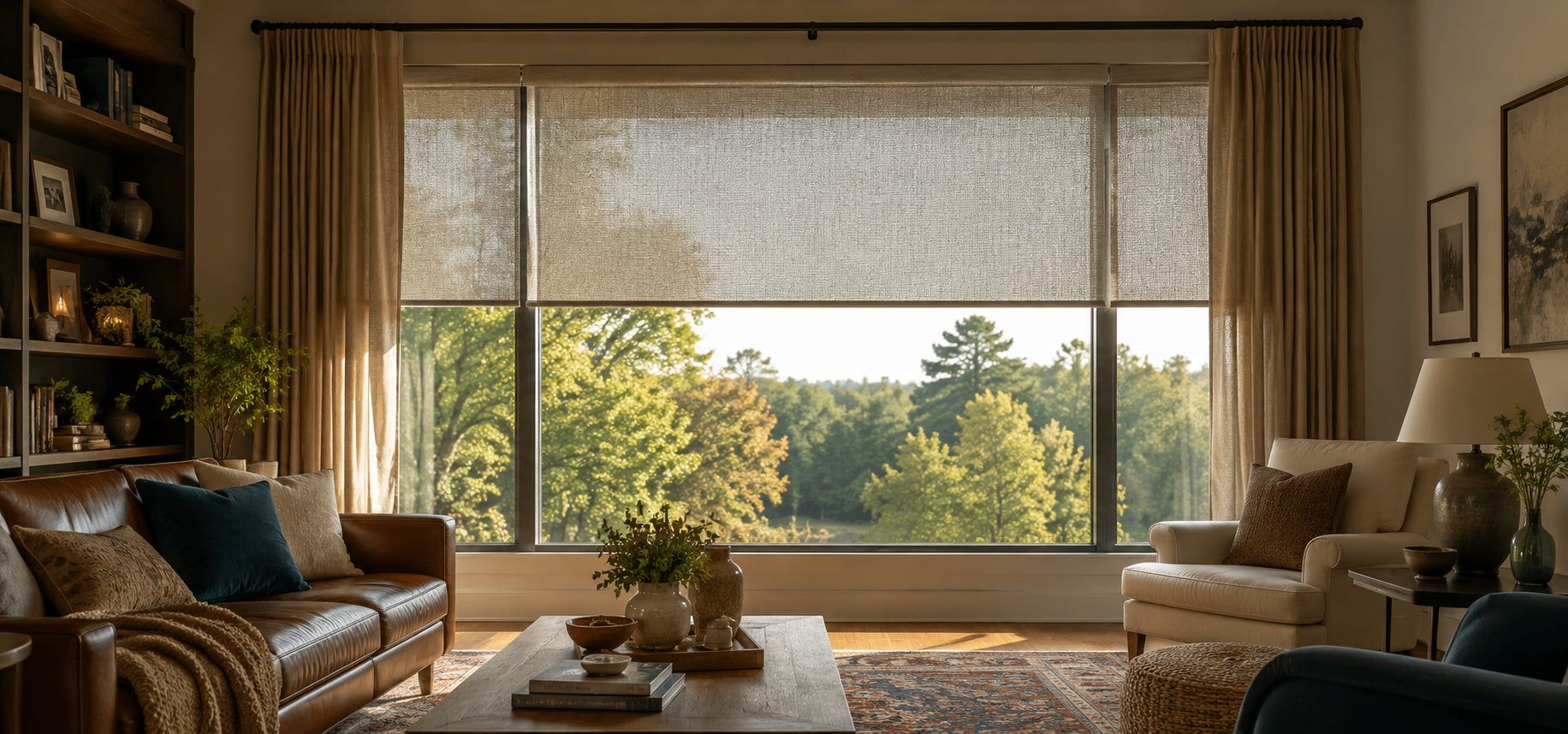

If your living room or dining room has a large fixed single pane of glass — a picture window — you've probably noticed that covering it isn't quite the same as covering a regular window.
The area is large, the view is wide, and the window doesn't open.
But this brings three concrete problems: harsh afternoon glare making the room uncomfortable, prolonged sun exposure fading sofas and floors, and the cold-bridge effect putting noticeable strain on heating and cooling bills.
Standard window treatments often don't translate well to picture windows — sizes don't reach, hardware isn't built for the weight, and manual operation isn't practical at this scale.
This guide walks through what to actually look for, using SmartWings collections as reference points.

4 Core Considerations for Picture Window Treatments
Before picking a specific product, it helps to think through these four needs — once they're clear, the product choice usually becomes obvious.
1. Light and Glare Control
Picture windows are typically placed in living rooms, dining rooms, and stairwells — spaces used mainly during the day. Afternoon glare is the most immediate pain point.
Decide whether you want full blackout or filtered light with the view preserved. This determines whether to choose a blackout or light filtering fabric.
2. UV Protection for Furniture
South- and west-facing picture windows expose sofas, floors, and artwork to prolonged sunlight, accelerating fading. Choosing a light filtering or UV-protective fabric preserves natural light while reducing UV damage.
3. Insulation
A large glass surface is the biggest cold bridge in a room. West sun pours heat in during summer; winter heating escapes through the same surface. Cellular shades, with their honeycomb structure, perform notably better here.
4. Operation Method
Picture windows are large, which means the corresponding shade is wider and heavier. Manual cords wear faster under that load, and pulling them gets tiring.
Motorized versions paired with remote or smart home control are the more practical choice for windows at this scale.
SmartWings Products Best Suited for Picture Windows
Working backward from those four considerations, three SmartWings product categories fit picture windows particularly well.
1. Cellular Shades — Best for Insulation
The insulation pressure on a picture window is much higher than on smaller windows, and cellular shades address that directly.
The trapped air inside the honeycomb cells buffers heat transfer, easing the load on both heating and cooling.
Best for: South- and west-facing picture windows, large windows near sofas or dining tables, older homes with hot summers and cold winters.
SmartWings recommendations:
Blackout Cellular Shades — from $179, with Single Cell and Double Cell options for different insulation levels
For more on the energy logic, see the cellular blackout energy efficiency guide and the honeycomb blackout buying guide.

2. Motorized Roller Shades — Minimal Look + UV Control
If you want the view to stay open and don't want the shade to become a visual element, motorized rollers are the better pick — the headrail is compact and the fabric rolls almost entirely out of sight when raised.
Best for: Modern minimalist interiors, view-priority living rooms, spaces where decorative softness isn't a priority.
SmartWings recommendations:
Blackout Roller Shades — from $159.99 (Vinyl model), for rooms needing full evening blackout
Light Filtering Roller Shades — preserve natural light while softening glare, with UV-friendly performance for furniture protection
For fabric comparisons, see the 12 types of roller blinds guide.
3. Motorized Drapery — Framing the View
If the picture window is the visual centerpiece of the room — a floor-to-ceiling window with a landscape view, a dining room view window — drapery frames the window like a picture, letting the view itself become part of the décor.
The panels stack to the sides when retracted and close fully when needed.
Best for: Living rooms with layered soft décor, dining rooms with scenic views, spaces where both decorative warmth and insulation matter.
SmartWings recommendations:
Motorized Curtains / Drapery — motorized open/close paired with remote or smart home control
For more on smart curtains, see the smart curtain brands comparison guide.
Picture Window Picks by Orientation & Room
Different orientations and room uses shift the priorities — working backward from real scenarios makes the decision more direct.
1. South- or West-Facing Picture Windows
Afternoon heat and glare are at their worst here — floors near the window getting hot to the touch by mid-afternoon is the classic sign. Prioritize Blackout Cellular or Light Filtering Cellular for more consistent insulation.
If you also want to keep the view open, Motorized Roller with light filtering fabric works.
2. Living Room with a Scenic View
When the view is the value — mountain, ocean, or garden views through a floor-to-ceiling window — the goal is for the shade not to steal attention. Motorized Roller offers the least visual interference when retracted; if you want the view to be framed decoratively instead, Motorized Drapery handles that softly.
3. Dining Room Picture Windows
Dining scenes are sensitive to glare and privacy. The two most common issues: 6–7 PM sun hitting directly across the table, and neighbors being able to see into the room during evening gatherings.
4. Stairwell or High-Mounted Picture Windows
Manual operation isn't realistic for high windows — climbing a ladder to reach a cord defeats the purpose.
These spaces basically require a motorized version. SmartWings motorized shades support remote operation, and pairing with timer or schedule features allows automatic adjustment by time of day.
5. North-Facing Picture Windows
Light is softer here, with less pressure on blackout and insulation, so the focus shifts to style fit. Light Filtering Roller or Drapery both work — the choice depends on whether the room leans minimalist or layered.

Common Mistakes to Avoid When Buying
Most picture window mistakes cluster around a few specific points. Knowing them in advance is usually enough to avoid them.
1. Ordering with Standard Window Sizing in Mind
Picture windows often exceed standard size ranges.
SmartWings' main product lines support custom sizing — when dimensions exceed the website's standard range, contacting customer service for a custom quote is more reliable than trying to force-fit a standard size.
2. Choosing Manual and Regretting It
Larger shades carry more weight, and manual cords wear faster under sustained load while also being harder to operate.
Picture windows are best defaulted to motorized, paired with remote or smart home control for daily ease.
3. Ignoring Long-Term UV Damage
South- and west-facing picture windows expose sofas, wood floors, and artwork to extended sun. Even when blackout isn't needed, a UV-protective light filtering fabric is worth choosing.
4. Mounting in the Wrong Position
For picture windows, outside mount installation often works better than inside mount, especially when blackout matters — the shade extends past the frame and reduces side light bleed. For installation details, see the outside mount blinds installation guide.
5. Skipping Smart Home Integration
The real value of motorization is automation — shades dropping by schedule, or working into a smart home scene with a single command.
SmartWings motorized shades are compatible with Apple Home, Google Home, Alexa, SmartThings, Home Assistant, Hubitat, and Homey, with Apple Home requiring a Thread Border Router like HomePod mini or Apple TV 4K.
FAQ About Picture Window Treatments
Q1: Which is better for a picture window — cellular or roller shades?
Cellular shades win on insulation thanks to the honeycomb structure that buffers heat transfer. Roller shades win on minimal visual presence and open views when retracted. Pick by which priority matters more for the room.
Q2: My picture window faces south — do I need blackout shades?
Not necessarily, but UV exposure is the bigger long-term concern. A UV-protective light filtering fabric slows fading on sofas, floors, and artwork while keeping natural light. Add blackout only if naps or evening privacy are also part of the need.
Q3: Do picture windows have to be motorized?
Not strictly required, but recommended. Larger shades are heavier, and manual cords wear faster under that load while being more tiring to operate. High-mounted picture windows like stairwells or double-height living rooms essentially need motorization.
Q4: Can SmartWings make picture window shades to custom dimensions?
Yes. Main product lines support custom sizing, including specialty shapes like arched and trapezoidal windows. For sizes beyond the standard range, contact customer service for a quote.
Q5: How expensive are shades for a large picture window?
SmartWings Blackout Roller Shades start at $159.99 (Vinyl model), and Blackout Cellular Shades start at $179. Oversized or custom orders are quoted separately by customer service based on dimensions and fabric.
Q6: Inside mount or outside mount for picture windows?
Outside mount works better for blackout and coverage, since the shade extends past the frame and reduces side light bleed. Inside mount is fine when the window frame itself is decorative and worth keeping visible.
Q7: Drapery vs Cellular — what's the difference for picture windows?
Drapery is decorative — side panels frame the view and add soft texture. Cellular is functional — handling insulation, energy efficiency, and light control.
Q8: How is a motorized picture window shade powered?
SmartWings offers battery, hardwired, and PoE Matter (select models). Battery runs a 4–6 month charge cycle; hardwired or PoE is often more practical for very large windows.


