
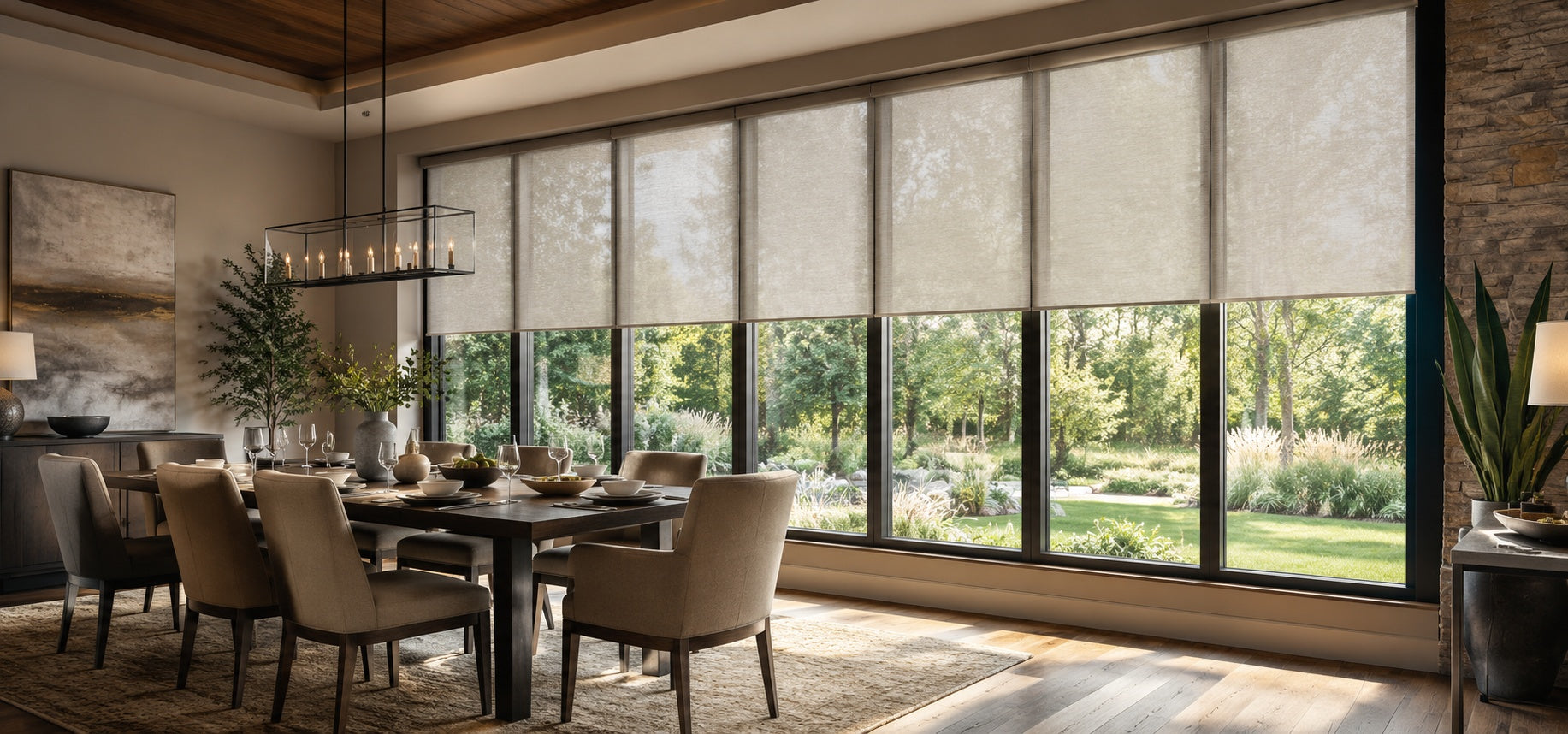

How do you pick the right shades for a large dining room window? Bay, floor-to-ceiling, wide single pane, sliding patio doors, multi-window — each window type calls for a different approach, so how do you narrow it down?
This guide breaks it down by 5 common dining room window types, with SmartWings collections as concrete reference points for each.

5 Common Types of Large Dining Room Windows
Before getting into product recommendations, here's a quick overview of how the 5 window types differ.
Window Type |
Visual Features |
Main Pain Points |
Bay Window |
Three or five panels angled outward |
Segmented coverage, corner treatment |
Floor-to-Ceiling |
Stretches from floor to ceiling |
Height, hard-to-reach operation, privacy |
Wide Single Pane |
One wide fixed pane, doesn't open |
Oversized, heavy motor load |
Sliding Patio Door |
Large sliding glass door |
Traffic flow, kids and pets passing through |
Multi-Window |
Multiple separate windows in a row |
Coordinated operation, visual consistency |
Let's go through each one.
1. Bay Windows: Window Treatment Picks
Bay windows usually have a larger center pane flanked by two smaller side panes, projecting outward to form a recessed nook.
The biggest challenge is structural — three (or five) separate panels need to be treated individually. A single continuous shade won't work; each segment has to be sized and installed on its own.
Best-Fit Products
Cellular Shades — Bay window corners typically require precise measurement and custom sizing. The folded structure of cellular shades coordinates well visually across segmented installations.
SmartWings' main product lines support custom sizing, including Trapezoid and Arched options for specialty shapes.
Motorized Roller Shades — Simple structure, independent installation. Each panel gets its own roller shade, and motorized control can synchronize all three for unified operation.
SmartWings Picks
Blackout Cellular Shades — from $179, a common pick for segmented bay window installations
Blackout Roller Shades — from $159.99 (Vinyl model), suited to modern minimalist bay windows
For measurement details and motorization options, see the motorized window blinds smart home guide.

2. Floor-to-Ceiling Windows: Window Treatment Picks
Floor-to-ceiling windows extend from the floor up to the ceiling, often reaching 2.5–3 meters in dining rooms.
This window type brings three concrete issues — manual cords can't reach the top, evening privacy becomes more sensitive, and the large glass surface puts extra strain on heating and cooling.
Best-Fit Products
Motorized Drapery — Drapery is almost the default pairing for floor-to-ceiling windows. Motorized open/close eliminates the cord reach problem, and the vertical drape stretches the visual height of the room.
Motorized Cellular Shades — For households prioritizing insulation, cellular shades take priority, paired with motorized control to handle the high-reach operation.
SmartWings Picks
Motorized Drapery / Curtains — motorized open/close, with timer or schedule for automatic adjustment by dining time
Blackout Cellular Shades — Single Cell or Double Cell for different insulation needs
For more on motorized curtains, see the smart curtain brands comparison guide.
3. Wide Single Pane Windows: Window Treatment Picks
A wide single pane is one continuous fixed window, often found in homes with scenic views.
The core challenge here is size — these windows commonly exceed standard product dimensions, so they need custom sizing or multi-motor solutions.
Best-Fit Products
Motorized Roller Shades — A single roller suits wide single windows for full coverage, with relatively light fabric weight reducing motor strain.
Layered Treatment — A light filtering shade for everyday use, paired with drapery for evening privacy and decorative warmth, is the most flexible approach for wide single windows.
SmartWings Picks
Hardwired Roller Shades — suited to oversized windows, with stable wired power for daily operation
Light Filtering Roller Shades + Drapery — a layered combination balancing light control and soft décor
For windows exceeding the standard size range, contact SmartWings customer service for custom sizing on main product lines.
4. Sliding Patio Doors: Window Treatment Picks
Sliding patio doors are common in dining rooms that open onto a yard or balcony.
The key consideration here is traffic flow — the shade can't block passage, cords need to be safe for kids and pets passing frequently, and the shade should move out of the way when the door opens.
Best-Fit Products
Motorized Drapery — Handles motorized open/close in patio door scenarios, with smoother operation than manual pulling.
Motorized Roller Shades — Roller shades retract fully without dangling cords, making them friendlier for households with kids or pets.
SmartWings Picks
Motorized Drapery — suited to patio door motorized open/close, paired with remote or smart home control
Blackout Roller Shades — roller models for patio doors needing blackout coverage
For cordless safety considerations in homes with kids and pets, see the cordless light filtering benefits guide.

5. Multi-Window / Window Bank: Window Treatment Picks
Multi-windows are several independent windows arranged in a row — three-window, five-window banks, with frames separating each pane.
The key challenge here is coordination — each window takes its own shade, but the look needs to stay unified and operation needs to be synchronized.
Best-Fit Products
Motorized Roller Shades — Each window gets its own roller shade, with motorized control synchronizing the lift across all panels. This is the most common approach for multi-window banks.
Cellular Shades — Segmented installation keeps the visual look coordinated, while the honeycomb structure improves insulation for each window.
SmartWings Picks
Blackout Roller Shades — matching across multiple windows for visual consistency
Blackout Cellular Shades — combining insulation and coordinated appearance
Motorized versions can be integrated into smart home scenes, allowing the entire dining room's lighting to adjust with a single command.
SmartWings motorized shades are compatible with Apple Home, Google Home, Alexa, SmartThings, Home Assistant, Hubitat, and Homey, with Apple Home requiring a Thread Border Router like HomePod mini or Apple TV 4K.

3 Cross-Type Considerations for Large Dining Room Windows
Whichever window type you have, three things are worth confirming before ordering.
1. Default to Motorized Operation
Large dining room windows are sizable, and manual operation gets tiring and wears out faster over time.
Motorized versions paired with remote or smart home control are the more reliable choice. For feature details, see the motorized window shade features guide and the Best Window Treatments for Large Dining Room Windows: Motorized Solutions Guide.
2. Match Privacy Rhythm to Dining Times
Dining rooms are used most heavily at breakfast, lunch, and dinner — and each time slot brings different light and privacy needs.
Day & Night Cellular or layered treatments can switch between modes by time of day, offering more flexibility than a single-layer shade.
3. Match Style to Overall Décor
Dining rooms are social spaces, and the shade's style directly affects the room's décor. Modern minimalist leans toward motorized roller, traditional and warm leans toward drapery, insulation-focused leans toward cellular.
Working backward from your home's overall décor style is more direct than comparing features alone.
FAQ About Large Dining Room Window Treatments
Q1: Do bay windows need segmented custom sizing or a single continuous shade?
Bay windows are structurally segmented, so a single continuous shade won't fit. Each panel gets its own custom-sized shade, and SmartWings' main product lines support custom sizing.
Q2: For floor-to-ceiling windows, drapery or cellular?
Drapery for style, with vertical drape stretching the room's height. Cellular for insulation, with the honeycomb structure buffering heat transfer.
Q3: Will shades interfere with sliding patio door operation?
Motorized drapery or roller shades don't block door operation — the key is leaving enough clearance for the shade when retracted or pulled aside.
Q4: Can multi-window banks be controlled by a single remote?
Once SmartWings motorized shades are connected to a smart home platform, a single scene can synchronize multiple windows.
Q5: How do I order an oversized dining room window shade?
When window dimensions exceed the website's standard range, contact SmartWings customer service for custom sizing on main product lines. Hardwired power is recommended for oversized models.
Q6: Do large dining room windows have to be motorized?
Not required, but manual operation on large windows gets tiring over time. Motorized versions with remote or smart home control are more practical for daily use.
Q7: How should I handle privacy in a large dining room window?
Use light filtering fabric during the day to keep the view open, then switch to a blackout layer or close the drapery for dinner — the most common privacy rhythm combination.


