
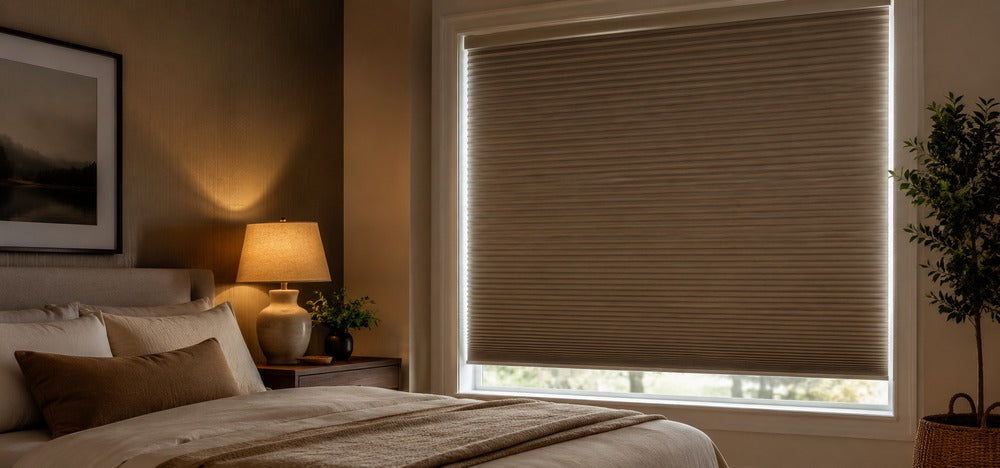

What sets a honeycomb blackout shade apart from an ordinary blackout shade is that it blocks light and insulates at the same time.
The hollow honeycomb cells trap air, reducing both the light coming in and the heat moving through the window, keeping out the afternoon sun in summer and holding warmth in winter.
Whether a honeycomb blackout shade is any good comes down to three things: how dense the blackout fabric is, how well the shade fits the frame, and whether it uses single or double honeycomb cells. Those three decide darkness, light leakage, and insulation.
The sections below walk through each, then give a few ready-to-use room setups and care tips built around SmartWings honeycomb shades.

How to Get a Honeycomb Shade Dark Enough
The biggest worry people have about honeycomb blackout shades is whether they can actually get a room dark enough. The honeycomb structure plus a blackout fabric blocks most of the light, but if there's a gap between the shade and the frame, a sliver of light can edge in around the sides.
That's what most people notice in real use.
Light leaks mainly in two places: the gap between the shade's sides and the frame. The fix comes down to fit and mounting. SmartWings honeycomb shades are custom-made to your window's measurements, so the width sits close to the opening and the side gaps shrink.
Inside versus outside mount makes a real difference too.
An inside mount sits within the frame for a clean look but leaves a small gap at the sides.
An outside mount installs above the opening and covers the edges, wrapping the whole opening and cutting side leakage noticeably.
If you're buying mainly for darkness, an outside mount is usually the safer call. For more on light control by room, see the blackout blinds guide for bedrooms, living rooms, and home theaters.

Single Cell vs Double Cell: Which to Pick for Each Room
Honeycomb shades come in single cell and double cell construction.
They look similar, and the difference is mostly in insulation and thickness.
Single Cell: One layer of cells, lighter, slimmer when stacked, and more affordable. Its darkness and insulation are plenty for everyday bedrooms and offices, and it suits most ordinary windows.
Double Cell: Two layers of cells with an extra pocket of trapped air, so it insulates better, though it stacks a little thicker. It suits windows with harsh afternoon sun, big seasonal temperature swings, or rooms where you want to ease the load on the air conditioning.
A simple test: feel how hot or cold the window gets on a summer afternoon or a winter night. If you can clearly feel the temperature at the glass, double cell is worth it. If the room stays steady, single cell is lighter and the better value.
Both can be custom-made in the SmartWings honeycomb shades collection.

What You Gain by Motorizing a Honeycomb Shade
Motorizing a honeycomb blackout shade solves a few things a manual shade can't.
When the afternoon sun is strongest, you can set the shade to lower on its own to block light and cut heat, which plays to the insulation the honeycomb already provides, with nothing to remember.
People on fixed schedules or who sleep during the day can set timed open and close, so the shade is in place morning and night, even on high windows you can't easily reach.
SmartWings honeycomb blackout shades are fully motorized and cordless, and compatible with major smart home platforms including Apple Home, Alexa, and Google Home (connecting through Matter over Thread requires a Thread Border Router, such as a HomePod mini or Apple TV 4K).
You can control them by voice or fold them into whole-home automations.
The cordless design also removes a hanging cord, which is safer for homes with children and pets. For setup, see the motorized window blinds smart home guide.

The Best Honeycomb Shade Setup for Every Room
Matching the three points above to specific rooms, these combinations are easy to follow:
Primary bedroom / kids' room: Single cell blackout fabric, outside mount, motorized timer. The outside mount keeps light out for sleep, and the timer opens and closes the shade morning and night, with one-tap full dark for daytime naps.
West-facing living room: Double cell, outside mount, smart control. The double cells handle strong afternoon sun and heat, and a midday auto-lower blocks light while easing the air-conditioning load.
Study / home office: Single cell, inside mount. Darkness and insulation are plenty here, the inside mount looks cleaner, and it costs less, which fits a room that's mainly about daylight and glare control.
High or hard-to-reach windows: Motorizing is the key part. Whatever the cell type, a motor means no climbing to operate it, then choose double cell or not by the window's exposure.
One measuring note before ordering: for an outside mount, measure width and height out to how far you want it to cover past the opening, since more coverage means less side leakage.
For an inside mount, measure the inside of the frame precisely. Inaccurate measuring is the most common reason a honeycomb shade's darkness falls short.

Honeycomb Shade Cleaning and Care Tips
The honeycomb structure is what gives these shades their insulation, so a few care habits keep them performing over the years.
Day-to-day cleaning is simple. Every so often, run a microfiber cloth, a feather duster, or a vacuum's soft brush attachment along the shade to lift dust from the cells and the surface.
For a spot of dirt, dab it with a little mild detergent and water, then let it air-dry.
What to avoid is soaking or washing. The cells are hollow, and long soaking can deform or collapse them, which hurts both insulation and the way they spring back, so keep cleaning to dry dusting and spot-dabbing rather than putting the whole shade in water.
Motorized shades are a little easier to maintain, since cordless operation without repeated manual pulling keeps the fabric evenly handled and less prone to warping over time.
SmartWings honeycomb shades are all custom-made to your window's measurements, with cell type, fabric, and motor chosen to suit.
Browse the SmartWings honeycomb shades collection, or compare other shade types in all products.
FAQ About SmartWings Honeycomb Blackout Shades
Q1: Do honeycomb blackout shades really get a room dark enough?
The honeycomb plus a blackout fabric blocks most of the light, though a sliver can edge in at the sides. The keys to deeper darkness are a custom fit close to the frame and an outside mount that covers the edges. SmartWings honeycomb shades are made to measure for exactly this reason.
Q2: How do I choose between single cell and double cell?
It depends on your insulation needs and the window's exposure. Single cell is lighter, more affordable, and plenty for everyday rooms, while double cell adds a second pocket of trapped air for stronger insulation. Choose double cell for harsh afternoon sun, big temperature swings, or to ease the air-conditioning load.
Q3: How do I minimize light leaking at the edges?
Two things help most: have the shade custom-made to fit close to the frame, and use an outside mount that covers past the opening. SmartWings honeycomb shades are custom-sized, so you can order the coverage an outside mount needs.
Q4: Are honeycomb blackout shades enough for shift workers or daytime sleepers?
They substantially reduce incoming light, and a custom fit with an outside mount helps further. SmartWings honeycomb shades can also be timed to lower on their own for daytime sleep. For very demanding cases, layering curtains adds extra coverage.
Q5: Can honeycomb blackout shades be motorized and voice-controlled?
Yes. SmartWings honeycomb blackout shades are fully motorized and cordless, and compatible with Apple Home, Alexa, and Google Home (Matter needs a Thread Border Router). They take voice control and timed open and close, which helps on high or hard-to-reach windows.
Q6: How do I clean honeycomb blackout shades, and can I wash them?
Dust them regularly with a microfiber cloth or a vacuum's soft brush, and spot-clean any dirt with a little mild detergent. Avoid soaking or washing them, since prolonged soaking can damage the hollow honeycomb structure.
Q7: Besides blackout, do honeycomb shades offer other benefits?
Yes, mainly insulation. The hollow honeycomb traps air and slows heat moving through the window, keeping out heat in summer and holding warmth in winter. Double cell insulates more noticeably and can ease the air-conditioning load over time.


