
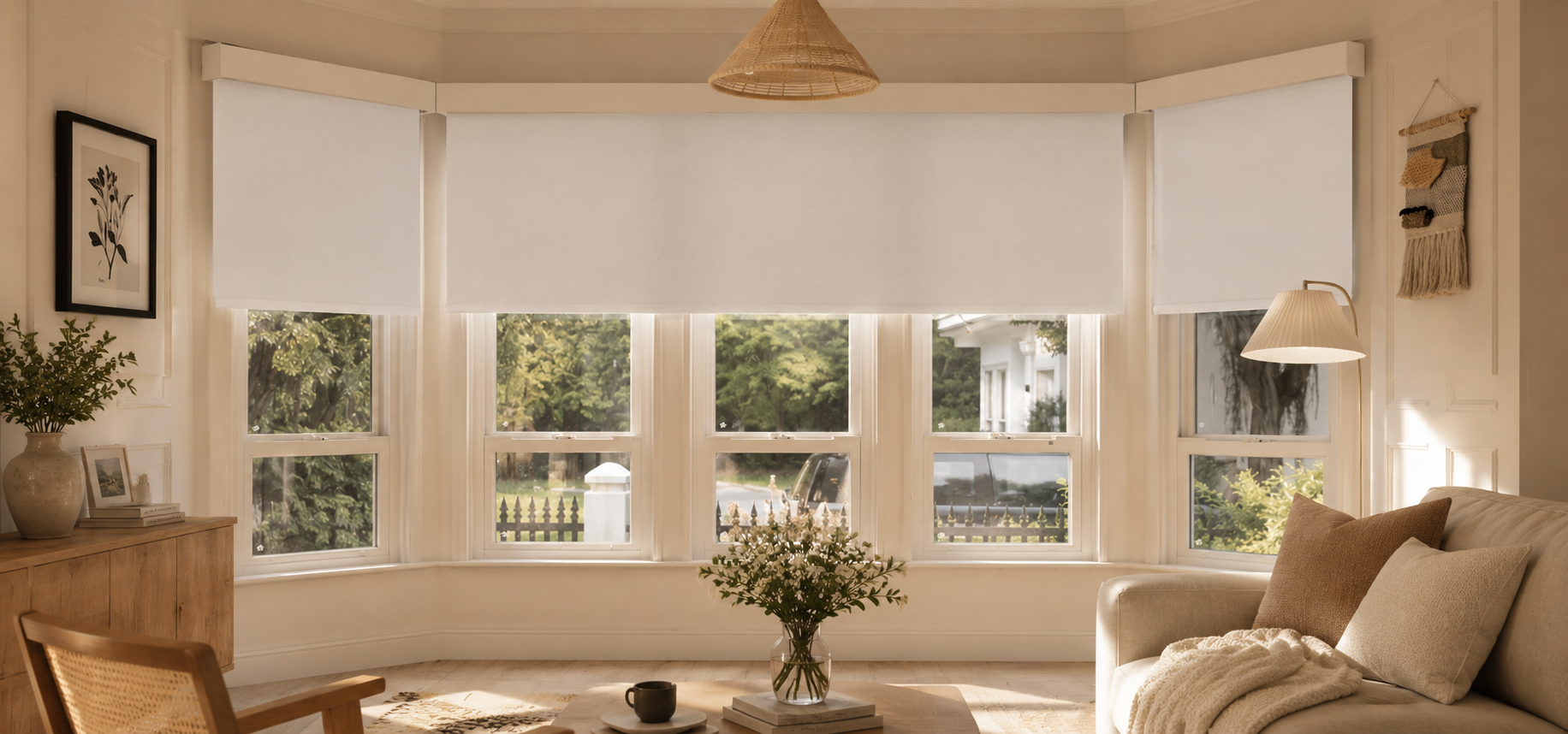

The most common bay window mistake shows up at the corners: two adjacent shades bump into each other where the panels meet, so they snag on the way up or leave an awkward gap.
The problem isn't the shade — it's the structure. A bay window is several panels joined at an angle, and the space at each corner is tight, so a headrail that's even slightly bulky will collide with the one next to it.
Choosing bay window blinds really comes down to two things: a shade slim enough to sit cleanly in the corners, and an easy way to control several panels at once. Let's start with how a bay window is built.
For the broader picture beyond bays, SmartWings covers most window types across its smart shade range.

Bay Window vs Bow Window
People use bay and bow interchangeably, but the shapes differ, and so does the way you cover them.
A bay window is usually three panels — a larger flat window in the center with two smaller ones angled toward it on each side. The corners are sharp and clearly angled.
A bow window is four or more panels set in a gentle curve, so it reads as a softer, rounded line, with smaller angles between neighboring panels.
Because a bow has more panels packed at tighter angles, the corner-collision problem is more pronounced, which makes a slim shade matter even more.

Where Bay Windows Get Tricky: The Corners
When a bay window is hard to dress, the corners are almost always why.
Each panel needs its own shade, and every shade has a headrail with some thickness. Where two panels meet at an angle, a bulky headrail that stacks deep will push the two shades into each other, interfering with how they raise and lower and leaving gaps.
So the first rule for a bay window is to pick a shade with a slim headrail that stacks compactly, letting adjacent panels settle into the corners without fighting. This is what sets a bay window apart from an ordinary flat window.
Which Shades Suit a Bay Window
By that standard — slim profile, clean fit at the corners — three SmartWings lines all work well on a bay, each with a different strength.
Roller shades are the easiest call for a bay. They're versatile and pair with almost any decor, and a row of them across the panels reads clean and consistent, which suits the multi-panel look of a bay window.
Cellular shades stack flat and compact, so they also suit tight corners, and the honeycomb structure adds insulation. Since a bay projects out from the wall and takes sun and heat on three sides, cellular shades have an edge on temperature.
Zebra shades have alternating sheer and solid bands you can align or offset, so you can shift between daylight and privacy through the day — handy for a bay you often sit in to look out. For how the three compare, see the guide to roller vs cellular vs zebra shades.

Why Each Panel Needs Custom Sizing
The panels in a bay often vary slightly in width and height, so one set of off-the-shelf sizes leaves a few panels misaligned.
SmartWings shades are made to each panel's actual measurements, so you order each one separately and every shade sits flush, settling precisely into the corners. For bays with curves or more complex angles, see the specialty-shaped window solutions.

Inside Mount or Outside Mount
On a bay, you decide inside or outside mount for each panel, and that choice drives how clean the corners look.
An inside mount sits within each window frame, so the shades settle into their own openings, the corners stay tidy, and panels are least likely to interfere — the most common bay approach, though it depends on precise measuring.
An outside mount sits over the opening and covers edge gaps better, but on a bay the adjacent shades are more likely to collide at the corner, so you need to plan the spacing. Inside mount is usually tidier on a bay; for the full trade-off, see inside vs outside mount.

Sync Every Panel with Motorized Control
With the fit sorted, there's the second issue: pulling several panels by hand is tedious, and the large center panel or a far corner is often awkward to reach.
This is where motorization earns its place. The panels on a bay can be grouped and controlled together, so one command raises or lowers them in sync instead of working around the bay one shade at a time. Sitting by the window, a single voice command brings every panel to the same height, so the row stays even.
SmartWings motorized shades are compatible with major smart home platforms including Apple Home, Alexa, and Google Home (connecting through Matter over Thread requires a Thread Border Router, such as a HomePod mini or Apple TV 4K). You can set schedules so the panels rise and lower on their own morning and night, or control them by voice.
The cordless design also clears away several hanging cords. On a bay, the cords from multiple panels tend to cluster and clutter; without them the whole bay looks cleaner, and it's safer for homes with children and pets.
For more on smart control, see the motorized window shades buyer's guide.

Bay Window Setups by Room
Matching the points above to common rooms:
Living room view bay: Zebra shades, inside mount, grouped motor control. Adjust the bands for view and privacy by day, and sync every panel without getting up.
Bedroom bay: Blackout roller or cellular shades, inside mount, scheduling. Block light for sleep, with the panels rising and lowering together morning and night.
West-facing bay: Cellular shades, motorized. The three-sided sun exposure makes cellular's temperature control worth it, with scheduling to lower the shades during peak sun.
Bay paired with a large fixed window: If a big picture window sits alongside the bay, see how to choose coverings for big picture windows to coordinate the look.
Across all of these, SmartWings makes each panel to measure, so the shade type, fabric, and motor are chosen to fit the bay.
FAQ About SmartWings Honeycomb Blackout Shades
Q1: Do bay and bow windows need different blinds?
Yes. A bay is usually three sharply angled panels, while a bow is four or more in a tighter curve where corner interference is greater. SmartWings roller shades and cellular shades both stack compactly, so they suit either type.
Q2: Can I use off-the-shelf shades on a bay window?
It's not recommended, since angled panels of differing widths tend to misalign and collide at the corners. SmartWings shades are made to each panel's measurements, so every shade fits flush and settles into the corner.
Q3: Should I pick roller, cellular, or zebra for a bay?
Choose roller for the cleanest corners, cellular for temperature control against three-sided sun, and zebra for adjustable daytime light and privacy. All three suit a bay and are custom-made by SmartWings; see how they compare.
Q4: Can each panel of a bay have a different shade type?
You can, as long as colors and materials coordinate, though one shade type usually looks more unified. SmartWings makes each panel to order, so you can mix to suit panels facing different sun exposure.
Q5: How do I control all the panels at once? voice-controlled?
Motorization is the easiest route. SmartWings motorized shades can be grouped to raise and lower together in one step, with voice control and scheduling, so the hard-to-reach center and corner windows are no trouble.


