
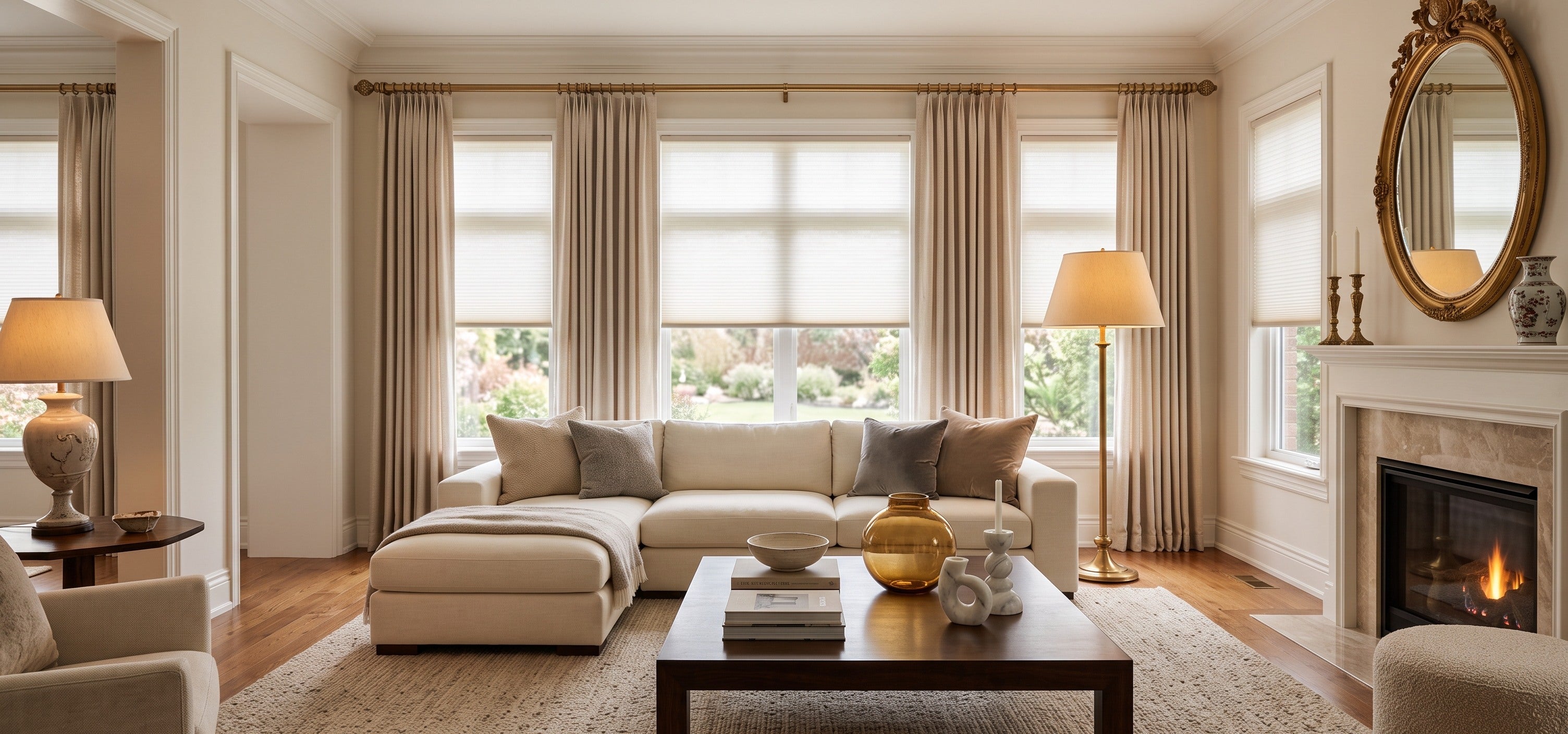

A layered window runs two treatments at once: a shade mounted close to the glass, and drapery panels in front of it on a separate track.
The pairing works when each layer has a different job. The shade controls daylight, glare, and heat. The drapery frames the window, adds texture, and takes over privacy after dark.
Most layered windows fall into four pairings. Which one applies depends on what the window has to deliver, not on how the room is decorated.

What the second layer is actually for
A single treatment has to compromise, because daytime and nighttime requirements point in opposite directions.
A weave open enough to keep the view cannot darken a room once interior lights are on, no matter how tight it is.
A fabric dense enough for privacy blocks the daylight that made the window worth having.
Layering resolves that by splitting the work. It also changes how the window reads, since a shade alone leaves a flat rectangle, while panels at the sides give the opening height and proportion.
SmartWings covers both layers in the same order, with motorized roller shades from $159.99, cellular shades from $179, and motorized drapery and curtains on their own track. The construction differences between curtains and drapery are set out in the curtain versus drapery guide.
Sunscreen shade with drapery panels
The day and night split. This is the most common layered configuration and the one that solves the most.
The sunscreen shade handles glare and solar heat through the day while keeping the outward view, which is usually the reason the window exists. The panels close in the evening, when the room becomes visible from outside.
Because the shade carries the functional load, the panels can be chosen for colour and texture rather than opacity. Many of these windows use stationary panels that frame the opening and never actually close.
This pairing suits living rooms and any space used across the whole day, particularly on west-facing walls where afternoon sun is the deciding factor.

Blackout shade with lined panels
Darkness first, appearance second. Here both layers do functional work.
The shade delivers the darkness, and lining in the panels adds a second barrier at the sides, where light finds its way around any shade. Mounting matters more than fabric weight, since an outside mount substantially reduces edge light before the drapery is involved.
Darker panel fabrics serve a practical purpose in media spaces, absorbing reflected light rather than bouncing screen light back into the room.
Blackout roller shades are the usual base here, with fabric families compared in the light filtering versus blackout guide.
Cellular shade with drapery panels
Comfort at the glass. This pairing is chosen for temperature rather than for light.
The honeycomb structure holds an insulating air layer against the window, which drapery on its own cannot replicate no matter how heavy the fabric. The panels then add the soft edge and the evening privacy.
It applies to windows that feel cold in winter or hot through the afternoon, and to older homes where the glass itself is the weak point. The reasoning behind the fabric choice is covered in the west-facing cellular shade guide.

Light filtering shade with sheer or decorative panels
Softness without losing the daylight. The lightest of the four pairings, and the one most often chosen for appearance.
A light filtering shade diffuses daylight rather than blocking it, and sheer or lightly woven panels add movement and depth without darkening the space further.
This combination assumes privacy is not the main requirement, so it suits rooms that are not overlooked, or rooms used mainly in daylight. Where evening privacy does matter, one of the two layers needs to be denser.
Keeping two layers coordinated
Layering looks deliberate when one layer leads and the other supports.
Let one layer carry the interest. A plain shade behind a textured or coloured panel reads as intentional, while two patterns on one window compete.
Keep the tones in one family and relate them to the room's other finishes rather than to the window in isolation.
Mount the track above the frame, not on it. Raising the rod adds height and keeps the panel clear of the shade hardware.
Match across a wall, not across the house. Two windows in the same room should agree. Different rooms do not have to.
Watch the panel width. Panels wide enough to sit mostly on the wall protect the daylight the shade was chosen to manage.

Space the second layer needs
Two layers need depth above the window and clear wall beside it, and both are easier to confirm before ordering than after.
Depth. The drapery track has to clear the shade fabric and its valance without contact, which usually pushes shallow frames to an outside mount.
Stacking width. Panels need wall on one or both sides to gather fully off the glass, otherwise they sit permanently across the window and work against the shade.
Mount selection is covered in the inside versus outside mount guide and the outside mount guide, with instructions on the window measuring page.

Which layer is worth motorizing
The one that moves every day, which in most homes is the shade.
Shades move with the sun, often several times a day on sun-facing windows, and that repetition is what motorization removes.
Drapery earns a motor when it closes nightly. Where the panels are decorative, a track motor adds cost without changing daily use.
Both layers should be motorized above arm height, since a stationary panel on a tall window cannot be adjusted at all.
Group them into scenes rather than running them separately. Two independently controlled layers get abandoned quickly. SmartWings shades and drapery work with Apple Home, Amazon Alexa, Google Home, and Home Assistant, with Matter setups requiring a Thread Border Router such as a HomePod mini or Apple TV.
Day-to-day operation is described in independent reviews from How-To Geek on the window coverings and Lifehacker on the smart blinds, with further coverage on the reviews page.
FAQ About Layering Shades and Drapery
Q1: Can I add drapery later to shades that are already installed?
Usually yes, provided there is wall space above and beside the window for a separate track. The track mounts independently of the shade brackets, so the existing shade does not need to be removed or replaced.
Q2: Does layering actually help with drafts and heat?
It helps, though most of the effect comes from the layer at the glass. A cellular shade traps an insulating air layer against the window, and drapery then reduces air movement around the opening.
Q3: Do sheer panels count as a layer, or do I need two functional treatments?
Sheers count as a layer visually, but they do not add privacy or darkness. If the window needs evening privacy, that has to come from the shade or from lined panels.
Q4: Is a second layer more expensive than a dual shade?
Generally yes, because drapery adds a track, hardware, and fabric priced by width. A dual shade delivers a day and night split on one bracket instead, as covered in the dual roller shade guide. Cost factors are broken down in the motorized shade cost guide.
Q5: How far does the drapery rod need to sit from the wall?
Far enough for the panels to clear the shade fabric and its valance without touching at any position. Check the projection against the depth of the shade you are ordering rather than against the window frame alone.
Q6: Does a layered window take more upkeep?
Slightly. Shade fabric is wiped or vacuumed in place, while drapery is cleaned according to its fabric and lining, so the two layers are maintained on different schedules rather than together.


