
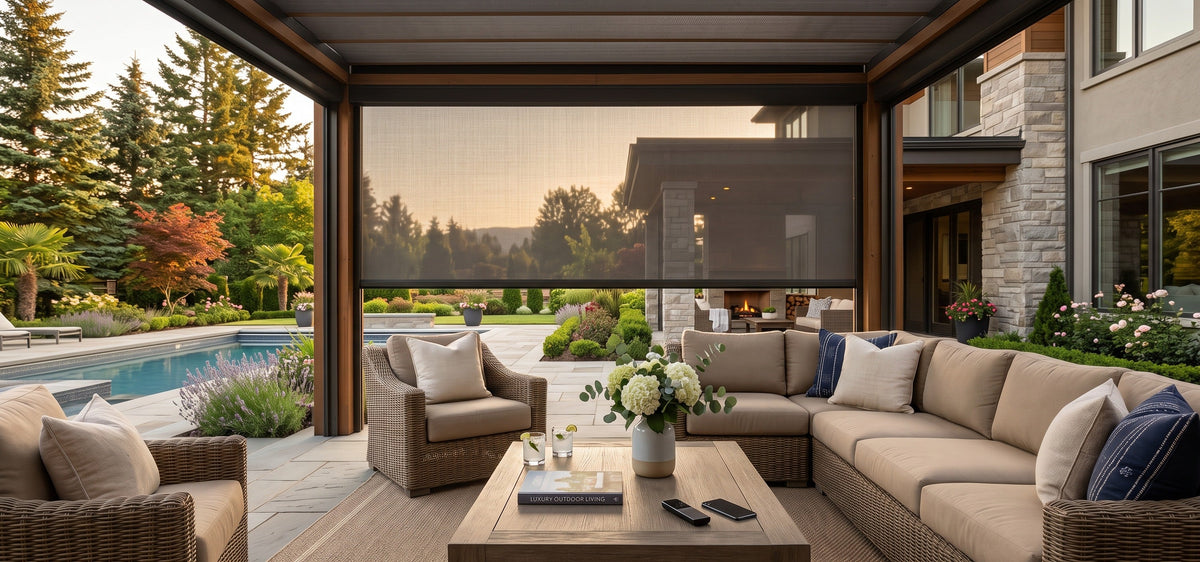

September and October are arguably the two best months of the year to be outside. The heat has broken, the mosquitoes have thinned out. Yet plenty of patios go quiet from Labor Day and stay that way until May.
The weather is rarely the reason. What happens is that the shading setup that worked all summer stops working in fall. The sun comes in at a different angle, the wind picks up, and the light goes earlier. All three have fixes, and none of them requires rebuilding anything.
Here is what goes wrong in each case and what handles it.

Why Does a Patio That Works All Summer Become Unusable on Fall Afternoons?
This is the one people miss, and it explains the common complaint that a patio somehow feels sunnier in October than it did in July. It has nothing to do with the weather and everything to do with where the sun sits.
In summer the sun is nearly overhead.
Around the solstice, the midday sun climbs past 70 degrees of elevation across much of the country, so the light comes down close to vertical. Anything overhead, whether a pergola, an awning or an umbrella, puts the whole patio in shade. The open sides do not matter.
In fall the sun sits low.
By October, at that same three or four in the afternoon, the sun is a great deal lower and the light arrives close to horizontal. Overhead cover no longer intercepts any of it. The sun passes straight under the pergola and lands directly on the faces of anyone sitting there.
So what a patio needs in fall is not more cover overhead. It needs cover at the sides. Outdoor shades hang vertically across the open face of the patio and stop light at that angle, which is something a pergola, an umbrella or an awning cannot do.
How to tell whether this is your problem
Three signs, and one is usually enough:
There is already a pergola or roof over the patio, and fall afternoons are still too bright to sit in
You find yourself moving chairs to chase shade rather than staying put
Midday in summer was comfortable out there, and midday in fall is not
Which side to hang them on
This follows the orientation of the patio, and rarely needs to be every face:
West facing patios: the west side is essential, since that is where the low afternoon sun arrives and it is the hardest direction to sit in
South facing patios: cover the south and southwest, as the fall and winter sun tracks south overall
East facing patios: cover the east side, mainly to handle low morning light
Patios open on three sides: start with whichever face takes the strongest sun and add the others later based on how you actually use the space
One face is often enough to solve most of the problem, so there is no need to do everything at once.
How to size them
Take the width from the clear span between posts, and carry the fabric over the posts rather than stopping at the opening, or a strip of light will come through at each edge. Run the height close to the ground, because fall light arrives from low down. A shade that stops at waist height still lets the sun straight underneath.
Measuring specifics and the usual mistakes are covered in the outdoor shade buying guide.
SmartWings motorized outdoor shades (from $199): built to the span of the opening, in 1%, 3% and 5% openness.

Why Do Patio Shades Billow and Fail Once Fall Winds Pick Up?
Fall wind is both more frequent and more sudden than summer wind. For an outdoor shade that is a structural issue rather than a comfort one.
A standard outdoor shade is anchored only at the top.
One panel hangs from a tube with the sides and bottom left free. Wind gets underneath, the whole panel behaves like a sail, and all of that load pulls against the handful of fixings holding the tube up.
At best it rattles all night. At worst the fabric tears where it is loaded, or the brackets work loose from the posts. This is why plenty of people install outdoor shades and then leave them rolled up for the whole windy half of the year.
Side channels are the fix.
The edges of the fabric run inside tracks fixed to the posts, so there is nowhere for the panel to balloon out to. Wind load spreads along the whole length of the track instead of concentrating at the top.
Two useful side effects come with it. Light no longer escapes at the edges, and with the fabric sitting tight to the posts, insects and leaves have a much harder time getting in around the sides.
Zip track versus a plain side channel
A plain side channel is a groove the fabric edge slides into, held by the depth of the groove alone. A zip track stitches a reinforced strip along each fabric edge, and that strip is locked inside the track and cannot come out. In strong wind a plain channel can let the fabric edge pull free. A zip track will not.
SmartWings Zipper Track windproof outdoor shades (from $448.99): fabric edges locked into zip tracks, rated per the official product description to withstand winds up to 45 mph.
Motorized versus hand crank matters more in fall
In summer, with light wind, the difference is only convenience. In fall, when wind arrives without much warning, the difference becomes whether the shade gets used at all.
A crank model has to be operated from outside, standing directly under the shade. Windy afternoons are exactly when nobody wants to go out there, so the shade tends to stay down longer than it should. A motorized shade retracts from indoors with a button or a spoken command, and the number of times it actually gets raised is not comparable.
The two are compared in detail in motorized versus manual crank zip track shades, and the full Zipper Track walkthrough is in this product overview.
What to do above the rated wind speed
Every outdoor shade has a limit, and above it the right move is to retract, not to expect the shade to hold.
The practical fall habit is to watch the forecast and raise the shades ahead of a windy afternoon. With a motorized shade you can do that on your way out the door rather than waiting until the wind is already up.

If It Is Still in the Fifties Out, Why Does the Evening Feel Too Cold to Sit?
An October evening might still be in the fifties, which on paper is perfectly sittable weather, and yet people go back inside. The reason is usually not the temperature. It is the wind.
Moving air strips heat from your skin far faster than still air does. At the same temperature, breezy and calm feel nothing alike, which is why putting on a jacket often helps less than simply blocking the wind.
With the shades down, the open face of the patio becomes a barrier. Most of the direct wind is stopped and the space behind the fabric holds relatively still air. Sitting in that pocket feels noticeably warmer than standing outside it.
Worth being clear that outdoor shade fabric is semi transparent. Even at 1% openness it is not sealed. What it reduces is direct wind, not air movement altogether. That turns out to be an advantage when a heater is running, since the space never becomes fully enclosed.
Paired with a patio heater the difference is more obvious again, because the heat is not immediately carried off and the heater works to much better effect.

Which Openness Should You Choose for Fall?
The same patio does not want the same fabric in summer as it does in fall, which is why some installations end up feeling useful for only half the year.
Summer is a heat problem. The sun comes from high overhead and the aim is to cut incoming solar radiation, which points toward a lower openness and a denser fabric.
Fall is a glare and wind problem, and you want to keep the light. Autumn sun is warm and welcome. It does not need blocking, only intercepting where it cuts across at eye level. Too dense a fabric here just makes the patio gloomy, which defeats the point of sitting outside in October.
Matched to how you use the space:
Summer only: 1%, for maximum reduction in solar radiation
Summer and fall, summer led: 3%, a compromise weighted toward heat
Fall and winter led, little summer use: 5%, keeps brightness and the view
Year round, budget allowing: different openness by orientation, 1% on the west face and 5% elsewhere
Fabric colour needs setting alongside it. Dark fabric absorbs stray light, giving a clearer view out and stronger glare control. Pale fabric reflects more and keeps the patio brighter, at the cost of a hazier view. Pick dark for view, pale for brightness.
More on how fabric relates to shading performance is in the outdoor shading guide.

Why Order Now Instead of Waiting Until Spring?
Outdoor shades peak in late spring, and ordering in fall rather than waiting makes a practical difference to this year.
Custom products take time between order and installation. Order in September and both October and November are still yours to use, which is the stretch when low sun cuts across the patio at its worst.
Wait until March or April and the whole of this autumn has gone by, and the shades arrive just in time for a summer problem they were not bought to solve.
SmartWings builds outdoor shades to the measured span of the opening and they work with Apple Home, Google Home and Amazon Alexa. Sizes, fabrics and pricing are on the site.
FAQ About Fall Patio Shades
Q1: Will outdoor shades keep rain out?
They will stop rain blowing in at an angle, but they are not a seal. The fabric itself is waterproof and water runs down its face, so the ground immediately inside can still get wet. Keeping rain out entirely is a job for overhead structure, not a vertical shade.
Q2: How do outdoor shades work alongside an awning or pergola?
They address different directions. Pergolas and awnings handle vertical light from overhead, outdoor shades handle horizontal light from the side. Summer is covered by the first two. Fall needs the third. Adding outdoor shades to an existing pergola is the most common pairing.
Q3: Is one side enough?
Usually. Start with whichever face takes the strongest sun, typically the west, and that resolves most of it. Larger patios open on three sides may want a second face added if there is still a noticeable draught running through.
Q4: Does fall wind make motorized outdoor shades more likely to fail?
Shades held in side channels handle wind far better than those anchored only at the top. The Zipper Track version is rated per the official product description to withstand winds up to 45 mph. Above that, retract them, which a motorized shade lets you do from indoors rather than going out into the wind.
Q5: Will outdoor shades make the patio dark?
No. The fabric is semi transparent, and all three openness levels still pass light and allow a view through once lowered, differing only in how clearly. What they intercept is direct glare, not light in general. For fall use, 3% or 5% is the better range.


