
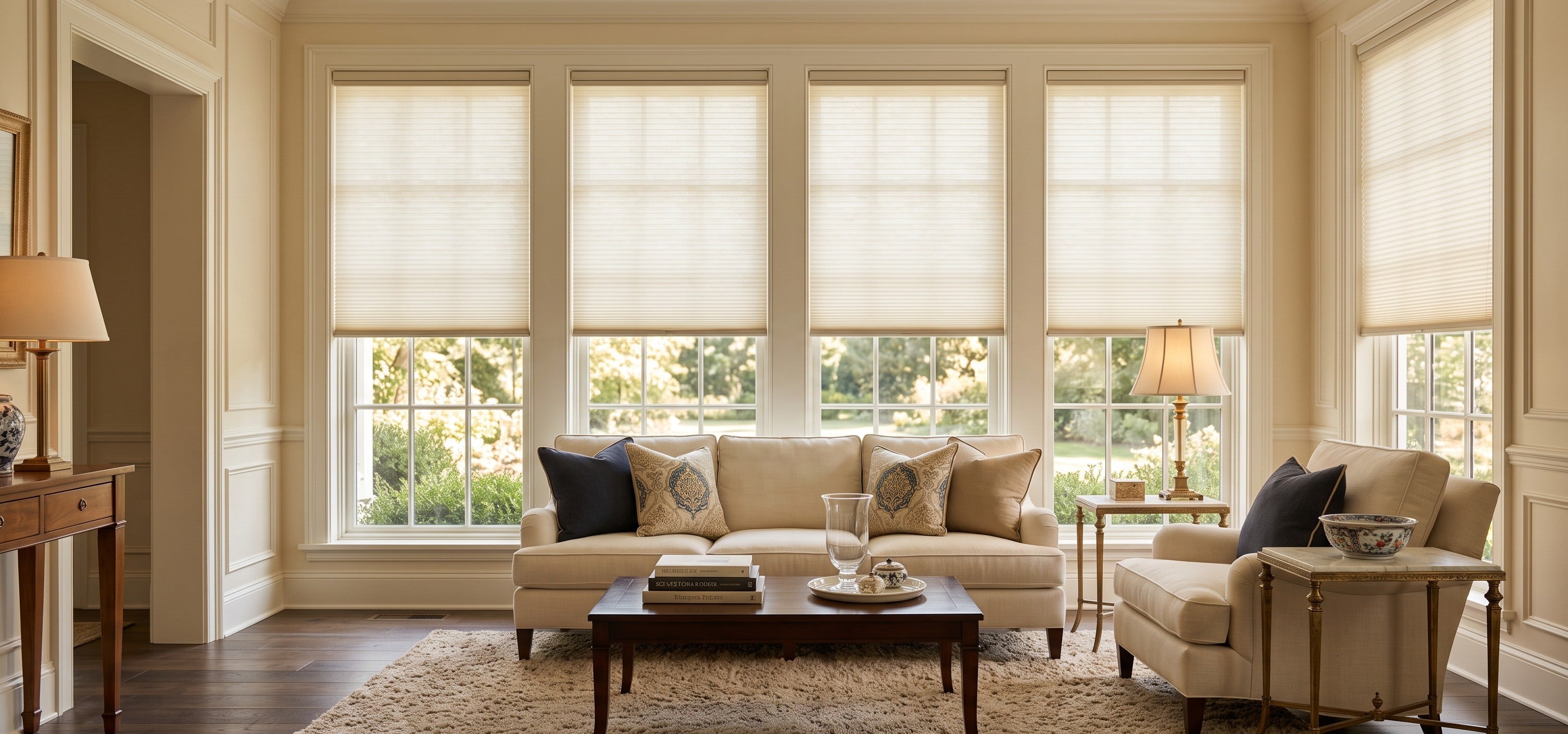

A sunroom earns its place through daylight and the view, with a full wall of glass bringing the outdoors all the way in. That same glass is also what makes the room stuffy by mid afternoon, throws glare across every screen, and slowly bleaches the furniture and flooring.
Good sunroom shading is not about shutting the light out. It is about holding onto the view while bringing the heat and glare down. Six options below, each suited to a different way of using the room, followed by how to choose based on which way the glass faces.

Sunscreen Roller Shades Cut Glare While Keeping the View
Sunscreen fabric is woven as an open mesh, so light gets diffused but sightlines pass straight through. From inside, the yard and the middle distance stay perfectly readable through a lowered shade. This is the default choice for most sunrooms.
Fabrics come in 1%, 3% and 5% openness. A lower openness lets less direct sun through and softens the view along with it, while a higher openness does the reverse. West facing sunrooms usually call for the lower end, north facing rooms and view driven spaces for the higher end.
SmartWings motorized sunscreen roller shades: 1%, 3% and 5% openness, suited to sunrooms where the view comes first.

Cellular Shades Do the Most for Afternoon Heat
The honeycomb structure holds pockets of still air inside the fabric, which helps slow the exchange of heat between the glass and the room. West facing sunrooms show the difference most clearly by mid afternoon, and double cell construction has deeper pockets than single cell.
Worth knowing: cellular fabric is not see through, so the view goes away entirely once the shade is down. That suits households treating the sunroom as a lounge, a yoga space, or an occasional guest room.
SmartWings motorized cellular shades (from $179): single and double cell, suited to sunrooms where temperature matters more than year round sightlines.
For how the two compare on temperature, see cellular versus roller shades.

Zebra Shades Let You Adjust Light All Day Long
Zebra shades run two offset layers of striped fabric. Rotating them brings the sheer and solid bands into or out of alignment, moving the room from fully open to nearly screened. Since sunroom light shifts from morning to evening, that continuous range beats fixed positions.
To be clear, zebra shades are a light control product rather than a blackout one. A sunroom used as a bedroom or media space needs blackout roller or blackout cellular shades instead.
SmartWings motorized zebra shades (from $189.99): suited to sunrooms with big swings in light across the day.
Woven Wood Shades Add Texture Without Darkening the Room
Most sunrooms are built around timber framing or broad white frames, and the natural fibre and warm tones of woven wood sit comfortably against both. Light passing through picks out the weave rather than flattening into a solid panel.
Natural fibres do shift in colour under sustained sun, which is worth factoring in for a room this bright.
SmartWings motorized woven wood shades (from $219): suited to sunrooms where texture drives the design.

Glass Roofs and Sloped Glazing Need Purpose Built Shades
A large share of the heat comes in through the roof, and roof and sloped glazing are exactly where standard shades cannot go. The fabric has to be held in side channels, otherwise gravity pulls it away from the glass. These positions are also out of reach, which rules out manual operation for daily use.
Building to a slope angle is what makes these positions workable at all, and it is where sunroom projects most often stall. SmartWings makes skylight and sloped window shades to angle and size, on the same custom programme that covers arched and trapezoid openings.
Measuring calls for the slope angle rather than width and height alone, and getting it wrong is not something you can correct afterwards. The method is on the specialty window measuring guide.
Outdoor Shades Stop Heat Before It Reaches the Glass
Everything above sits indoors, which means the heat has already come through the glass by the time the shade deals with it. Outdoor shades hang on the exterior face, intercepting direct sun before it arrives. For a sunroom that gets genuinely hot in summer, that is the earlier and more effective intervention.
The fabric carries an IPX4 waterproof rating and can stay up year round. The Zipper Track version runs in side channels and, per the official product description, withstands winds up to 45 mph.
SmartWings motorized outdoor shades (from $199): suited to west and south facing sunrooms in heavy summer use. Whether this works depends on having somewhere to fix the top rail and side channels above the glazing, so it suits sunrooms with a solid frame or overhang more than fully glazed structures. More on choosing them in the outdoor shading guide.

How to Choose Based on Orientation and Use
Start with the direction the glass faces. West and south facing sunrooms carry the heaviest summer load, and the most effective sequence is outdoor shades on the exterior with a sunscreen or cellular layer indoors behind them. East facing rooms deal mainly with harsh morning glare, which a sunscreen shade at the lower openness end handles on its own. North facing rooms get soft light all day and rarely need much more than a sunscreen shade at the higher openness end, or woven wood where texture matters more than performance.
Then account for the roof. Any sunroom with a glass roof or sloped glazing should be covered overhead first and at the side windows second, since the roof is where most of the heat arrives. Reversing that order is the single most common reason a shading project underdelivers.
Finally, factor in how the room gets used. A sunroom doubling as a bedroom, media room or office needs two layers rather than one, with blackout roller or blackout cellular shades for darkness and a sunscreen layer for daytime glare. Where the light shifts sharply through the day and the room is used at scattered hours, zebra shades cover more of that range from a single product.
For the difference between light filtering and blackout, see how to choose between them. For other rooms that run hot, see window treatments for hot rooms.
Three Things That Trip People Up in Sunrooms
Frame depth decides whether an inside mount is possible. Sunroom framing is usually slim aluminium, and the opening is often too shallow to take an inside mount. Switching to an outside mount with an overlap allowance solves it. The pairings are set out in the window type guide.
There is rarely a power point. Sunrooms are typically later additions with no wiring in the walls. Battery powered shades go straight in, with runtime depending on how often they cycle and how wide the panels are. Anything meant to run maintenance free needs wiring planned during construction.
Doing the side windows now and the roof later. The roof glazing is the main heat source, so side windows alone deliver noticeably less. If the work has to be staged, reverse the order and start overhead.
SmartWings was named CNET's top pick for motorized blinds in 2026. Every shade is cordless and motorized, works with Apple Home, Google Home and Amazon Alexa, and can run on a sunrise and sunset schedule. Fabrics carry GREENGUARD, anti-UV, flame retardant and anti-bacterial certifications, motors and controls come with a three year warranty, and shipping is free worldwide with no minimum order. The full range can be priced by window size on the SmartWings site.
FAQ About Sunroom Window Treatments
Q1: Does a three season room need shades in winter?
Yes. Glass loses heat far faster than wall, and the air pockets in cellular shades work in that direction too. Double cell is the better fit in regions with wide seasonal swings.
Q2: Will sunroom shades get wrecked by the sun?
Every fabric changes under sustained exposure. What differs is how fast. Synthetics hold up better than natural fibres, so woven wood suits sunrooms with less direct exposure, while a synthetic fabric is the safer choice on the glass taking full afternoon sun.
Q3: Can outdoor and indoor shades be used together?
Yes, and it is a common setup on west facing sunrooms. The outdoor shade intercepts direct sun at the exterior face, and an indoor sunscreen or cellular layer handles whatever glare and visual privacy is left.
Q4: Can sunroom shades be installed as a DIY job?
Side windows usually can be, and brackets and instructions ship with the order. Glass roofs and sloped glazing are better left to a professional, since both involve working at height and aligning to an angle.
Q5: Should sunroom shades be dark or light?
Dark fabric gives a clearer outward view during the day and does more to suppress glare. Light fabric reflects more and keeps the room feeling brighter. View driven sunrooms usually go dark, brightness driven ones light.
Q6: If the sunroom doubles as a guest room, does it need full blackout?
If anyone is sleeping there, yes. Blackout roller or blackout cellular shades bring the light down to a level that works for sleep, with a separate sunscreen layer for daytime glare. Zebra shades are not the right choice for this.


