
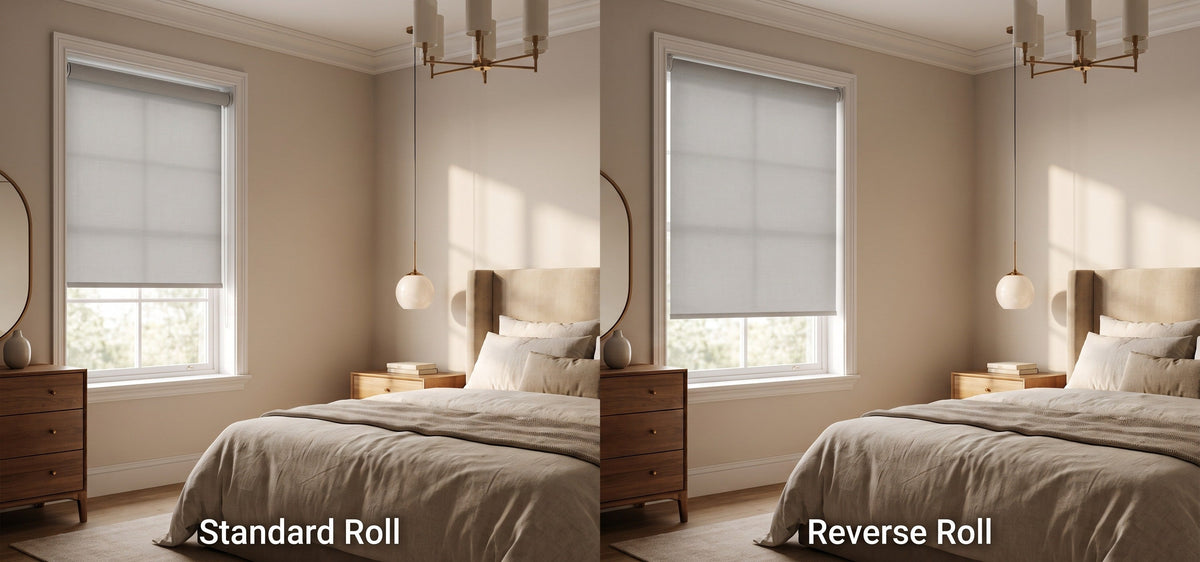

You have picked the fabric and confirmed the measurements. Roll direction decides how that shade sits on your window: against the glass, or forward of the tube and slightly into the room.
Knowing what separates the two lets you match the right one to your window. It affects how dark the room gets, whether the fabric clears your window hardware, how far the shade projects, and how you specify the valance, bottom bar, and side channels.

What each roll direction actually does
Both types use the same tube, the same motor, and the same fabric. The only variable is which side of the tube the fabric leaves from, and everything else follows from that.
Standard roll brings the fabric down the back of the tube, so it hangs in the plane closest to the glass. The tube itself sits in front of the fabric and stays visible from inside the room unless a valance or cassette covers it.
Reverse roll brings the fabric over the front of the tube, so it hangs a short distance further into the room. The fabric passes across the face of the tube on its way down, which is why the hardware disappears from view.
That forward shift is what creates clearance. Anything mounted inside the window opening, from a casement crank to an alarm contact, sits behind the fabric rather than in its path.
You will also see these sold under other names. Standard roll appears as back roll, and reverse roll as front roll or waterfall roll. Different order forms, same two options.
SmartWings lists this as Roll Type, and both are available across the motorized roller shade range from $159.99.

Where the two differ
|
Standard roll |
Reverse roll |
|
|
Fabric position |
Against the glass |
Forward, into the room |
|
The tube |
Visible unless a valance covers it |
Concealed behind the fabric |
|
Side light gaps |
Narrower |
Wider |
|
Window hardware |
Fabric runs onto cranks and handles |
Fabric clears them |
|
Fabric face |
Broken by the tube at the top |
Continuous top to bottom |
|
Projection into the room |
Minimal |
Greater |
The pattern holds across every row. Standard roll wins wherever proximity to the glass is the point, which is light control. Reverse roll wins wherever distance from the glass is the point, which is clearance and appearance.
Neither direction changes how the shade operates, how quiet it is, or how it connects to your smart home. Those come from the motor and the platform, not from the fabric path.

Where the light gets in with each
Both roll types leave gaps, because a shade is never a sealed panel. What the roll direction changes is the sides. What happens at the head of the window is set by the valance instead.
Standard roll leaves thin lines at the sides. On an inside mount the fabric is made narrower than the opening so it can travel without binding, and that clearance shows as a line down each edge.
Light above the fabric is a valance question, not a roll direction question. An exposed tube leaves an opening at the head of the window on either configuration, and a cassette valance encloses the tube and closes it. Choosing standard or reverse roll does not change this.
Where the roll direction does matter is how close the fabric sits to the glass. Standard roll holds it closest, which keeps those side lines at their narrowest, and that is why it is the usual starting point in a bedroom.
All of it can be managed. A cassette valance closes the head of the window, an outside mount extends coverage past the frame on all sides, and side channels capture the edges. The combined effect is set out in the motorized blackout roller shade guide and the side channel page.
Choose standard roll when
Your room needs to be dark. Bedrooms, nurseries, and media rooms depend on fabric held close to the glass, and this is the one situation where the difference between the two is genuinely visible. Fabric options are compared in the light filtering versus blackout guide, with the densest weaves in the blackout roller shade collection.
Your window opening is shallow. An inside mount with limited depth has no room to push the fabric forward without the bottom bar sitting proud of the frame, so standard roll uses the space you have more efficiently.
You want the shade to recede. Fabric tight to the glass, with a cassette across the top, reads as part of the window rather than as an object in the room. This is usually the goal in a space where the furniture or the view should lead.
Furniture sits close to the window. A sofa back, a desk, or a headboard against the glass leaves little tolerance for a shade that projects, and standard roll keeps that space clear.
You are adding side channels. Channels are designed around fabric running near the glass, so they pair naturally with this direction.
Choose reverse roll when
Something projects into the opening. Casement and awning cranks, sash locks, alarm contacts, and lever handles all occupy the fabric's path. Reverse roll is the intended solution for these windows rather than a workaround.
Your sill or trim is deep. A projecting sill or heavy casing can hold the bottom bar away from the glass at an angle, so the shade looks like it is hanging crooked. Bringing the fabric forward lets it drop straight.
The fabric is the feature. Textured weaves, natural fibres, and sunscreen fabrics show better across one continuous fabric face from top to bottom.
View through the weave matters more than darkness. In a living room or office running an open sunscreen fabric, the extra distance from the glass costs you nothing you would notice, and the cleaner face is worth more.

How to check your own window before ordering
Four checks settle it in a couple of minutes, in this order.
Look inside the opening. Note any crank, handle, lock, or sensor that sits proud of the frame. If anything does, reverse roll is decided here and the remaining checks are secondary.
Measure the depth. A shallow frame limits how far the fabric can move forward, and it may also point you toward an outside mount, as covered in the inside versus outside mount guide and the outside mount guide.
Decide how dark the room has to be. If the answer is properly dark, standard roll plus an outside mount is the combination to start from.
Check what sits in front. Furniture, a radiator cover, or a drapery track all need clearance from a shade that projects forward.
Measuring instructions for either configuration are on the window measuring page.
What changes elsewhere on your order
Roll direction is not an isolated line. Four other choices move with it.
Valance or cassette. This is specified on every order, whichever direction the fabric runs. The choice is between leaving the tube open and enclosing it in a cassette, and that is what determines how the head of the window finishes and how much light passes above the fabric.
Bottom bar. A reverse roll bottom bar sits further into the room and is visible from the side as well as the front, which is where a fabric-wrapped bar looks considered and a plain metal one looks like hardware.
Anything mounted in front. A drapery track has to clear the shade at every position, and reverse roll reduces the space available for it. Confirm this before ordering both layers, as set out in the layering guide.
Consistency across a room. Roll direction should match on windows that sit on the same wall. A row where one shade hides its tube and the next does not is immediately noticeable once the shades are down, even to someone who could not name the reason.
What motorization changes about this choice
Two of the traditional arguments weaken once there is a motor in the tube, and one becomes more important.
Reaching your window hardware matters less. With a manual shade, reverse roll was partly about being able to get behind the fabric to a crank. A motorized shade lifts on a schedule or a single command, so access stops being a daily consideration.
Nobody handles the fabric. No pulling means the hem stays clean and the roll stays even over years of use, regardless of which direction it takes. Everyday operation is described by How-To Geek in its review of the window coverings and Lifehacker in its smart blinds review, with more on the reviews page.
Clearance at the head of the window matters more. A hardwired or PoE shade brings a cable run to the top of the opening, and reverse roll changes how that hardware sits in relation to the fabric. Power and connection options are compared in the Matter over Ethernet versus Matter over Thread guide and the hardwired collection.
What drives the final price across either configuration is broken down in the motorized shade cost guide.
FAQ About Standard Roll and Reverse Roll Shades
Q1: Is front roll the same as reverse roll?
Yes. Front roll, waterfall roll, and reverse roll all describe fabric unwinding over the front of the tube, while back roll and standard roll describe the opposite.
Q2: Which is the default if I do not select anything?
Standard roll. It suits most windows and gives tighter light control, so reverse roll is worth choosing deliberately rather than arriving at by accident.
Q3: Does reverse roll cost more?
No. It is a configuration choice rather than an upgrade, and your price is driven by fabric, size, motor, and valance instead.
Q4: Can I change the direction after installation?
On a motorized roller shade, yes. Standard roll can be switched to reverse roll, and reverse roll back to standard, through the remote. The steps vary by model, so contact the SmartWings team for the procedure that applies to your shade.
Q5: How far into the room does reverse roll sit?
Far enough to clear typical window hardware, and far enough to notice where furniture is close to the glass. Check the projection against your window depth rather than assuming an inside mount will absorb it.
Q6: Does roll direction affect how well side channels work?
Yes. Channels are built for fabric running close to the glass, so they pair with standard roll. A reverse roll shade sits forward of that line and gains less from them.
Q7: Can two windows in the same room use different directions?
They can when one has a crank and the other does not, though the difference shows when both are down. On the same wall, matching the direction is worth more than optimising each window on its own.


