
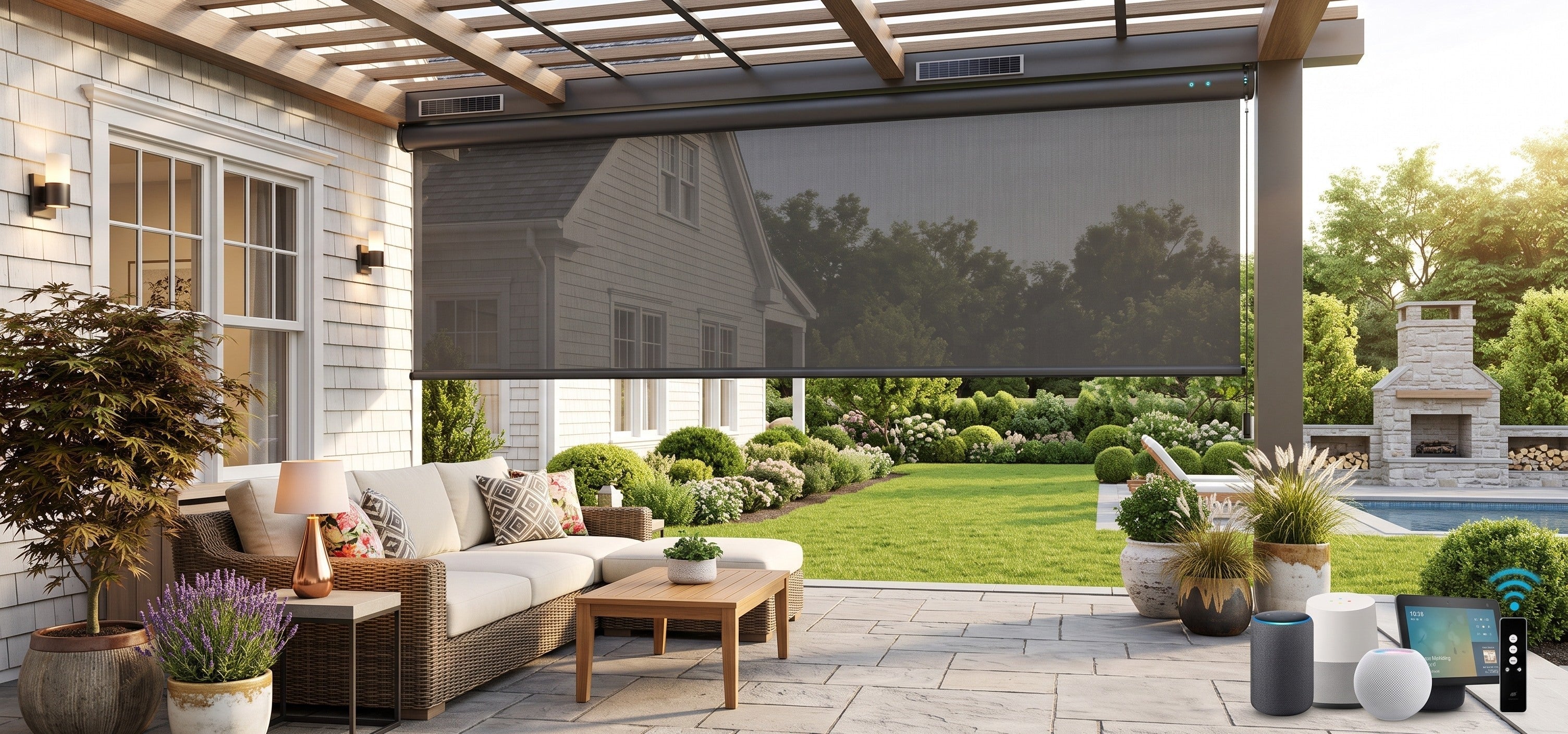

Outdoor shades mount on the exterior face of the glass and intercept sunlight before it arrives. Interior shades act after light has already passed through the glass and the heat is inside. That difference in position is what separates their performance on temperature.
It does not follow that every window needs exterior shading. In most homes only a handful of windows carry meaningful solar load, and the rest are served well enough by an interior solution.
The sections below work through the allocation by orientation, product type, and season. SmartWings outdoor shades are made to window measurements and start at $199.

Where Exterior Shading Does Its Work
Glass absorbs solar radiation and transmits that energy into the room as heat. An exterior shade intervenes before that step, holding sunlight off the glass so the pane heats up far less.
An interior shade sits on the other side of that sequence. It handles glare well, improves visual comfort, and slows heat loss through the glass after dark, but it can do only so much with solar energy that has already entered.
SmartWings outdoor shades use a Sunscreen fabric woven with a cross-weave technique, producing a tight, robust texture with a distinct cross pattern built for outdoor conditions including sun, rain, wind, and sand. The guide to outdoor coverings for heat and UV covers fabric performance against UV in more detail.

Deciding by Orientation
Orientation determines how much sun a window receives across the year and when it arrives, which makes it the right starting point.
West-facing: the highest priority. Late-day sun sits low enough to enter almost horizontally, eaves contribute very little, and this coincides with the hottest part of the day
South-facing: next in priority. Summer sun is high, so windows under an eave get partial protection, though large unshaded south windows still warrant exterior treatment
East-facing: depends on use. Morning sun arrives at a similarly low angle, but before outdoor temperatures climb, so the issue is glare rather than heat
North-facing: generally unnecessary. Direct sun across the year is limited and an interior solution covers it
Two further factors shift the assessment: glazing area and whether anything shades the window from above. Floor-to-ceiling glass and runs of grouped windows present a much larger surface, while a deep eave already provides natural midday shading and reduces the need.
For handling west-facing rooms specifically, see the guide to cellular shades in west-facing rooms.

Choosing Between the Two Outdoor Systems
SmartWings offers two structures. The difference is not the fabric but how the fabric is held, and that determines where each one belongs.
|
Motorized Outdoor Shades |
Zipper Track Windproof Outdoor Shades |
|
|
Price |
From $199 |
From $448.99 |
|
Retention |
Standard drop, sides unsecured |
Both fabric edges held in vertical tracks, forming a seal |
|
Wind |
Suits sheltered positions |
Withstands winds up to 45 mph with no flapping or displacement |
|
Sealing |
Open and ventilated |
Multi-layer seals block wind, rain, dust, and insects |
|
Openness |
1% / 3% / 5% |
Filtered View 3% / Open View 50% |
|
Appearance |
Standard valance |
Fully enclosed headbox conceals motor and wiring, tracks sit concealed |
|
Best suited to |
Covered porches, balconies, and other sheltered spots |
Open patios, pergolas, windy sites, spaces needing a seal |
Exposure decides it. Where a roof and posts already provide shelter and wind is limited, the standard system is sufficient. For open positions, seasonal winds, or turning a patio into a semi-enclosed space usable year-round, the sealing on the Zipper Track system makes a visible difference.
The two side-retention methods also differ. A zipper track locks the fabric inside the rails for better stability and sealing, while a guide wire uses tensioned cables for a more minimal look and allows slight movement in a breeze, which suits semi-enclosed patios.
Irregular site conditions are workable as well. One customer's patio sloped gradually for drainage rather than sitting level, and the approach was confirmed through pre-purchase engineering support before ordering, with installation going smoothly. Situations like this are best raised in advance rather than resolved on site after a standard order.

Choosing an Openness Level
Once the system is settled, openness is the next decision. How tightly the fabric is woven governs screening, view, and airflow together.
The standard system offers three levels:
1% Openness: the tightest weave with the least light transmission, offering moderate privacy and UV protection
3% Openness: moderate light transmission with balanced privacy and visibility
5% Openness: a looser weave with more light and visibility, and an open, airy feel
Where cooling is the main goal, 1% and 3% suit west-facing and unshaded south-facing windows best. SmartWings positions 5% as the balanced choice, blocking harmful UV rays while keeping the pleasure of natural sunlight.
The Zipper Track system offers two:
Filtered View (3% Openness): high-density PVC mesh combining durability, waterproof performance, and UV resistance, blocking wind, rain, dust, and insects while keeping a filtered view out, suited to exposed patios and pergolas
Open View (50% Openness): a screen-like mesh prioritizing airflow and visibility while keeping insects out, suited to covered porches and anywhere ventilation matters most
On color, the standard 1% and 3% fabrics come in White, Beige, Light Grey, Black, Deep Taupe, and Dark Grey, while 5% comes in White Grey, Dark Grey, Black, Dark Brown, Black Gold, Coffee, and Grey.
Zipper Track offers six colors at 3% and black at 50%. Darker fabrics cut glare and sharpen the view out, while lighter fabrics reflect more sun and read lighter against the facade.
All of these are open-weave fabrics. Once interior lights come on, sightlines in increase, so any space needing darkness or nighttime privacy still requires a blackout shade on the inside.

Winter Reverses the Situation
Exterior shading that works in July blocks sun you want in January.
Winter sun sits low enough to reach deep into a room, and the warmth arriving through the glass during the day works in your favor. Leaving an outdoor shade down through those hours gives that gain away.
The right approach is a seasonal reversal: down through peak sun in summer, up during the day in winter and down after sunset. The multi-layer sealing on the Zipper Track system earns its place on winter nights, reducing air leakage and moisture intrusion, preventing cold air from getting in, and helping lower heat loss and reliance on space heaters.
This is difficult to execute on a manual shade. Switching seasons means sustaining a new habit for months at a time, and in practice most shades stay in whatever position they were left in.
Scheduling Makes the Seasonal Switch Happen
This is where motorization pays off most clearly outdoors. The reversal stops depending on memory and becomes a one-time setup.
Timed Control: lowers ahead of peak sun in summer and raises as the evening cools, then stays up through winter days and drops before sunset
Sunrise/Sunset: adjusts position as daylight shifts and moves with the season on its own, with no need to reset times every few weeks
Group Control: brings down an entire west-facing wall or a whole patio in one move, which matters when the weather turns quickly
Scene Control: saves preferred position combinations and recalls them with one command
On platforms, the Matter motor uses Matter over Thread and connects to Apple HomeKit, Amazon Alexa, Samsung SmartThings, and Google Assistant, with a Thread Border Router required in the home. Zigbee and Z-Wave motors suit Samsung SmartThings, Home Assistant, Homey, and Hubitat. Customers running Apple HomeKit report the shades holding off sun, wind, and rain as expected, with control working the way they hoped. Remote-only models are available for setups that do not need platform integration.
For power, the motors charge by Type-C cable or connect to household wiring, and the Zipper Track system ships with a solar panel and an outlet-charging adapter so outdoor positions can top up from daylight. The platform selection guide covers the differences, and the guide to energy-conscious use of motorized shades covers seasonal routines.
Sizing to Confirm Before Ordering
Outdoor shades are made to measure, and the two systems carry different requirements, so settle the mounting method before measuring.
Standard outdoor shades, depth: an inside mount needs a minimum of 2 1/8 inches (5.4 cm), with more than 3 1/8 inches (8 cm) recommended, while an outside mount needs at least 3 1/8 inches (7.9 cm) of flat surface above the opening
Standard outdoor shades, valance: two options are available, with the standard valance suiting heights up to 99 inches and the oversized valance up to 140 inches
Zipper Track shades, depth: 4 5/16 inches (11 cm) for an inside mount, and the same 4 5/16 inches (11 cm) of flat space above the opening for an outside mount
Zipper Track shades, valance: a single valance profile, available in a choice of colors
Outside mount coverage: add 2 to 6 inches (5.1 to 15.2 cm) to both width and height
Order at the exact opening size with no deductions, since the factory applies its own allowance in production. For the full measuring method on each system, see the how to measure guide.
Where cooling is the goal, an outside mount generally outperforms an inside mount, since coverage extends beyond the opening and sun is intercepted before it reaches the frame and surrounding wall.
In practice, height is the measurement that most often goes wrong. Openings are not always square, patio surfaces may slope for drainage, and a single measurement rarely accounts for either. SmartWings provides pre-purchase engineering support, and sending measurements with site photographs for review saves adjusting on site later.
When installing several panels in a run, the first one usually takes some time to work through and the rest go noticeably faster. For something on the scale of six panels across a full porch, set aside half a day.
Windows Where Exterior Shading Is Not an Option
Not every window allows an exterior installation, and this comes up more often than expected.
Community rules: some HOAs set specific requirements for anything attached to the facade, colors included
Upper-floor windows: exterior work above the ground floor involves working at height, which raises both installation and maintenance costs
Rented homes: altering the building exterior is generally not permitted
No load-bearing surface: the wall material or structure does not meet the dimensional and load requirements above
In these cases the interior solution carries the full load. The air pockets in a cellular shade sit between the glass and the room, slowing heat transfer inward in summer and outward in winter.
SmartWings cellular shades start at $179 and come in single cell and double cell, with the double cell holding a thicker layer of air. The guide to cellular shade insulation covers the interior side in more detail.
Allocating the Budget
Standard outdoor shades start at $199, the Zipper Track system at $448.99, and cellular shades at $179, with the final figure set by size, openness, color, valance, and motor version.
Applied to the assessment above, the windows needing exterior treatment cluster on the west side and on unshaded south-facing glass, and there are not many of them. Concentrating the budget there does more than spreading it evenly across the house. Working in phases, the west-facing main living space is the place to start, since the change in comfort registers most clearly.
On materials, both the Sunscreen and PVC mesh fabrics carry GREENGUARD certification for low chemical emissions, along with anti-UV, flame retardant, anti-bacterial, lead-free, and RoHS certification. An IPX4 waterproof rating and wind resistance support leaving them outdoors year-round, and the fabrics resist fading, mildew, and aging.
On hardware, the Zipper Track system uses powder-coated aluminum alloy that resists rust in harsh outdoor conditions, a fully enclosed headbox concealing the motor and wiring, and a rubber-lined bottom bar that seals against wind, rain, and debris.
Each order includes user manuals, an outlet-charging adapter, a solar panel, installation screws, and a hex key. Shipping is free worldwide with no minimum, and motors carry a 3-year warranty.
The motorized shade pricing breakdown covers the full cost structure.
Measurements and photographs of the exterior can be sent to SmartWings before ordering, and the outdoor patio shade buying guide covers what to check on site.
FAQ About Outdoor Heat-Blocking Shades
Q1. Do outdoor shades block heat better than interior blinds?
For solar radiation, yes, because they intercept sunlight before it reaches the glass and stop the pane absorbing and transmitting that energy inward. Interior shades act after the glass and are better suited to glare control and nighttime insulation.
Q2. Which windows benefit most from exterior shading?
West-facing windows come first, since late-day sun arrives at an angle low enough that eaves cannot block it, followed by large unshaded south-facing glass. North-facing windows receive limited direct sun across the year and generally do not need it.
Q3. How do I choose between the standard system and Zipper Track?
It comes down to exposure. Covered porches and balconies are well served by the standard system, while open patios, pergolas, and windy sites suit the Zipper Track system, which withstands winds up to 45 mph and seals against wind, rain, dust, and insects.
Q4. Can shades be installed where the patio slopes or the surface is uneven?
Yes. Conditions like these need confirming before the order goes in, and SmartWings provides pre-purchase engineering support to adapt the approach to the actual site. Send measurements along with photographs for review.
Q5. What is the difference between 1%, 3%, and 5% openness?
It is how tightly the fabric is woven. 1% is the tightest with the least light transmission, 3% is balanced, and 5% is the most open. Where cooling is the priority, 1% and 3% work better, while 5% preserves more of the view.
Q6. Should outdoor shades stay down through winter?
No. Winter daylight contributes usefully to indoor temperature, so raising them during the day and lowering after sunset makes more sense. The sealing on the Zipper Track system reduces air leakage overnight and keeps cold air out.
Q7. Can outdoor shades be left outside year-round?
Yes. The fabrics are built for outdoor conditions including sun, rain, wind, and sand, and resist fading, mildew, and aging. The Zipper Track system is waterproof and windproof when fully closed, with powder-coated aluminum hardware that resists rust.
Q8. Is there a warranty on outdoor shades?
Yes. Motors carry a 3-year warranty, and shipping is free worldwide with no minimum order.


