
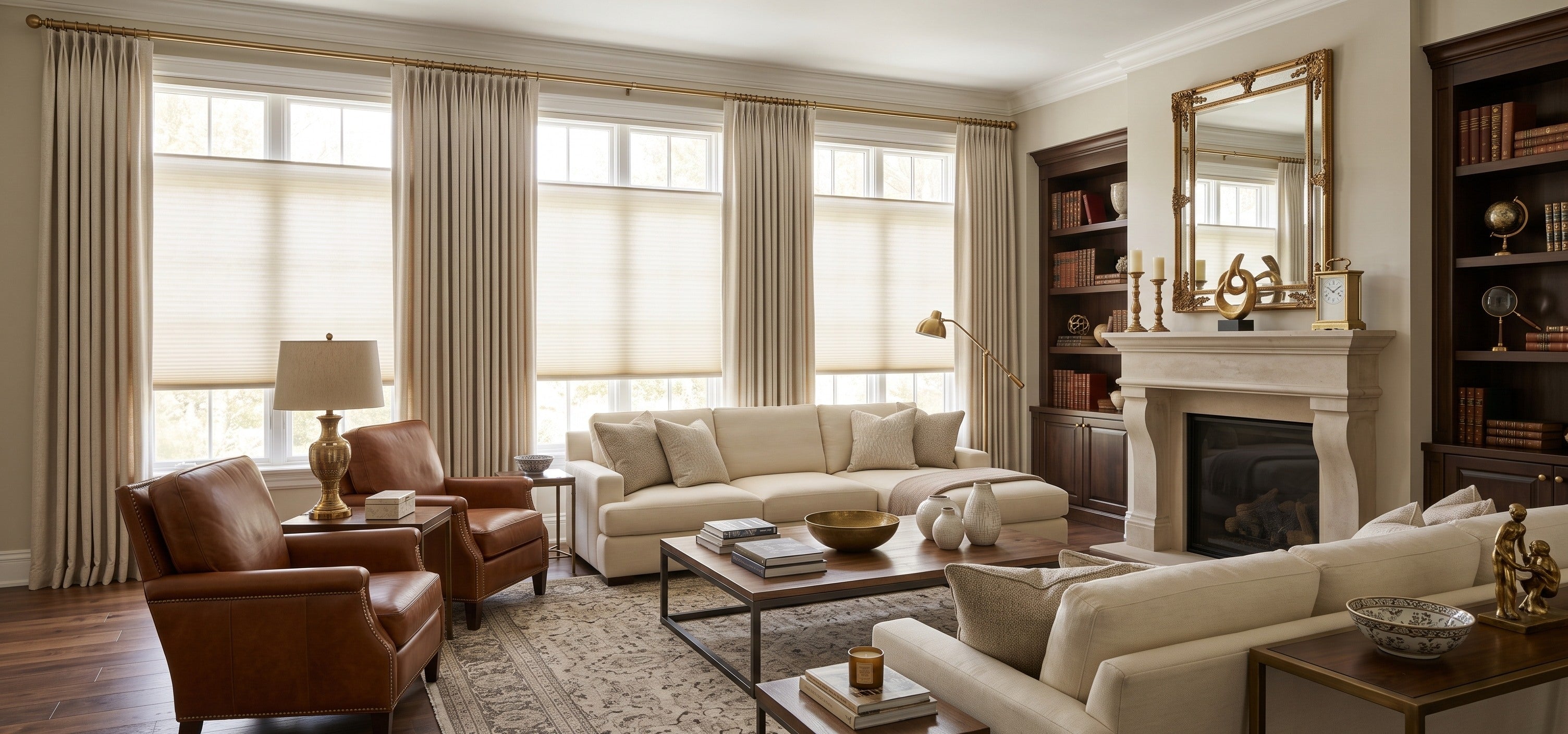

Window treatments shape how a room handles light, privacy, and texture, but not every style holds up over time. Some designs that were standard a decade ago now feel bulky and awkward to operate, while newer options have improved on appearance, everyday convenience, and durability.
If you are planning to update the windows in your home, knowing which styles are being phased out and what has taken their place makes the decision a lot easier.
Key takeaways
Vertical blinds, heavy valances, and thin aluminum blinds are the three most commonly replaced styles
Going cordless and motorized is the single most common change in this round of updates
Natural materials are steadily replacing faux wood and other imitation finishes

Vertical Blinds Are Fading, Wide Motorized Roller Shades Are Taking Over Sliding Doors
Vertical blinds hang as separate vanes, so the spacing drifts out of alignment over time and the stack takes up part of the doorway when opened. A wide roller shade covers the entire opening with a single panel and rolls up into a compact tube at the top, leaving the walkway clear.
The wider the door, the more a single custom panel beats piecing several units together, since every seam is another place light gets through. Very wide openings do reach a point where a single panel is no longer practical, so confirm the maximum width for the fabric you choose before ordering.
SmartWings motorized roller shades: made to the width of the opening, suited to patio sliders and garden doors.

Heavy Valances Are on the Way Out, Concealed Mounting Is the New Approach for Large Windows
Valances and swags sit above the top of the window, taking up head height, and their pleats and trim cannot be taken down and washed. Concealed mounting tucks the track and tube out of sight so the window face stays clean and the full opening stays usable.
Motorized tubes are compact enough on their own that most rooms need no extra covering over them.
SmartWings motorized drapery (from $219): keeps the soft drape of fabric, suited to floor-to-ceiling and picture windows in living and dining rooms.

Thin Aluminum Blinds Are Being Replaced by Cellular and Zebra Shades
Aluminum slats bend permanently under pressure and never straighten out, so after a few years the stack sits unevenly. A single layer of metal also offers little resistance to heat moving through the glass.
Cellular shades trap air in their honeycomb pockets, which helps moderate that exchange. Zebra shades use two offset layers of fabric that let you move gradually between open view and screened light.
SmartWings motorized cellular shades (from $179): single and double cell options, suited to bedrooms and children's rooms. SmartWings motorized zebra shades (from $189.99): suited to living rooms and studies where daytime light needs frequent adjusting.

Corded Lift Systems Are Being Retired, Cordless Motorized Operation Is Now Standard
Hanging cords are a strangulation hazard around children and pets, and on tall or stairwell windows the cord never reaches far enough to be practical, so the shade ends up sitting untouched.
Cordless motorized shades have no exposed cords at all and run from a remote, a voice command, or a smart home platform.
Every SmartWings shade is cordless and motorized, and works with Apple Home, Google Home, and Amazon Alexa. Details on cord-free safety are on the child safety page.

Sill-Length Curtains Are Giving Way to Floor-Length Panels
Curtains that stop at the sill leave light paths along the sides and bottom, so neither privacy nor insulation is complete. Floor-length panels cut those gaps down considerably, and mounting the rod closer to the ceiling makes the window read taller.
Small kitchen and bathroom windows where floor length does not work are better served by a roller shade than by a short curtain.
SmartWings motorized drapery (from $219): suited to primary and guest bedrooms with full-height windows.
Faux Wood Is Losing Ground, Natural Woven Wood Is Coming Back
PVC slats fade unevenly under sustained sun, and the printed grain reads as plastic up close and in daylight. Woven wood gets its texture and color from the fiber itself, so light passing through shows the depth of the material rather than a surface print.
This is the main reason natural materials have returned to favor over the past few seasons.
SmartWings motorized woven wood shades (from $219): suited to living rooms, bedrooms, and studies.
Which Replacement Suits Your Window Type
Standard windows: motorized roller shades (from $159.99) or motorized cellular shades (from $179)
Large windows and sliding doors: wide roller shades or motorized drapery (from $219), where one panel beats several joined together
Rooms that need gradual light control: motorized zebra shades (from $189.99)
Rooms that need to go close to fully dark: blackout roller shades or blackout cellular shades, since zebra shades are a light-control product rather than a blackout one
Rooms built around natural materials: woven wood shades (from $219)
Patios and covered outdoor areas: motorized outdoor shades (from $199), with IPX4 rated fabric
For the difference between light filtering and blackout, see how to choose between the two. To match a window shape to a product category, the official window type guide lays out the pairings.

Why Choose SmartWings for Your Window Treatment Upgrade
SmartWings is a brand built around custom motorized window treatments. Every product is cordless and motorized, spanning roller, cellular, zebra, dual, Roman, woven wood, drapery and outdoor shades, and each one is made to the measurements of the window, including arched, angled, and other specialty shapes.
The shades work with Apple Home, Google Home, Amazon Alexa, and other mainstream smart home platforms. Fabrics carry GREENGUARD, anti-UV, flame retardant, and anti-bacterial certifications, motors and controls come with a three year warranty, and shipping is free worldwide with no minimum order.
SmartWings was named CNET's top pick for motorized blinds in 2026, and has been recommended by Wirecutter and WIRED. The full range of models and fabrics can be priced by window size on the SmartWings site.
Three Things to Settle Before You Order
Decide on inside or outside mount before you measure. Inside mount calls for the width and height of the opening measured at three points each, taking the smallest reading. Outside mount needs an overlap allowance beyond the frame. Old bracket holes rarely line up with new ones, and the wider footprint of an outside mount bracket often covers them. See the inside versus outside mount guide for the choice and the official measuring page for the method.
There is a fixed gap between headrail and fabric. Motorized shades have a structural gap of 1 3/16 inch (3 cm) between the headrail and the fabric. In bedrooms and other rooms where light control matters most, consider side channels at the time of ordering.
Confirm how the shade will be powered. Battery powered models need no additional wiring and can go straight into a finished room, while hardwired models suit new builds and spaces already under renovation. A Matter over Thread connection requires a Thread Border Router.
FAQ About Window Treatment Trends and Alternatives
Q1: Can I update window treatments in a rental?
Yes, with an outside mount. Outside mounting involves less alteration to the frame than inside mounting, which is why it is the usual choice in rentals, though it is worth confirming the installation method with your landlord first. Both options are available on the SmartWings site.
Q2: What do I do about the holes left behind after removing the old shades?
New brackets rarely land on the old holes, so plan on filling them and drilling fresh ones. Outside mount brackets have a wider footprint and often cover part of the old pattern, which is worth factoring in while you measure.
Q3: How often do window treatments need replacing?
There is no set lifespan, since it depends on the material, sun exposure, and how often the shade is used. Uneven fading, bent slats, and a lift mechanism that sticks are all signs it is time, and the guide to blind lifespan covers this in more detail.
Q4: Do motorized shades need professional installation?
Most standard windows can be handled as a DIY job, and brackets and instructions ship with the order. Specialty shapes and high windows are better left to a professional. The installation guide walks through the steps.
Q5: Which room should I start with?
Most households start with the primary bedroom, where better light control and cord-free operation make the most immediate difference. Living rooms and other shared spaces usually come next because of their size and visibility, followed by west and south facing rooms. Tall and specialty windows are worth saving for last so they can all be motorized in one pass.
Q6: Does every room need the same style?
No. A common approach is to keep the fabric palette and mount type consistent while letting the product category follow the function of each room, for example roller shades in the living room, blackout cellular shades in bedrooms, and zebra shades in a study. The result reads as one scheme while each space gets the light control it actually needs.


