
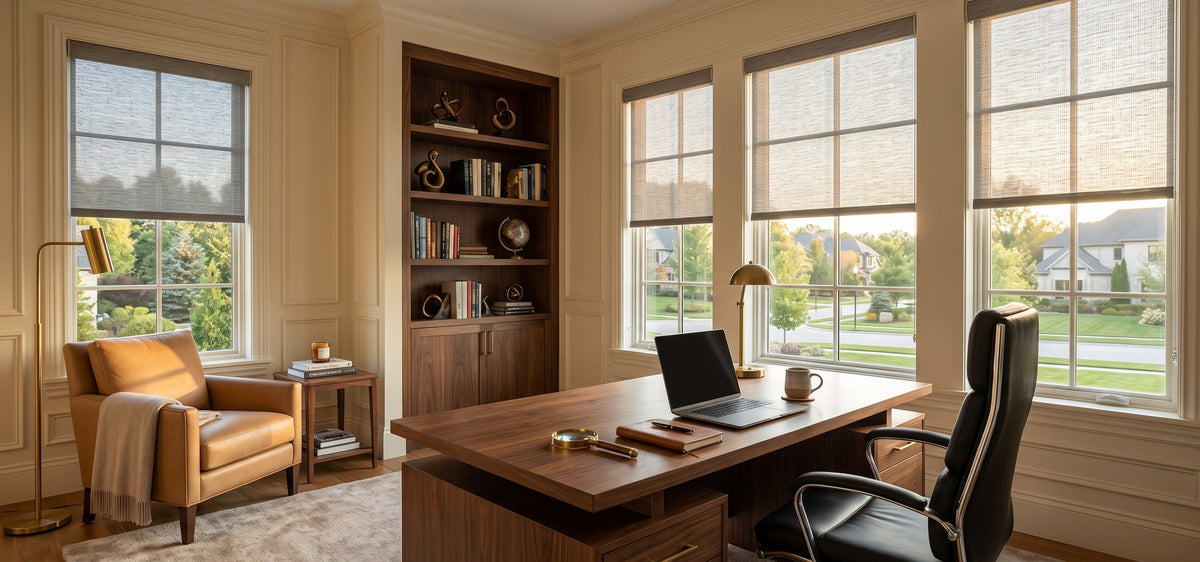

Solar shades and roller shades look like two separate products, but the hardware underneath is identical. Both are a single tube at the top of the window carrying one continuous panel of fabric, raised and lowered by the same motor. Measuring, mounting and control are no different between them.
The one real difference is the fabric. Solar shade fabric is woven as an open mesh, with gaps between the fibres that scatter incoming light while letting your sightline pass through. Roller shade fabric is tightly woven or coated with no openings at all, available anywhere from light filtering to blackout, none of which give an outward view.
So the question to settle is not which product is better. It is whether this particular window needs to keep its view. Keep the view and you want a solar shade. Bring the room down in brightness and you want a roller shade.
The table below lays the differences out by how you would actually use them, so you can check it against your own windows.
|
Solar shades |
Roller shades |
|
|
Fabric construction |
Open mesh weave |
Tightly woven or coated, no openings |
|
Daytime view |
Clear outward view |
No outward view |
|
Glare |
Diffuses direct sun, room stays bright |
Reduces direct sun, room gets darker |
|
Room darkening |
Limited |
Light filtering through blackout |
|
Daytime privacy |
Outsiders see little |
Full cover |
|
Privacy after dark |
Outsiders can see in once lights are on |
Full cover with blackout; light filtering shows silhouettes |
|
Colour range |
Mostly neutrals |
Wider colours and patterns |

What Shared Hardware Actually Gets You
Because both types run on the same tube, motor and brackets, that shared hardware turns into two practical advantages when you buy and live with them.
You can mix them in one room without it looking uneven. Put solar fabric on the picture window and blackout fabric on the side windows, and because tube diameter and headrail height match, nothing sits higher or looks thicker than anything else along the same wall.
Changing fabric later does not mean measuring again. Fit solar fabric now and decide two years on that you want blackout, and the measurements and bracket positions you already have still apply, so reordering is a much shorter conversation than starting from scratch.
On the SmartWings site, roller shades covers all three fabric families, with the mesh fabrics broken out separately as sunscreen roller shades for easier browsing. They are one product line, sorted by fabric.

Solar Shades Fix Glare, Roller Shades Fix Brightness
These two sound close but describe different problems, and choosing the wrong one is why some people feel their new shades did nothing.
Glare is direct sun hitting your eyes or bouncing off a screen. The room might not be dark at all, you simply cannot watch television or work at a laptop comfortably. Mesh fabric breaks that direct beam into diffuse light, so the harshness disappears while overall brightness stays roughly where it was and the view stays intact. That is the problem solar fabric solves.
Brightness is how light the room is overall. Napping, watching a projector, getting a child down before sunset all need the amount of light itself reduced. Roller fabric has no openings, so light drops according to the opacity you choose, from slightly dim all the way to nearly dark. The view goes with it.
The test is simple. If the complaint is "too harsh," you want a solar shade. If it is "too bright to sleep" or "I cannot read the screen," you want a roller shade.
Opacity levels are broken down in the light filtering versus blackout guide.

One Way Privacy on Solar Shades Works by Day and Reverses at Night
A common assumption is that mesh fabric has a built in property that lets you see out while nobody sees in. It does not. The effect comes from the brightness difference across the glass, not from the fabric.
During the day it runs one way. Outside is bright, inside is dim. Looking from the bright side toward the dim side, what you mostly see is light reflecting off the face of the fabric, not what sits behind it. Looking from the dim side outward, your eye travels straight through the openings. So you can read the yard clearly from indoors while the yard sees a blur.
After dark it runs the other way. Lights go on inside, and now inside is the bright side. By exactly the same mechanism, someone outside can see what is happening in the room quite clearly, while from indoors the window turns into a mirror showing your own reflection.
That means bedrooms, bathrooms and ground floor rooms facing a street are not covered by solar shades alone. Once it is dark, there is effectively nothing there. Rooms like these need blackout fabric outright, or a second layer to drop in the evening.
The full mechanics are covered in which shades let you see out but not in.

With Solar Fabric, Colour Affects the View More Than Openness Does
Solar fabric is graded by openness, and SmartWings offers 1%, 3% and 5%. Openness is the share of the fabric surface made up of gaps, so a lower number means fewer openings and less direct sun getting through.
Going by that number alone is where people pick wrong, because how clearly you can see out during the day is driven mainly by fabric colour, not by openness.
Dark fabric gives the clearer view outward. Dark fibres absorb the stray light landing on the fabric, so the surface itself does not glow and your eye can focus straight through the openings onto whatever is outside. Contrast is high and detail holds up, and glare control is stronger too. The trade is a dimmer room and a heavier looking fabric.
Light fabric keeps the room brighter. Pale fibres bounce light back inside, so the space feels open and airy. But because that surface is now glowing, your eye picks up the reflection before it reaches anything outside, and the view reads as though seen through haze.
Pick both variables together:
View driven rooms: dark fabric at low openness
Brightness driven rooms: pale fabric at high openness
Crossed, such as pale fabric at 1%: neither a clear view nor a bright room

Rooms With Both Daytime and Night Time Needs Want Both Fabrics
Some rooms cannot be solved with a single fabric no matter which one you pick. A west facing living room is the classic case. Afternoon sun is fierce and you want the glare down without giving up the garden, which argues for solar fabric. Come evening the lights go on and you want to be screened from outside, which argues for blackout.
Fit solar and you have no privacy at night. Fit blackout and daytime is either fully open or fully dark with nothing in between.
Dual shades exist for exactly this. Two tubes mount on one set of brackets, one layer for light filtering and one for blackout, each raising and lowering on its own. Through the day only the front layer comes down, holding the view while cutting glare. In the evening the back layer drops for full cover.
SmartWings motorized dual shades: two fabric layers on one bracket set, controlled separately. More on how they are used in the dual shade guide.
Worth separating clearly: dual shades and zebra shades are two different collections. Zebra shades run alternating sheer and solid bands across one continuous panel, adjusted by shifting the bands in and out of alignment. Dual shades are two fully independent panels that can sit at different heights. The first is light adjustment, the second is two solutions layered.
Matching Rooms to the Right Choice
Living rooms, studies and sunrooms with a view: solar shades, dark fabric at low openness, keeps the view while cutting glare
Bedrooms and children's rooms: roller shades in blackout fabric, brings light down to a level that supports sleep
Home theatres and media rooms: roller shades in blackout fabric, keeps reflections off the screen
West and south facing rooms needing view by day and cover by night: dual shades, one layer for each job
Ground floor street facing rooms and bathrooms: roller shades in blackout fabric, do not rely on the one way effect
Home offices and desks facing a window: solar shades, handles screen glare while the room stays bright
The full pairing of window shapes to product categories is on the window type guide.
SmartWings was named CNET's top pick for motorized blinds in 2026. SmartWings builds both fabric families on the same motorized hardware and the same custom programme, so one order can carry different fabrics across different rooms and still look consistent, or layer two fabrics on a single window. Motors and controls carry a three year warranty, and shipping is free worldwide with no minimum order. Every fabric can be priced by window size on the site.
FAQ About Solar Shades vs Roller Shades
Q1: Do solar shades give privacy at night?
No. The one way effect depends on outside being brighter than inside, and once the lights go on that reverses and outsiders can see in. Rooms needing night privacy want blackout fabric, or dual shades with the blackout layer dropped after dark.
Q2: Which costs more, solar or roller shades?
Price is driven by size, fabric selection and motor type rather than by which family the fabric belongs to. At the same size the gap between the two is usually small.
Q3: How do I pick between 1%, 3% and 5% openness?
Start with orientation: 1% for west facing windows taking strong afternoon sun, 3% for ordinary exposures, 5% for north facing or view driven rooms. Then pick colour: dark to see out clearly, pale to keep the room bright. Set both together or the result will not match what you expected.
Q4: Can solar shades work in a bedroom?
During the day, yes. They cut glare without dropping the room into darkness, which suits working or reading in there in the afternoon. As a sleep solution, no. Bedrooms want blackout roller shades, or dual shades to cover both needs.
Q5: Can I mix both fabrics in one room?
Yes. The hardware is the same, so headrail height and tube diameter match and nothing looks out of line along one wall. The usual approach is solar fabric on the window carrying the view and blackout fabric on the rest.


