
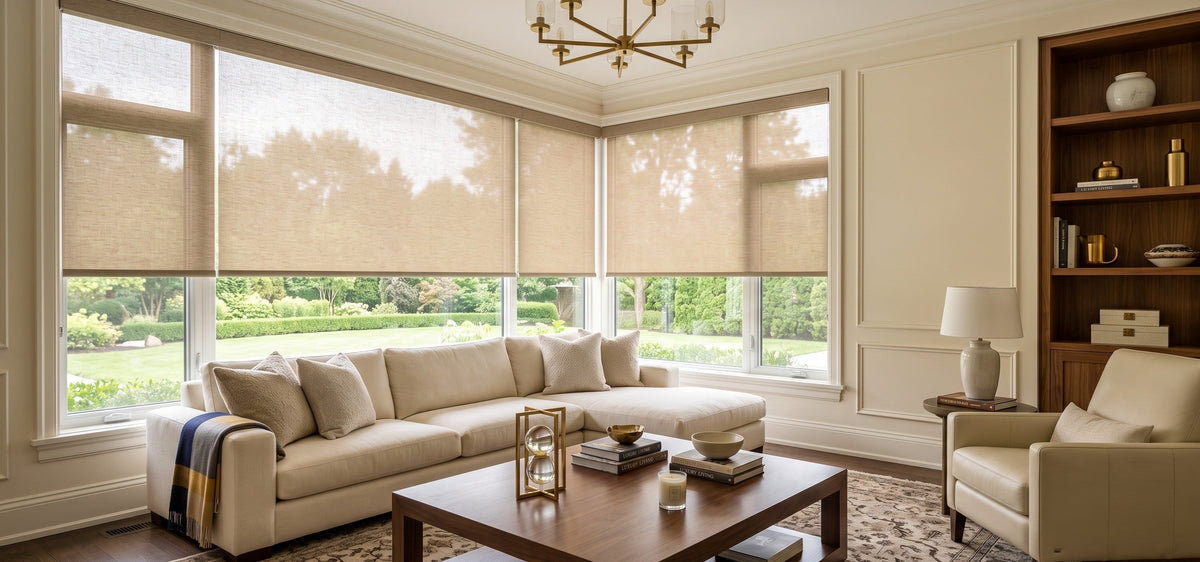

Three things go wrong on corner windows often enough to be predictable:
The two shades collide when both are raised
A vertical band of light runs the full height of the seam
The two sides finish at visibly different heights
None of these is a product fault. They come from ordering before the corner itself was pinned down. What works on a corner window depends on how the two panes meet, and the product category turns out to be the last variable that matters, not the first.

Whether There Is a Post in the Corner Is the First Thing to Establish
Stand inside and look straight at the corner. There are three cases, and they behave differently at every stage:
Post present: a vertical post or strip of wall separates the two panes
No post: the panes butt directly together, with only a bead of sealant or a narrow metal joint between them
Angled corner: the internal angle is something other than 90 degrees
Measuring, mounting and the range of workable products all change between them. This is the dividing line behind every installation problem listed above. Settle which one you have and the rest of the decisions follow.

A Corner With a Post Behaves Like Two Ordinary Windows
The post separates the two openings completely, so each shade mounts inside its own frame and the two never touch. Roll-up diameter and stack depth stop being constraints, which leaves the product choice wide open.
This is the easy version. Measuring and installation follow the standard routine on the official measuring page.
The one thing still worth watching is height alignment. Where the two panes differ in size, the headrails need to sit on a single level line, or the two shades will finish at different heights when raised.
Without a Post, Decide Which Shade Overlaps the Other Before Ordering
When the panes meet directly, the two shades meet at their side edges. Mount inside and a vertical gap is unavoidable. Mount outside and one shade has to overlap the other's edge.
That overlap order sets the finished width of both shades, so it has to be settled before the order goes in. Changing it afterwards means drilling fresh holes.
The usual arrangement:
Run the wider side at full width
Start the narrower side from the corner, lapping over the first
Where one side takes noticeably stronger sun, give that side the full width for better light control
Corners like this favour products with a small roll-up diameter. Motorized roller shades and motorized zebra shades project the least into the room, which keeps interference between the two to a minimum.

An Angled Corner Changes the Overlap, Not the Shape of the Shade
An angled corner might come in at 135 degrees or at something less common. The two panes themselves are usually still rectangular, so the shades are too.
What the angle changes is the geometry at the junction: how far each shade has to run past the corner on an outside mount before the two actually meet, and how wide the gap sits in plan.
Order it as if it were a right angle and those overlap figures come out wrong, leaving a gap at the corner that cannot be closed afterwards. Supply the measured angle along with the dimensions, and measure each pane separately rather than assuming they match. The method is on the specialty window measuring guide.
A Continuous Track Sidesteps the Corner Entirely
On a full height corner, or where both sides are wide, there is another route: skip the two separate shades and run one continuous track around the corner, carrying a single run of fabric from one end to the other with no break.
The stack ends up at the two outer ends rather than in the corner, so collisions and seam gaps never arise. The trade off is that both sides open and close together.
Whether a track can be carried around a given corner depends on the angle and the hardware, so this is worth confirming before committing to it. SmartWings motorized drapery (from $219) is made to measure, and the team can advise on what a specific corner will take.

Light Escapes at Exactly Two Places
The vertical seam between the two shades. An inside mount always leaves one. Switching to an outside mount and lapping one shade over the other's edge closes it. Bedrooms and media rooms can go further and add side channels, which take out the outer vertical light paths on both shades at the same time.
The horizontal gap between headrail and fabric. On motorized roller shades that gap measures 1 3/16 inch (3 cm). Other shade types run their own figure, so it is worth checking the spec for the product you are ordering. Every window has one.
Both are decisions made at the point of ordering. Very little can be done about either once the shades are up.
Product Choice Comes Last, Though It Still Counts
With the structure settled, the field is fairly open. Only one property makes a real difference at a corner: how much space the shade occupies when it is up.
Rolled, not folded: roller and zebra shades roll onto a tube, the first choice where there is no post
Folded stack: cellular shades stack shorter than fabric-fold products, though a double cell build stacks taller than a single cell and taller than a rolled shade
Deepest stack: fabric-fold products including Roman shades and woven wood shades, whose folds can meet in the corner when both are raised, avoided by mounting inside or choosing a flat fold
No corner stack at all: drapery on a continuous track, with the stack pushed to the ends
Corner windows carry more glass than ordinary windows, so heat moves
through them more freely in both summer and winter. Motorized cellular shades in a double cell build make a more noticeable difference here than on a small window.
Where the two sides face different directions, zebra shades let each one sit at its own opening rather than forcing both to move together.
The full pairing of window shapes to product categories is on the window type guide.

When It Is Worth Having Someone Measure on Site
Most corners with a post can be measured and installed as a DIY job, with brackets and instructions supplied. These cases carry a higher cost of error and are worth handing over:
The internal angle is not 90 degrees and needs measuring
There is no post and the room has real blackout requirements
The two panes differ noticeably in size, or the walls are visibly out of plumb
The corner runs higher than you can reach standing
A full height corner needs a continuous track
SmartWings was named CNET's top pick for motorized blinds in 2026. Every shade is cordless and motorized, built to measured dimensions rather than stock sizes, so the two sides of a corner can differ in width and height within a single order. Motors and controls carry a three year warranty, and shipping is free worldwide with no minimum order. Sizes and pricing are on the SmartWings site.
FAQ About Corner Window Treatments
Q1: How do I tell whether my corner has a post?
Stand square to the corner and look at where the panes meet. A visible vertical structure, usually an inch or more across, means there is a post. Only a bead of sealant or a narrow joint means there is not. If it is hard to judge, run a hand along the glass into the corner and feel for a step.
Q2: Can I do one side now and the other later?
With a post, yes, and starting with the side that takes stronger sun makes sense. Without a post it is not advisable, since the overlap order determines the finished width of both shades and they need sizing together.
Q3: Are bay windows handled the same way?
No. A bay projects outward across three or more facets, usually with clear posts dividing them, and each facet is treated on its own. A corner window meets at a wall corner, and the whole difficulty sits at that one junction. Bay windows are covered in the bay window guide.
Q4: Should both shades use the same fabric?
Yes, as a rule. The two panes read as one surface from inside, and any difference in fabric or colour makes the corner division stand out. Where the two sides face very different directions, hold the fabric constant and handle the light difference through how far each one is lowered.
Q5: How noticeable is the vertical gap on an inside mount without a post?
It depends on frame depth and the clearance allowed for each shade, but it typically reads as a narrow vertical line, visible in daylight from inside. In rooms built around light and view it hardly registers. In bedrooms and anywhere needing real darkness, go straight to an outside mount with side channels.


