
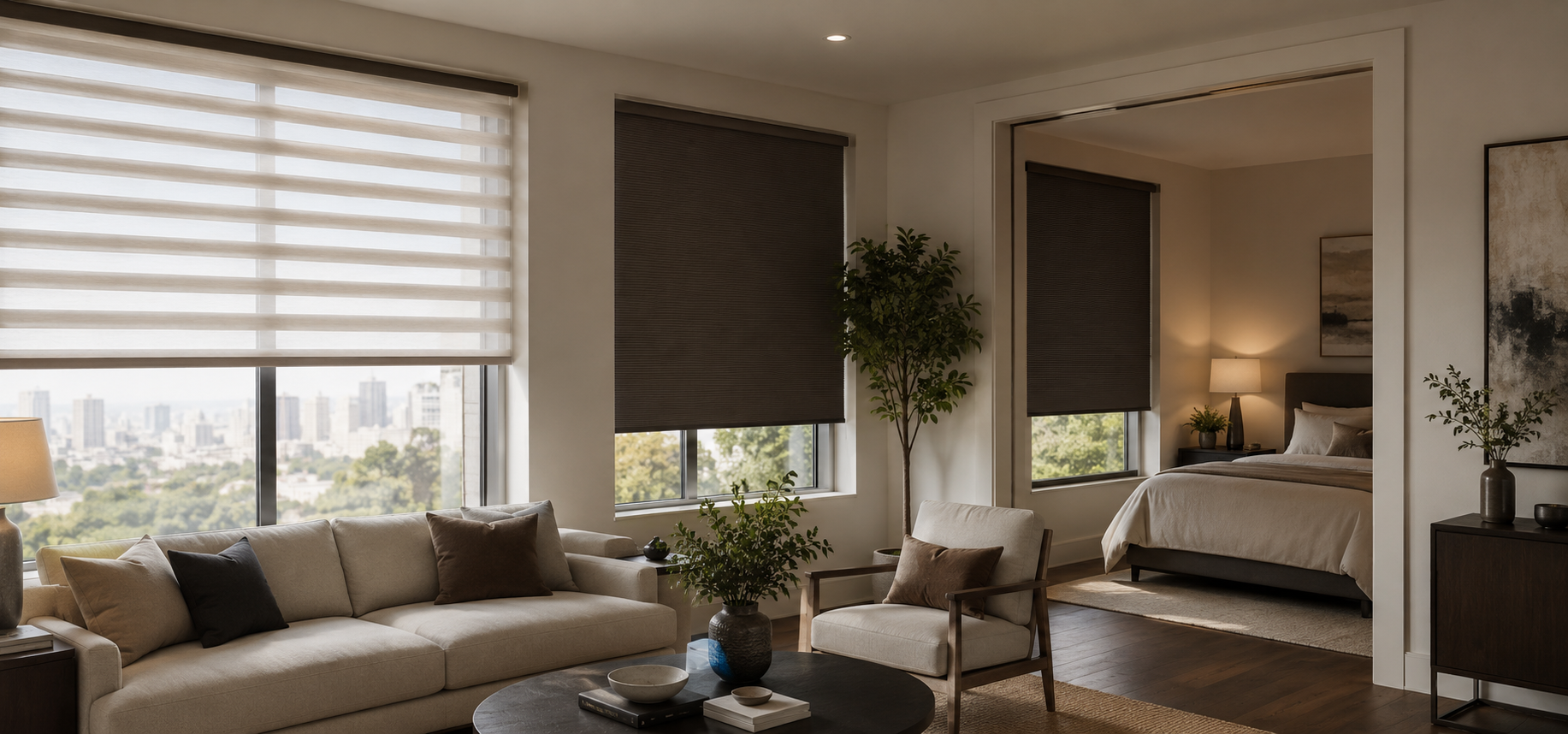

Different rooms need different things from their window treatments. A bedroom window, for example, often calls for soft morning light to make waking up gentler, then full darkness at night for restful sleep. Living rooms are similar — bright and open during the day, more private once evening sets in.
The same window can need almost opposite light conditions at different times of day — and that's exactly the problem dual shades are built to solve.
The structure is simple: two independent fabric layers housed in the same roller mechanism — one blackout, one light filtering — each on its own motorized lift. A single product covers your full day of light control.
This guide walks through how dual shades work, the style and fabric choices available, the motorized control options, and which rooms suit them best.

What Dual Shades Are: Two Fabrics, One Mechanism
Dual shades — also called double roller shades or double blinds — are window treatments that combine two independent fabric layers in a single roller assembly. The two layers are typically paired this way:
Top (or front) layer: light filtering — softens daylight while preserving the outdoor view and natural-light ambiance
Bottom (or back) layer: blackout — provides deep room darkening for sleep or screen-viewing environments
Each layer connects to its own motorized lift, so you can lower one and keep the other rolled up, or stack both for full coverage.
Lower the light filtering layer in the morning for a softer glow, stack the blackout layer at night for deeper darkness, and combine them at any angle in between.
This "two layers, one window, each doing its own job" structure is what makes dual shades dependable in spaces with complex lighting needs — bedrooms, home theaters, living rooms.
One product handles the full range of conditions, with no need for two separate sets of window treatments.

Style Options: Fabrics, Colors, and Valance Design
The "style" side of dual shades comes down to three things: fabric color palette, fabric texture, and the top valance design.
Fabric colors range from light to dark tones across multiple options. Homeowners typically pair them in one of these directions:
Light-tone light filtering layer + darker blackout layer — soft by day, substantial by night
Same-family colors — unified and visually clean
Contrasting tones — the outward-facing side and the room-facing side can be considered separately
Fabric textures vary across the SmartWings Dual Shades collection, suiting modern, transitional, and refined-contemporary interiors. Before ordering, requesting fabric swatches is a good idea — physical samples show the real feel and color far better than on-screen images.
Valance design is where dual shades make a strong visual statement.
The SmartWings flagship Harmony Duo Plus uses a square valance design — clean lines, and a structure that helps reduce light leakage at the top, which makes a real difference in bedroom darkening.
Overall, dual shades lean modern and minimal. The cordless build keeps windowsills clean and uncluttered, and they fit naturally into modern, transitional, and refined-contemporary interiors.

Function Options: Motor, Smart Home, and Battery
Beyond style, the "function" side of dual shades is about three things: motor protocol, smart home compatibility, and power source.
Motor protocol — SmartWings Dual Shades offer multiple motor options, with the mainstream choices being Zigbee, Z-Wave, and Matter over Thread. Each fits a different smart home ecosystem:
Matter over Thread — best fit for Apple Home and Google Home users
Z-Wave — best fit for Z-Wave smart home systems
Zigbee — best fit for Zigbee-based ecosystems
Smart home platforms — SmartWings Dual Shades are compatible with Apple Home, Google Home, Amazon Alexa, and Z-Wave smart home systems. For platform-specific setup, see the Apple Home buying guide, the Google Home 5 key factors guide, and the Alexa compatibility guide.
Power and battery life — SmartWings Dual Shades use a built-in rechargeable lithium battery, running 4–6 months on a full charge. Recharging uses a standard USB-C cable, with no rewiring or battery replacement required.
Control methods stack together: control through the Apple Home, Google Home, or Alexa app; voice assistant; schedules and scenes; and an optional multi-channel remote.
The feature that gets used most in daily life is scheduling — the light filtering layer rises with the morning, the blackout layer lowers in the evening, and manual control becomes nearly unnecessary.

Which Rooms Suit Dual Shades Best
Dual shades adapt to a wide range of spaces, but each room has its own priorities — and the right pairing depends on them.
Bedrooms
The bedroom is where dual shades shine most. Drop the light filtering layer in the morning for a gentle wake-up; stack the blackout layer at night for restful sleep.
The square valance on the Harmony Duo Plus helps reduce light leakage at the top of the shade — a real improvement for anyone sensitive to early-morning light or working night shifts.
A SmartWings Dual Shades upgrade review on YouTube summed it up as "the upgrade I should've chosen first" — one product covering both daytime and nighttime light needs is the core value of dual shades.
Living Rooms
Living rooms call for openness by day and privacy by night. Lower the light filtering layer during the day to block direct sightlines from outside while keeping natural light and outdoor views; later in the evening or once guests have left, stack the blackout layer for a more enclosed and private atmosphere.
Home Theaters
Home theaters are all about light control during screen time. Use the light filtering layer for everyday lighting, and stack the blackout layer with a single tap when it's movie time.
The Harmony Duo Plus square valance further reduces top-edge light bleed, helping screen contrast stand out.
Kids' Rooms
Two priorities in kids' rooms: child safety and naptime conditions. SmartWings Dual Shades are fully cordless, making them well suited to homes with children and pets.
Drop the light filtering layer for daytime play; switch to blackout for naps to help kids settle quickly. For related pairings, see the bedroom blackout blinds guide.
Dining Rooms and Large Windows
For large windows or floor-to-ceiling glass in dining rooms, SmartWings Dual Shades support custom sizing for wider spans.
The light filtering layer keeps the dining area bright with natural daylight; the blackout layer comes in for strong afternoon sun or private evening meals.

How to Choose the Right Dual Shade for Your Home
Before choosing dual shades, think through three questions:
Which room is the primary use case? Bedrooms and home theaters prioritize the blackout layer; living rooms and dining rooms care more about the light filtering layer and overall styling.
Which smart home platform do you want to connect to? Apple Home and Google Home users will lean toward Matter over Thread; Z-Wave system users will choose the Z-Wave motor.
What size and mount style fit your windows? SmartWings Dual Shades support custom sizing — follow the measurement guide on the product page and provide width × height when ordering.
For mounting, SmartWings Dual Shades support both inside mount (inside the window frame) and outside mount (outside the frame).
Inside mount looks cleaner and sits flush; outside mount covers more area and works well for bedrooms that need deeper darkening.
For a broader take, see the best smart blinds for windows 2026 buying guide.
FAQ About Dual Shades
Q1: What do the two fabric layers in dual shades do?
SmartWings Dual Shades have two independent fabric layers. The light filtering layer softens daylight while preserving the outdoor view. The blackout layer provides deep room darkening for sleep or screen viewing. Each layer runs on its own motor, covering both daytime and nighttime light needs.
Q2: Can both fabric layers be lowered at the same time?
The two layers of SmartWings Dual Shades operate on independent motors and can be lowered separately or stacked together at any angle.
Q3: Which rooms are dual shades best suited to?
Bedrooms, living rooms, home theaters, and kids' rooms — any space where light needs shift throughout the day. SmartWings Dual Shades give you soft daylight and deep darkness from a single product.
Q4: How long does the battery last on dual shades?
SmartWings Dual Shades run 4–6 months on a full charge, recharged with a standard USB-C cable.
Q5: How do I choose between SmartWings dual shade models?
SmartWings offers two models: standard Motorized Dual Shades and flagship Harmony Duo Plus. Harmony Duo Plus features a square valance that reduces top-edge light leakage, making it the stronger pick for bedrooms and home theaters. The standard model works well for living rooms and dining rooms.
Q6: Are dual shades difficult to install?
SmartWings Dual Shades ship with mounting brackets, screws, a manual, and a USB-C cable. Standard windows take 10–20 minutes to install as DIY, and both inside mount and outside mount are supported.
Q7: How do I care for and clean the fabric?
Dust the fabric with a soft brush or low-suction vacuum, and spot-clean stains with a damp cloth. Avoid hand-washing or machine-washing. For details, see the how to clean blinds & shades guide.


