
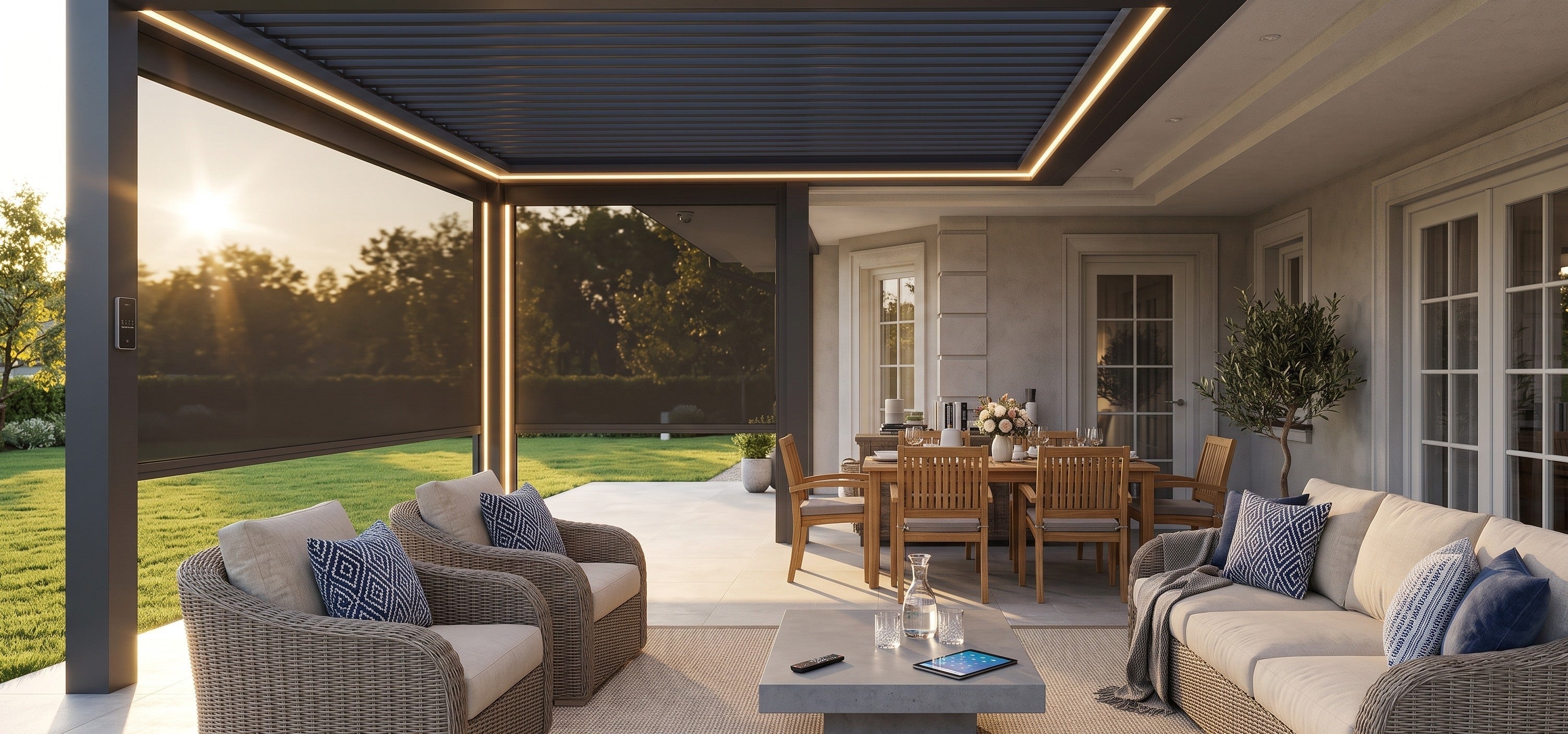

Patio covers a wide range of spaces. Covered porches, open decks, pergolas, apartment balconies, and screened porches all fall under the same word.
These spaces call for different decisions. Each offers different mounting conditions, and each has a different problem to solve.
The sections below work through five common structures, covering the mounting conditions each provides, the fabric that suits it, and what to confirm before ordering. SmartWings outdoor shades are made to site measurements and cover all five.

Three Conditions to Confirm Before Comparing Products
Walk the space and check these three points first. They set the range of options available to you.
A load-bearing surface along the top: beams, fascia boards, and concrete headers all take fixings directly, while aluminum awnings and plastic panels need their load capacity assessed separately
Fixing points at the sides: posts, walls, or columns determine whether side channels can be added, and without them the fabric moves noticeably in exposed positions
Span width and wind exposure: wider and more open positions place higher demands on fabric weight and motor torque, and beyond a certain width the opening is better split into multiple panels
Two details are worth checking on the top surface. Fixings need to reach a structural member rather than sheathing or trim, and older fascia boards sometimes need reinforcing before they will hold a loaded shade through a season. Where a beam sits behind a decorative facing, the bracket depth has to account for that gap.
Once these three points are settled, the options usually narrow to one or two. The outdoor patio shade buying guide sets out the wider selection criteria.

Covered Porches
Covered porches offer the most complete set of mounting conditions. The roof structure provides a ready surface along the top, posts are usually already in place, and shades fix directly under the beam or against the post.
Mounting: an outside mount is standard, with brackets fixed beneath the beam so the fabric covers the full opening once lowered. Where posts exist at the sides, side channels reduce movement. The outside mount installation guide covers the hardware and method.
Fabric: the roof already handles overhead sun, so the shade deals with low-angle light and sightlines from the side. A mid-range openness suits most porches, and the tightest weaves are rarely necessary.
Worth noting: a porch open on three sides benefits from different fabrics by orientation. The west side takes the strongest late-day sun and suits a tighter weave, while the remaining sides can stay more open.
One geometry point: overhang depth determines how much the roof contributes. A deep overhang blocks high summer sun on its own, which means the shade is working mainly in the early morning and late afternoon. A shallow overhang leaves more for the shade to handle through the middle of the day, and a tighter weave becomes more useful.

Open Decks and Uncovered Patios
Open spaces have no overhead structure, which is the point most often missed at the planning stage. A shade needs something to fix to, and these spaces generally do not provide it.
Mounting: a supporting structure usually has to be added first. Common approaches include posts and a beam along the deck edge, using an adjacent house wall as one fixing point, or a frame built above existing railings.
Fabric: exposed positions see noticeable movement, so side channels are worth including. The SmartWings Zipper Track system holds both edges of the fabric inside a track, which keeps the panel steadier than an unsecured drop.
Worth noting: if structural work is not planned for now, a single run on the side taking the strongest sun delivers most of the benefit without enclosing the whole deck.
On ground clearance: leaving a small gap at the bottom keeps the hem clear of standing water and debris after rain, and makes sweeping the deck easier. Where the deck surface slopes for drainage, that slope should be measured, since a shade cut to a single height will sit unevenly against it.

Pergolas and Outdoor Structures
Pergolas typically span wider than porches, and the top is slatted rather than solid. Both factors affect the mounting method and the result.
Mounting: shades fix to the perimeter beams and drop down the sides. On wider spans, several panels side by side work better than one continuous run, since each stays steadier and each can be adjusted according to where the sun is.
Fabric: gaps between the slats let midday sun through from above, so the side shades are handling low-angle light. Overhead shading needs planning separately, and side panels do not substitute for it.
On splitting panels: where a pergola has intermediate posts, aligning panel edges with those posts looks deliberate and gives each panel a clean side fixing. Splitting a span without posts to align to leaves a visible seam in open air, so post positions are worth planning around from the start.

Apartment Balconies
Balcony constraints come from building rules as much as from structure. Many buildings restrict drilling into the exterior facade, which leaves the underside of the slab above and the side dividing walls as the usable mounting surfaces.
Mounting: mounting under the slab is generally the first option, with the fabric dropping inside the railing line. This leaves the building exterior unchanged.
Fabric: balconies are mostly about daytime screening and cooling during the late-day sun. A tighter weave gives better daytime screening while still letting air through.
Worth noting: confirm the building rules before ordering, since some communities also specify permitted colors.
On the railing line: dropping the fabric inside the railing rather than outside it keeps the shade within your own boundary, which usually matters for approval. It also protects the hem from wind lifting it against the railing, and side channels fixed to the dividing walls keep the panel contained in a windy position.
Screened Porches and Three-Season Rooms
These spaces are already enclosed, so the shade shifts from holding off weather to managing sun and sightlines.
Mounting: shades can go inside the screen or outside it. Mounting inside looks tidier, while mounting outside intercepts sun before it reaches the screen, which does more for temperature.
Fabric: these rooms already have some screening in place, so a mid-range openness works well. A very tight weave leaves the interior noticeably dark.
Worth noting: bamboo and woven wood shades are not suited to these spaces. Sustained UV exposure and humidity swings affect how those materials hold up, and outdoor-specific fabrics are the better choice.
On the screen frame: screen frames are rarely load-bearing, so fixings need to reach the surrounding posts or header rather than the frame itself. This is worth checking before deciding between an inside and outside mount, since it can settle the question on its own.
What Outdoor Fabrics Actually Block
Outdoor shade fabrics are woven with ventilation holes. Air passes through rather than building up behind the fabric, and that same structure means these shades work differently from interior ones.
UV: tighter weaves block more UV rays, with a corresponding reduction in view and airflow
Daytime screening: while the outside is brighter than the space behind the shade, sightlines in are noticeably reduced, and tighter weaves do more
After dark: the situation reverses once interior lights come on, and outdoor shades do not deliver what an interior blackout shade does, so the inside face of the glass needs handling separately
Temperature: intercepting sun before it reaches glass or masonry does more than blocking it once it is already inside
Openness is a trade rather than a setting to maximize. A tighter weave screens better and keeps more heat off the surface behind it, and it also darkens the space and cuts airflow. A more open weave keeps the view and the breeze and asks less of the structure in wind. Ordering swatches and holding them up on site, at the hour the space actually gets used, is more reliable than deciding from a product page.
The guide to outdoor coverings for heat and UV covers how exterior and interior shading divide the work.
Motorized Operation and Power Outdoors
Outdoor shades usually mount higher than interior windows and span wider, which raises the cost of adjusting them by hand. That is why motorization delivers more outdoors than it does inside.
Power: a battery motor runs roughly 4 to 6 months per charge depending on how often the shade cycles.
Outdoor positions suit a solar panel. Where the panel receives around two to three hours of direct sun a day, it keeps the battery topped up on its own and separate charging is no longer needed. The panel does need a position that actually gets that sun, which on a deep covered porch is worth confirming rather than assuming.
Control: a remote handles day-to-day adjustment, while a schedule can lower the shade through the strongest sun and raise it after sunset. SmartWings outdoor shades are compatible with Apple Home, Amazon Alexa, and Google Home, and also work with Home Assistant and Hubitat. The platform selection guide covers the differences.
On wide spans with several panels: assigning panels to separate remote channels lets you shade only the side taking sun, which is the point of splitting the span in the first place. Grouping them onto one channel is possible where the whole run is normally used together.
Price: SmartWings outdoor shades start at $199, with the final figure set by size, fabric openness, whether side channels are included, and the motor version. Wide openings are quoted per panel, and the motorized shade pricing breakdown sets out the full cost structure.
Site measurements and photographs of the structure can be sent to SmartWings before ordering, which is particularly worthwhile for open decks and irregular pergolas.
FAQ About Outdoor Patio Blinds
Q1. What should be confirmed first when choosing outdoor blinds?
The structure, specifically whether there is a load-bearing surface along the top, whether there are fixing points at the sides, and how wide the opening spans. Once those three are settled, the range of workable fabrics and mounting methods becomes clear.
Q2. Do outdoor shades provide screening at night?
During the day yes, after dark far less. Outdoor fabrics are woven with ventilation holes, so once interior lights come on, sightlines in increase and an interior shade is needed on the inside face.
Q3. Can outdoor blinds be installed where there is no overhead structure?
Yes, though a fixing point has to be created first, whether that means posts and a beam along the edge or using an adjacent house wall as one side. Where there is nothing at all to fix to, installation is not possible.
Q4. How wide can a single outdoor shade panel be?
Wider openings are usually covered by several panels side by side rather than one continuous run, with each panel controlled separately. Send your measurements to SmartWings to confirm the right split for your opening.
Q5. Do motorized outdoor shades need wiring?
Not necessarily. The battery version needs none, and a solar panel keeps it topped up in an outdoor position, while a hardwired version is an option where site conditions allow.
Q6. Are outdoor blinds suitable for apartment balconies?
Yes, generally mounted under the slab above so the facade stays unchanged. Check the building rules before ordering, since some communities specify permitted colors as well.


