
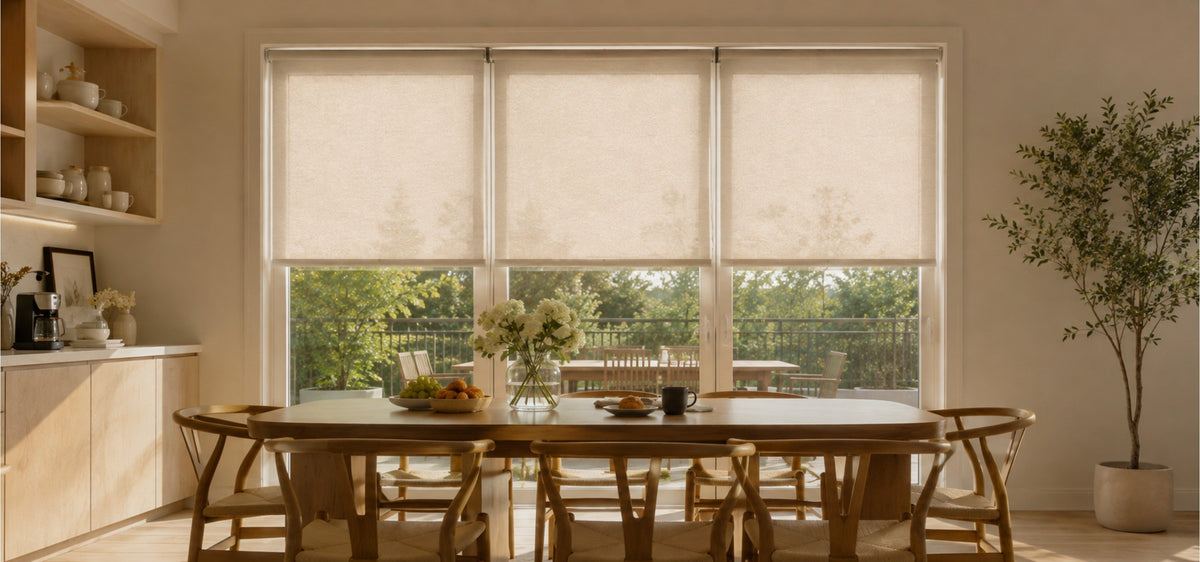

A single panel gives the cleaner look and the better light control, because there is no seam in the middle of the window. Splitting into two or more panels handles weight and long-term serviceability better, and it is the right answer whenever the window is already divided by a post or mullion.
That is the whole tradeoff. What makes the decision harder is that both options are available on most wide windows, so nothing about the window itself forces the choice.
The factors below decide it in practice, followed by the situations where the answer is not really open, and how to specify each option so it performs the way it should.

Which factors actually decide it?
Five things separate the two options, and they do not all point the same way.
|
Factor |
One wide panel |
Two or more panels |
|
Appearance |
Uninterrupted span, cleaner horizontal line |
A visible vertical seam at the meeting point |
|
Light control |
No centre gap |
A narrow gap where panels meet |
|
Fabric behaviour |
Long spans need heavier hardware to roll evenly |
Shorter spans roll more predictably |
|
Servicing |
The full width comes down for any repair |
One panel can be serviced or replaced alone |
|
Control |
One motor, one action |
Several motors moved together through scene control |
Appearance and light control favour a single panel. In a media room or a bedroom, the centre seam is exactly where light shows once the room is dark.
Weight and serviceability favour splitting. Fabric weight increases with width, and every component on that window has to carry it for the life of the shade.
Control is no longer the deciding factor it once was. Manual shades made wide panels genuinely hard to operate, which is why splitting used to be the default recommendation on any large window.

When does a single wide panel make sense?
When the glass is uninterrupted and the room has a reason to care about the seam.
Picture windows and single-pane spans. With no mullion to align to, a split creates a division the architecture does not have, and the eye reads it as a mistake rather than a choice. Coverage options for these windows are set out in the large picture window guide.
Rooms where darkness matters. A centre seam is a light line down the middle of the wall. In bedrooms and media rooms, that is the one place light is least welcome, which usually settles the question on its own.
View-first rooms. A single roll at the top keeps the window reading as one opening when the shade is up, rather than as a row of hardware.
SmartWings builds shades to the measurements of the window, and unusually wide spans are worth confirming with the team before ordering so the hardware is specified for the load. Motorized roller shades start at $159.99.

When is splitting the better answer?
When the window is already divided, or when a single panel would be carrying more than it should.
Windows with mullions or posts. A split that lands on an existing division line disappears. Fighting that line with one continuous panel draws attention to the mismatch.
Corner windows. A roller shade needs a straight tube and cannot turn a corner, so two panels planned to meet cleanly is the only workable layout.
Sliding doors in daily use. Splitting lets the panel over the active leaf move independently, so the whole opening does not have to be cleared every time the door is used.
Very wide spans. Beyond a certain width, the fabric and hardware are doing enough work that dividing the load produces a shade that behaves better over years of use.
Staged budgets. Two panels can be ordered and installed in sequence, which a single panel cannot.
Considerations specific to extra-wide openings are covered in the guide to remote-controlled roller blinds at 106 inch widths.
If you split, how do you split well?
The difference between a split that looks deliberate and one that looks like a compromise is in the planning.
Align the division to the architecture. Put the meeting point on a mullion, a post, or the centre line of the opening. Anywhere else reads as arbitrary.
Keep the panels equal. Unequal widths are noticeable even when the reason for them is practical.
Order the panels together. Fabric produced in one run avoids the slight tonal variation that shows when two panels sit side by side.
Plan the meeting point for the room. A narrow gap is unavoidable where two panels meet. In a living room it is unnoticeable; in a bedroom it is worth mounting outside the frame to reduce what shows.
Group the panels in a scene. Several motors on one window should move as one action rather than being adjusted separately, which is set out in the smart home platform guide.

If you go with one panel, what should you specify?
Three things carry a wide single shade, and all are decided at the order stage.
Hardware sized for the span. A wide shade needs a tube specified for its width and fabric weight, which is what keeps the roll level rather than dipping in the centre over time.
Fabric weight matched to the width. Heavier blackout fabrics put more load on a wide span than a light filtering weave does, so the fabric choice and the hardware choice are one decision, not two. Fabric families are compared in the light filtering versus blackout guide.
Continuous power where possible. A wide panel asks more of the motor on every cycle, and a hardwired shade removes recharging from the equation entirely on a shade that is awkward to reach.
An outside mount in dark rooms. Covering beyond the frame reduces edge light on a wide span, as covered in the outside mount guide and the inside versus outside mount guide.

How does motorization change the comparison?
It removes the strongest historical argument for splitting, and adds one planning step in return.
Operating effort disappears. The reason wide manual shades were discouraged was the force needed to raise them evenly. A motor makes width a hardware question rather than a daily inconvenience.
Several panels can behave as one. Scene control moves two or three motors together, so a split window still operates with a single action rather than one command per panel.
Power planning replaces operating effort. More motors on one window means more power points or more batteries to keep charged, which is where a wired approach earns its place. The connection options are compared in the Matter over Ethernet versus Matter over Thread guide.
Independent accounts of how these shades operate day to day are available from How-To Geek in its review of the window coverings and Matter Alpha in its hands-on review, with more on the reviews page. Cost factors for either configuration are broken down in the motorized shade cost guide.
FAQ About Wide Window Shade Configurations
Q1: How do I measure a wide window if I am ordering two shades?
Measure the opening at several points across the width and work from the narrowest figure, then divide that width between the panels rather than measuring each half separately. Full instructions are on the window measuring page.
Q2: Is one wide shade more expensive than two smaller ones?
Not necessarily, and the comparison is rarely straightforward. A single panel needs hardware specified for the span, while two panels mean two motors and two sets of brackets. The cost guide breaks down what drives the difference.
Q3: Can the panels on one window use different fabrics?
They can, though it rarely looks intentional on a single opening. The exception is a window where one section faces a different condition, such as a sliding door beside a fixed pane.
Q4: Can one remote control several panels on the same window?
Yes. Multi-channel remotes handle several shades, and scene control on a supported platform moves them together, as covered in the remote control guide.
Q5: Will two panels raise and lower at exactly the same rate?
They move together when triggered together, though small differences at the midpoint of travel are normal across separate motors. Panels of equal width behave more consistently than uneven ones, which is another reason to divide the opening evenly.
Q6: Does a wide single shade take longer to open and close?
Travel time depends on the drop rather than the width, so a wide shade and a narrow shade of the same height move at a similar pace. Scheduling makes this irrelevant in daily use, as covered in the motorized shade features guide.
Q7: If one panel needs replacing later, will it still match?
Fabric batches can vary slightly over time, so an exact match is not guaranteed years after the original order. This is one of the practical advantages of a split window, since only one section is ever affected.
Q8: What about a wall of several separate windows rather than one wide opening?
Treat each window as its own shade and align the hardware height across all of them, so the row reads as one line. Grouping them into a single scene keeps the wall operating as one surface.


