
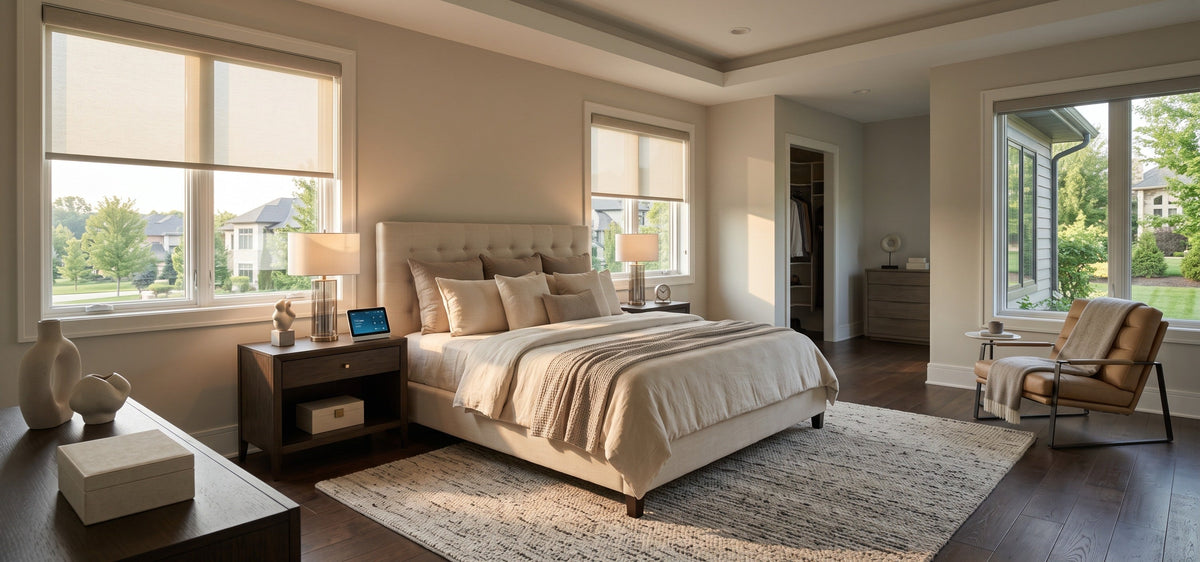

Homeowners choose motorized roller shades for how little there is to look at: one panel of fabric, one roller, and almost nothing left visible once the shade is up. In a bedroom or across a wall of glass, that same restraint can read as unfinished — the roller and brackets sit exposed at the top, and a line of daylight runs above the fabric.
The part that resolves it is the valance: a cover spanning the top of the shade that conceals the roller, the brackets, and the motor. There are only three ways to finish that top edge, and the choice comes down to the depth you have, the fabric you picked, and what the room is for.

Roller Shade Valance Types Compared
|
Finish |
Look |
Top light control |
Depth required |
Best suited to |
|
Open roll |
Roller and brackets exposed, lightest profile |
None |
Least |
Deep recesses, black-framed glass walls, stairwells, utility spaces |
|
Fabric-wrapped cassette |
Top matches the panel, reads as one surface |
Good |
Least |
Bedrooms, nurseries, media rooms, walls with several windows |
|
Square valance |
Roller fully enclosed, cleanest line |
Best |
Most |
High ceilings, custom soffits, ceiling-pocket installations |
Why Light Escapes Above a Roller Shade
A roller shade rolls up in front of the glass, and the fabric hangs off the front of the tube. That leaves a gap between the panel and the wall roughly as wide as the roller itself — wider on big windows, because heavier fabrics roll onto thicker tubes.
Fabric cannot close that gap. A blackout panel controls the area it covers; the opening sits above and behind it. This is why the most common comment after a blackout shade goes in is that the panel is dark but the top of the window is not.
Sleeping and viewing rooms: the top edge decides the result, not the finish's looks.
Daytime rooms: the same gap goes unnoticed, so the finish is a styling choice.
Runs of several windows: a cover also hides the fact that no two rollers sit at exactly the same height.

Open Roll, Fabric-Wrapped Cassette, or Square Valance
Open roll. The shade reads as an architectural element rather than a soft furnishing.
Works where the recess is deep enough to conceal the roller on its own
Suits rooms already built around black frames and large panes
Leaves the top gap open, so it belongs in daytime and utility spaces
Fabric-wrapped cassette. The cover is wrapped in the panel fabric, so the top of the window and the shade become one surface.
Asks no more inside-mount depth than an open roll, so it stays available where the recess is shallow
The most forgiving of the three: uneven trim, mixed window widths, and long runs all resolve into one horizontal line
Close to essential with a dark blackout fabric, since a lit strip stands out more against a darker panel
The natural pairing for outside mount, where hardware sits on the wall
Square valance. The tube is enclosed from the front and above.
The most complete finish and the tightest control of the top edge
Set into a soffit or ceiling pocket, the shade appears to emerge from the ceiling
Asks the most of the opening, and a pocket has to be planned while the ceiling is still open

How to Measure Mounting Depth for a Roller Shade Valance
Depth decides which finishes are available, and inside mount is where it runs out. What sets the requirement is the top cover alone — open roll, fabric-wrapped cassette, and square valance each carry their own minimum inside-mount depth, and the motor is housed inside that cover rather than taking up any depth of its own.
Measure it in this order:
Measure from the front edge of the opening to the first thing that protrudes — handle, crank, or screen frame — not to the glass.
Note whether the window opens inward, which removes usable depth on casement windows.
Check what already occupies the head of the opening, such as a drapery track or rod.
If the depth is tight, there are two ways forward:
Choose a slimmer finish — move from a square valance to a fabric-wrapped cassette, which asks no more inside-mount depth than an open roll.
Move to outside mount — brackets sit on the wall or trim above the opening, depth stops being a constraint, and the panel extends past the opening for better coverage. Measuring for it is covered in the outside mount blinds guide.
- Arched, slanted, trapezoid, and skylight openings sit outside the standard configurations. Their top hardware is built around the specific opening, so measurements are confirmed before the order goes in.

Matching a Roller Shade Valance to Your Fabric
|
Fabric type |
What matters most |
Finish that fits |
|
Blackout |
Closing the gap above the panel |
Fabric-wrapped cassette or square valance |
|
Solar / light filtering |
View and glare, not darkness |
Any of the three — decide on looks |
|
Dual-sided |
The street-facing side of the fabric |
One fabric family across the elevation; the cover is chosen for the room side |
Blackout fabric makes the top edge the only remaining light path, so it earns a cover. Solar fabric is translucent by design, so the same gap disappears into the room's brightness.
Dual-sided fabric is what the street actually sees, because its outer face carries its own color. The cover is a separate decision — its exterior is not wrapped in the panel fabric and does not follow the fabric's color — so an elevation reads as one scheme when the same fabric family runs across it, not because the covers match.
Choosing a Roller Shade Valance Room by Room
|
Room |
Recommended finish |
Reason |
|
Bedroom, nursery |
Fabric-wrapped cassette or square valance |
The top edge decides whether a blackout fabric performs |
|
Media room |
Cassette where depth allows |
Tightest control of light above the panel |
|
Living room, study |
Any |
Choose whether the window recedes or stays crisp |
|
Kitchen |
Fabric-wrapped or open roll |
A wipeable surface matters more than darkness |
|
Runs of several windows |
One finish throughout |
Consistency reads as a single scheme |
Fabric and layering choices for the darkest rooms are covered in the guide to blackout shades for bedrooms, living rooms, and home theaters.
Long runs of windows need three things held constant:
The same finish on every window
The same fabric family across the run
The same mounting height above each opening — matched covers still look uneven when brackets sit at different heights
Where drapery is layered over the shade, the projection at the head of the window goes to the drapery track or rod first, and the shade's finish is chosen with what remains. The motorized window treatment types guide covers how the categories combine.

Specifying the Valance on a SmartWings Roller Shade Order
SmartWings roller shades are motorized and made to measure, starting at $159.99 in the Vinyl blackout fabric.
Blackout fabrics: Essential, Linen, Safari, Vigor, Eclipse, and dual-sided Bouvardia
Solar fabrics: Aventus at 1%, 3%, and 5% openness, Linen Dune at 5%, Metis at 0%
Three things are settled at the time of ordering:
Mount type — inside or outside, based on the measured depth
Top finish and bottom rail — specified with the shade rather than added later, and both affect the final price, as set out in the motorized shade price breakdown
Valance — open roll, fabric-wrapped cassette, or square valance, and this is the one choice that sets the minimum inside-mount depth the opening has to clear
Motor options include Matter over Thread, Zigbee, and Z-Wave 800 LR, and the shades are compatible with Apple Home, Amazon Alexa, and Google Home. Matter over Thread requires a Thread Border Router in the home, such as a HomePod mini or Apple TV 4K. Schedules, sunrise and sunset triggers, and scene control are set in the smart home platform, and a remote can be added where a physical control is easier.
Fabric and motor pairings are compared in the 12 types of roller blinds guide.
Motor options include Matter over Thread, Zigbee, and Z-Wave 800 LR, and the shades are compatible with Apple Home, Amazon Alexa, and Google Home. Matter over Thread requires a Thread Border Router in the home, such as a HomePod mini or Apple TV 4K.
FAQ About Roller Shade Valances
Q1: Does a roller shade need a valance?
Not in every room. It earns its place when hardware should be hidden, when light above the panel matters, or when several windows need to match.
Q2: Does a valance improve blackout performance?
At the top edge, noticeably. Dark fabrics benefit most, since a lit strip contrasts more sharply against them — see the blackout shade guide for fabric choices by room.
Q3: What is the difference between a valance and a cassette?
Two of the three top covers. A fabric-wrapped cassette is finished in the panel fabric so the head of the window matches the shade; a square valance is a squared cover with a crisper architectural line.
Q4: How much mounting depth does a motorized roller shade with a valance need?
Only the top cover decides it — the motor sits inside and adds nothing. Open roll and a fabric-wrapped cassette ask the least, a square valance the most; the recommended depth for each is in the SmartWings measuring guide.
Q5: Does a valance hide the motor?
Yes. The motor sits inside the tube, and the cover conceals tube, brackets, and motor together.
Q6: Should the valance match the fabric or the trim?
Matching the fabric turns the window into one continuous surface. Matching the trim draws a deliberate line at the head of the window; keep it consistent across a facade where the exterior side of the fabric is visible.


