
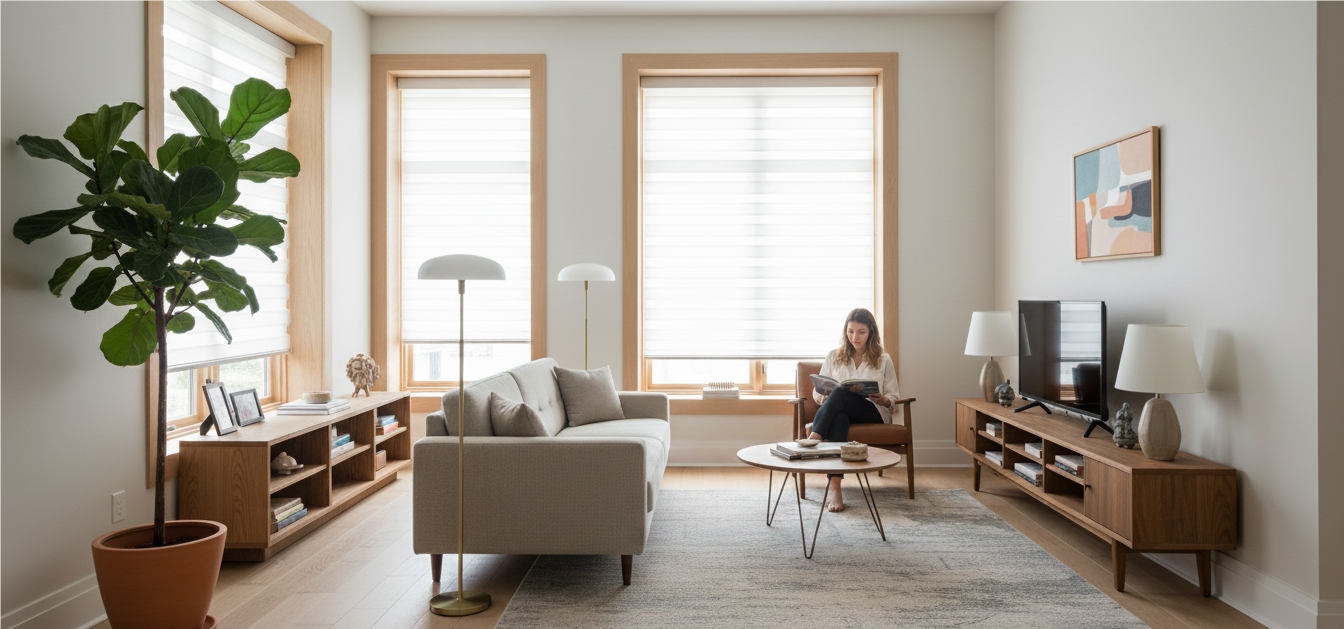

The key differences between motorized window shades go beyond the shade type itself — they also come down to the motorized solution behind it: how it is powered, how it is controlled, and whether it connects to a smart home system.
A basic motorized shade may only offer remote control operation, while a full smart setup can include voice control, scheduled automation, and coordination with other devices.
The power source also affects installation complexity and where the shade can be used — battery power suits existing homes, while PoE is better suited for new construction or commercial projects.
SmartWings offers multiple options across control methods, power solutions, and smart protocols, fitting a range of scenarios from a single window upgrade to a multi-window deployment.

Control Methods: From Remote to Smart Automation
The control method affects how convenient a motorized shade is to use day-to-day. Here are the main options available today. SmartWings products offer multiple control methods to choose from.
Remote control is a straightforward option, suited for users who prefer simple operation without setting up a smart platform.
Voice control works through smart home platforms. SmartWings shades are compatible with Apple Home (Siri), Alexa, and Google Home, allowing voice commands to raise or lower the shades.
Apple Home requires a HomePod mini or Apple TV 4K to serve as a Thread Border Router.
Timer and schedule control let shades open and close at set times automatically — for example, opening at a fixed time each morning and closing in the evening. This works well for households with consistent daily routines.
Scene automation is a more advanced use of smart control. Through a smart home platform, shades can be included in custom scenes that coordinate with other devices.
SmartWings supports the Matter protocol, which is compatible with Matter-certified smart home ecosystems.

Power Options: Choose What Fits Your Home
The power source affects installation complexity and ongoing maintenance. SmartWings offers three main power options to fit different home situations.
Battery power has a lower installation barrier. No pre-wired power outlet or wall wiring is needed, and setup is relatively simple.
SmartWings battery-powered shades charge via USB-C, making them a good fit for already-renovated homes and rental properties.
Hardwired DC (12V) provides continuous power without the need for periodic charging. This option suits new construction where power lines can be run during the build, or windows that already have a nearby power source.
PoE (Power over Ethernet) delivers both power and data through a single Ethernet cable. SmartWings is the world's first brand to launch a PoE Matter motor.
This option suits multi-window centralized management scenarios, such as whole-home smart projects or commercial spaces.
For most households, battery power is a common starting point. If a renovation or expansion is planned later, hardwired or PoE options can be considered at that stage.

Smart Protocols: Determining Platform Compatibility
A smart protocol is the "communication language" between the shade and the smart home platform. Choosing the right protocol means the shade can work with your existing smart home devices.
Matter (over Thread) is a relatively new smart home interoperability standard, compatible with Apple Home, Alexa, Google Home, and other major platforms. SmartWings is one of the earlier window shade brands to support Matter.
Zigbee is compatible with SmartThings, Home Assistant, Hubitat, and other platforms, and is widely used among smart home enthusiasts.
If your home already runs Zigbee devices, SmartWings Zigbee motors can join the existing network.
Z-Wave is compatible with SmartThings, Home Assistant, Hubitat, Homey, and other platforms. SmartWings was among the first shade brands to launch Z-Wave 800 series motors.
If you do not have a smart home system yet, Matter is currently the protocol with broader platform compatibility, making it a good starting point. If your home already uses Zigbee or Z-Wave devices, choosing the matching SmartWings motor lets it integrate into the existing setup.

SmartWings Solution Overview
Category |
Available options |
SmartWings coverage |
Shade types |
Roller, Cellular, Zebra, Woven Wood, Outdoor, Drapery/Curtains |
All six types have corresponding product lines |
Control methods |
Remote, voice, timer, scene automation |
Multiple control methods available |
Power options |
Battery, DC hardwired, PoE |
Three options available |
Smart protocols |
Matter, Zigbee, Z-Wave |
Three protocols available |
Compatible platforms |
Apple Home, Alexa, Google Home, SmartThings, Home Assistant, Hubitat, Homey |
Compatible with major platforms |
For a detailed comparison of each shade type's fabric, function, and room recommendations, see the 2026 Smart Blinds Practical Buying Guide.
For a closer look at motorized shade features and what to prioritize, see the Motorized Window Shade Features Guide.
SmartWings' main product series supports custom sizing. The cordless motorized design is safer for homes with children.
FAQ About Types of Motorized Window Shade Solutions
Q1: Can I use motorized shades without a smart home system?
SmartWings shades support remote control operation, and are also compatible with Apple Home, Alexa, Google Home, and other smart platforms. You can choose the control method that fits your needs.
Q2: How do I choose between Matter, Zigbee, and Z-Wave?
If you do not have a smart home system yet, Matter is compatible with a broader range of platforms and serves as a good starting point. If your home already uses Zigbee or Z-Wave devices, choosing the matching SmartWings motor lets it integrate into the existing network.
Q3: How often does a battery-powered shade need charging?
Charging frequency depends on the shade size and daily usage, and varies by situation. SmartWings battery-powered shades use a USB-C port for charging.


