
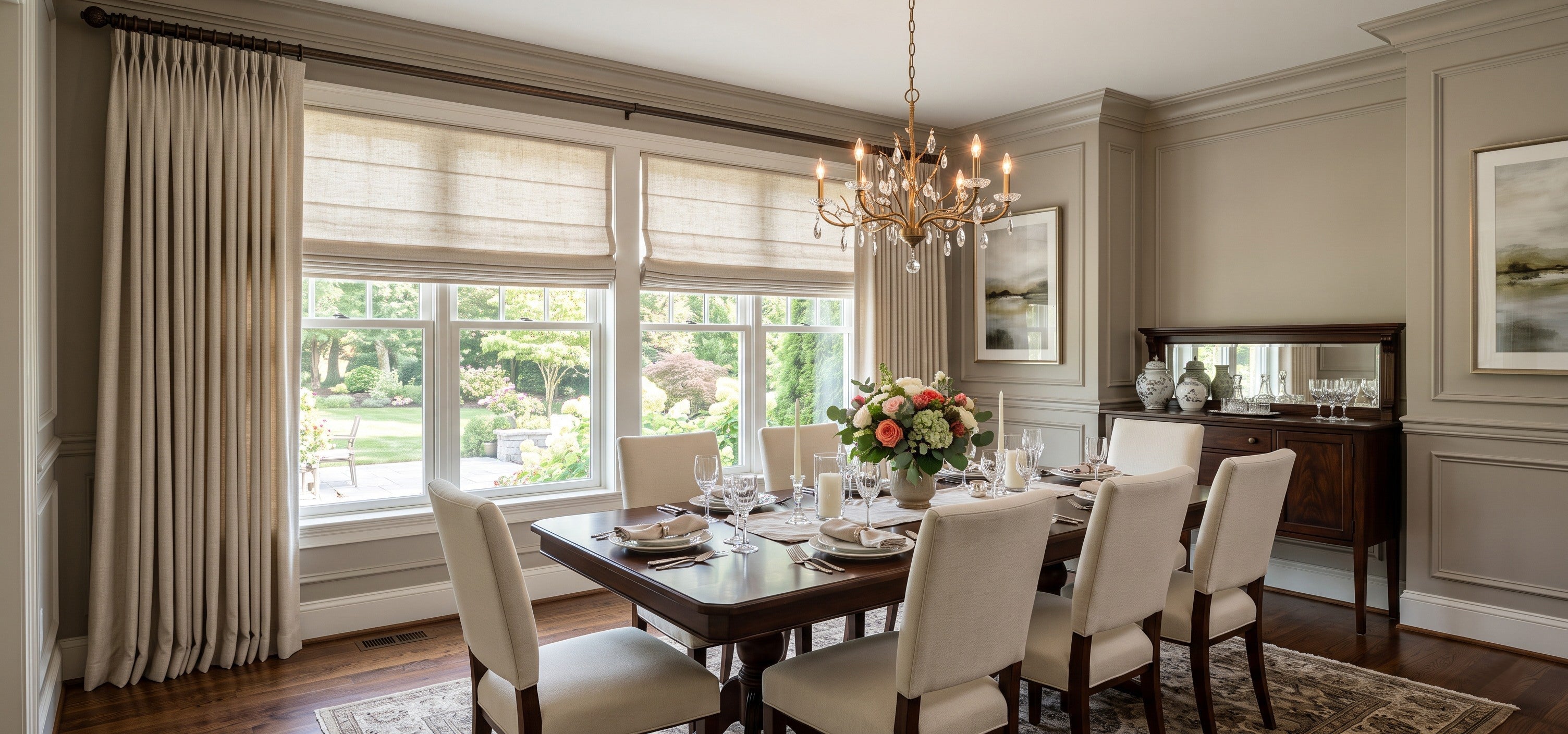

Good dining room window shades need to do three things: soften daylight, cut glare off the table, and provide enough privacy after dark, all without making the room feel heavy.
The dining room is a social space, and light sets its mood. Most dining rooms do not need blackout coverage; they need balance. This guide works through shade styles, layering, upkeep, and budget the way the room is actually used.

What Do Large Dining Room Windows Actually Need?
Start with orientation. It determines when your dining room becomes uncomfortable:
Window orientation |
Typical problem |
What to solve for |
East-facing |
Low, harsh morning light at breakfast |
Softening direct sun while keeping brightness |
West-facing |
Afternoon heat, tabletop glare, furniture fading |
Heat buffering and glare control together |
Fabric selection |
A limited set of options per listing |
Complete fabric and color ranges, with swatches available before purchase |
South-facing |
Long daily sun exposure |
Flexible, adjustable light control |
Street-facing |
Exposure to outside view once lights come on |
Switching between open daytime and private evening |
Large windows amplify every one of these problems, and they amplify the effort of adjusting shades by hand, which is where automation enters later in this guide.

Which Shade Styles Work Best in a Dining Room?
The styles below are compared by how they handle dining room light and privacy; for the same question organized by product category, see the companion guide to window treatments for large dining room windows by type.
Light filtering roller shades: clean lines and glare control. These soften direct sun into an even glow, preserve the view, and wipe clean easily, which makes them the default for modern dining rooms. SmartWings motorized light filtering roller shades start at $159.99.
Zebra shades: one shade for day and evening. Alternating sheer and solid fabric bands mean a small adjustment shifts the window from open to private. For street-facing dining rooms, this is the option that protects evening privacy without giving up daytime openness. SmartWings zebra shades start at $189.99.
Cellular shades: the heat answer for west-facing rooms. The honeycomb cells trap air at the glass, buffering afternoon heat while managing glare, and the soft fabric helps reduce echo in dining rooms with hard floors and glass surfaces. SmartWings cellular shades, in Single Cell and Double Cell constructions, start at $179.
Woven wood shades: natural texture. These filter daylight gently and pair well with wood tables and organic finishes. Note their more open weave at night: with bright interior lighting, rooms facing close neighbors may want an additional layer. SmartWings woven wood shades start at $219.
Blackout shades: a narrow use case here. Blackout fabric removes the natural glow that makes meals feel inviting, so it earns a place only when the dining room doubles as a media space. Over-specifying blackout is the most common dining room mistake.

When Does Layering Make Sense?
Not every dining room needs layered treatments. Three situations justify adding a drapery layer over the shade:
Street exposure with frequent evening use. A shade plus side drapery panels gives more comfortable privacy once interior lights are on.
Hard-surfaced rooms. Tile floors, a glass table, and high ceilings can make a dining room feel stark and sound harsh. A fabric layer softens both the look and the acoustics.
Wide glass in cold climates. The air pocket between a shade and drapery reduces winter heat loss across large panes.
In smaller dining rooms, skip the layers. With limited wall space, a single light filtering shade keeps proportions cleaner. For visual references on how layered and single treatments read on oversized glass, the large window treatment ideas roundup covers a range of room styles.

How Do You Keep Dining Room Shades Looking New?
Dining rooms are hard on window treatments: food splashes, humidity from hot dishes, and daily use all age fabrics faster than in other rooms. Upkeep varies more by material than most buyers expect.
Roller shades are the lowest-maintenance option. The flat fabric surface takes a wipe with a barely damp cloth, and smooth finishes such as vinyl-coated fabrics shrug off splashes near serving areas.
Zebra shades need a light touch: dust the bands with a soft brush or vacuum attachment, and avoid pressing moisture into the sheer sections.
Cellular shades collect dust inside the cells over time. A monthly pass with a soft brush vacuum attachment keeps the honeycombs clear; compressed air handles anything deeper.
Woven wood shades ask for the most regular attention. Dust settles between natural fibers, so a routine once-over prevents buildup that is harder to remove later.
Three habits extend the life of any of these: spot clean promptly with mild detergent rather than letting stains set, never soak fabric panels, and check mounting brackets once or twice a year, particularly on wide, frequently operated spans.
If the household includes young children or regular entertaining, weight stain resistance heavily in the fabric choice. It matters more in a dining room than in any other room of the house.

How Should You Match Shades to Your Budget?
Set the budget by counting windows first, not by picking a product first. Dining rooms often have two or three windows on one wall, and a per-window difference of even modest size multiplies across the set, so the meaningful number is the cost of the whole wall.
From there, three principles allocate the budget well:
Spend on the problem window. If one window takes the afternoon sun or faces the street, it deserves the more capable (and often costlier) treatment. Secondary windows can carry simpler fabrics in the same color family.
Mid-range light filtering fabrics are the value center. They cover the widest set of dining room needs, and premium designer materials rarely add daily function to match their price.
Prefer motorization included over motorization added. Pricing structures differ across the market: where motorized operation is an add-on, it can raise the per-window cost substantially. Prices that already include the motor make the whole-wall math predictable.
As a planning baseline, SmartWings starting prices run: light filtering roller shades from $159.99, cellular shades from $179, zebra shades from $189.99, and woven wood shades from $219, all motorized and made to submitted measurements, which matters on the wide spans where stock sizes rarely fit.
Three Common Mistakes When Choosing Dining Room Shades
Over-specifying blackout. A dining room needs light turned down, not off. Blackout fabric trades away the warmth that makes the room work.
Going too dark on color. Dark fabrics absorb natural light and visually shrink the room, an effect that shows fastest in smaller dining spaces. Match the wall color or go slightly lighter.
Ignoring orientation. A west-facing window needs heat buffering; a north-facing window may need a brighter, more open fabric to keep the room from feeling flat. The same shade in both spots serves neither well.
Where Automation Pays Off on Large Windows
Wide and tall dining room windows undermine every plan above if adjusting them is a chore. Scheduled motorized operation turns three daily adjustments into a one-time setup: shades rise before breakfast, lower through peak sun to protect the table and the temperature, and shift to the privacy position before evening.
SmartWings motorized shades work with Apple Home, Amazon Alexa, and Google Home, so dining room schedules can join wider household routines, with voice commands covering the exceptions. Connecting through Matter requires a Thread Border Router in the home, such as a HomePod mini or Apple TV 4K. For the full range of scheduling options, see the motorized window shade features guide.
FAQ About Dining Room Window Shades
Q1: What are the best window shades for a dining room?
Light filtering roller shades, zebra shades, and cellular shades cover most dining room needs. Choose by orientation and privacy: light filtering for general use, cellular for west-facing heat, zebra for street-facing privacy. SmartWings offers motorized, made-to-measure versions of all three.
Q2: What color shades make a dining room look bigger and brighter?
White and light neutral fabrics reflect more daylight and visually enlarge the room. Cream, soft beige, and pale gray add brightness without harsh contrast, and SmartWings carries light colorways across every fabric line.
Q3: Should dining room shades be lighter or darker than the walls?
Matching the wall color or going slightly lighter keeps the space cohesive and prevents the windows from feeling visually heavy. Reserve darker fabrics for rooms with abundant light and generous proportions.
Q4: Are there shades you can see out of that still give privacy?
Yes. Light filtering fabrics and the sheer bands of zebra shades allow an outward view during the day while limiting the view in. After dark, when interior lights outshine the outdoors, shift zebra bands to the solid position or add a drapery layer.
Q5: Do dining rooms need layered window treatments?
Most do not; a single light filtering shade is often enough. Add a drapery layer only for street-facing privacy, to soften a hard-surfaced room, or for winter insulation across wide glass.
Q6: How do you cover a very wide dining room window?
Divide the span into two or three aligned shades rather than one oversized panel. The set reads as a single composition, and SmartWings motorized shades operate in unison so the panels move together.


