
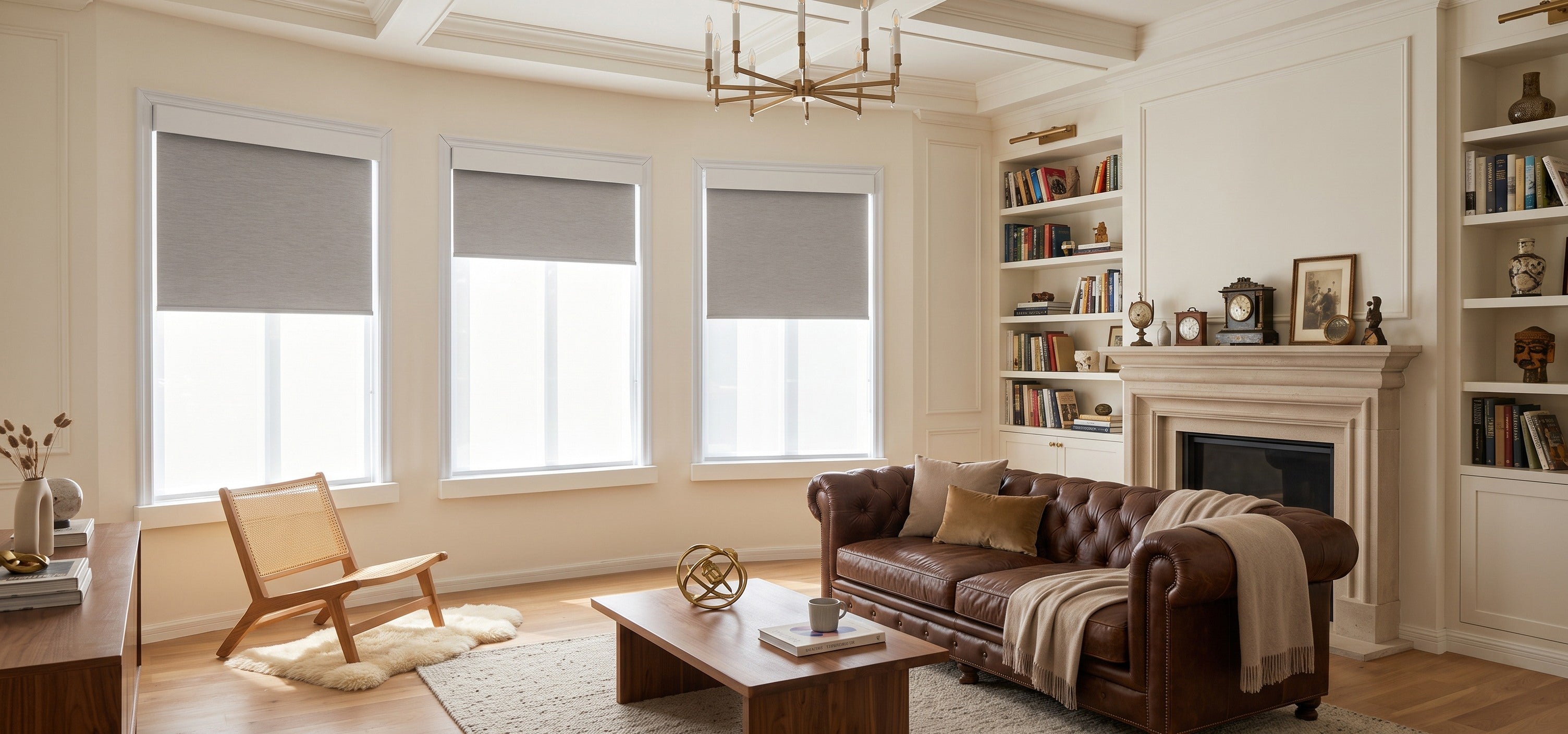

Most households run into two opposing needs at the same window. During the day you want to cut the direct sun without giving up natural light. At night you want to block the view in from outside and settle the room into real darkness.
A single fabric struggles to do both. A light filtering fabric protects the daylight but does nothing about the sightline after dark. A blackout fabric solves the night, then flattens the room the moment you lower it in the afternoon.
Motorized dual roller shades split those two jobs between two separate layers. Every dual roller shade from SmartWings is motorized, with a dedicated motor on each layer, so you can lower one or both. The sections below cover fabric pairings, room fit, and cost.

How the Two Layers Work
A dual roller shade is built from two independent roller fabrics mounted at the same window, one behind the other.
Front layer (room side): usually a light filtering or sheer fabric that softens direct sun while keeping the view and the daylight feel
Back layer (glass side): usually a blackout fabric, used for sleep, naps, and screen viewing
You choose which layer to lower based on the time of day. Lower the front layer alone and daylight still comes through with the glare taken out. Lower the back layer in the evening and the room dims quickly.
That is the core difference from a single roller shade: one window no longer forces a choice between light and darkness. SmartWings motorized dual roller shades allow both layers to be specified separately for fabric and color.

Dual Roller Shades vs Zebra Shades
The two names get used interchangeably across the industry, but they describe two different structures. Sorting this out before you order is what keeps you from buying the wrong product.
Dual Roller Shades |
Zebra Shades |
|
Structure |
Two complete fabrics, front and back, independent |
One fabric with alternating sheer and solid bands |
Adjustment |
Each layer raises and lowers on its own |
Move up or down to align or offset the bands |
Darkening |
Blackout back layer delivers a genuinely dark room |
Still passes light when bands align; not a bedroom darkening solution |
Depth required |
Needs more mounting depth |
Single layer, compact footprint |
Best suited to |
Primary bedrooms, media rooms, any space needing darkness |
Living rooms, studies, spaces that want a view out without a view in |
The decision is straightforward: choose dual roller shades when you need real darkness, and zebra shades when you only want to modulate daytime light. These are two separate collections at SmartWings, not two names for the same product.
For a side-by-side look at how the three main shade types compare on light control, insulation, and room fit, see the roller, cellular, and zebra shade comparison guide.

Are Motorized Dual Roller Shades Worth It
The answer comes down to whether the window's demands actually shift over the course of a day.
Worth installing when:
Daytime and nighttime needs at the same window pull in opposite directions: daylight during the day, darkness or privacy after dark
The home faces a street or sits close to a neighboring building: you need to block sightlines during the day without closing the window off entirely
The room is a primary bedroom, media room, or study: these spaces see the widest swing in light requirements
You would rather not stack several systems on one window: a dual roller shade handles both jobs in one opening, cleaner than a shade plus sheer plus curtain
Less necessary when:
The room has a single orientation and steady light all day: a single roller shade or cellular shade covers it
The space only needs darkening: storage rooms and some bathrooms are fine with one blackout roller shade
The window frame has shallow depth: the dual structure needs more mounting room, so confirm the opening first
Motorization matters more here than on a single shade. Two fabrics operated by hand quickly become a chore. Motorized, a single remote press or voice command lowers whichever layer you want, and a schedule can switch between them without any input.

How to Pair the Two Fabric Layers
Fabric pairing is the central decision on a dual roller shade. It sets both the quality of daylight and how dark the room gets at night.
Pairing by function:
Light filtering plus blackout: the most common combination, soft daylight and a dark room at night, well suited to primary bedrooms and media rooms
Sheer plus blackout: a more open daytime feel with more of the outside view retained, well suited to living rooms and bright spaces
Light filtering plus room darkening: lowers overall brightness without full darkness, well suited to guest bedrooms and studies
Pairing by color:
Light front layer with a dark back layer: visually light during the day, decisive once the back layer comes down, the lowest-risk combination
Two tones from the same color family: the transition reads naturally when both layers are down, well suited to rooms with a unified palette
Warm-toned sheers: warm white, oatmeal, and warm ivory linen-look fabrics are replacing the cool whites of recent years, giving incoming daylight a softer cast that sits more comfortably with current interior palettes
On the headrail: a cassette valance conceals both roller tubes behind a single face, reading as one clean line from the room. In primary spaces it looks considerably tidier than exposed twin tubes.
SmartWings sends fabric swatches by mail. Checking real color and texture under your own light is far more reliable than judging from a screen.
Which Rooms Suit Dual Roller Shades
|
Space |
Recommended |
Reason |
|
Primary bedroom |
Yes |
The widest gap between daytime light and nighttime darkness |
|
Street-facing living room |
Yes |
Sightline control by day, privacy after dark |
|
Media room |
Yes |
Frequent switching between everyday light and viewing darkness |
|
Study |
Yes |
Screen glare needs managing without running lights all day |
|
Nursery or kids' room |
Depends |
Makes sense where nap darkness matters; the cordless build is also safer |
|
Kitchen |
Usually not |
A single wipeable fabric is more practical |
|
Bathroom |
Usually not |
Privacy needs are constant all day, so one layer is enough |
Primary bedrooms are the clearest case. The light filtering front layer lets morning light arrive gently, and the blackout back layer comes down when you need to catch up on sleep or work around a shift schedule.
How dark the room actually gets also depends on mounting. An inside mount always leaves a gap between fabric and frame, while an outside mount covers more area with fewer side gaps. On SmartWings blackout roller shades the gap between headrail and fabric measures roughly 1 3/16 inch (3 cm), which is structural and common to roller shades generally. For the full reasoning on bedroom darkening, see the guide to choosing bedroom blackout shades.
Street-facing living rooms turn on one point: daytime and nighttime privacy work in reverse. During the day the outside is brighter than the room, so a light-colored filtering fabric blocks most sightlines. Once interior lights come on at night that flips, silhouettes become visible from outside, and the back layer needs to come down.
For how each room type maps to each shade type, see the room-by-room window treatment guide. For how mounting affects darkness and appearance, see the guide to choosing between inside and outside mount.

Controlling Each Layer Independently
Each layer carries its own motor, which means the control system treats them as two separate devices.
Remote control: a multi-channel remote can address either layer on its own, or assign the two layers to different buttons
Scheduling: you can have the light filtering layer lower on its own in the morning while the blackout layer stays up
Voice control: address a single layer through a compatible platform
Position control: either layer can stop at any point in between rather than fully open or fully closed
SmartWings motorized shades are compatible with Apple Home, Amazon Alexa, and Google Home, and also work with Home Assistant and Hubitat. Motors are available in Matter over Thread, Zigbee, and Z-Wave 800 versions, so you can match the protocol to the platform already running in your home.
Battery motors run roughly 4 to 6 months on a full charge depending on how often the shades cycle and how heavy the fabric is, and recharge by Type-C cable or solar panel.
What Motorized Dual Roller Shades Cost
Budget a dual roller shade as two fabrics on one window. That is the main difference from a single shade.
What moves the final price:
Grade of each fabric: blackout fabrics generally cost more than light filtering ones, and both are priced separately
Window size: width and height together drive fabric usage and the motor torque required
Motor and protocol: Matter over Thread, Zigbee, and Z-Wave 800 versions are priced differently
Power method: battery and hardwired builds have different cost structures
Headrail finish: cassette valance and bottom bar styles are appearance options
For reference, SmartWings blackout roller shades start at $159.99 for a single shade and run to $209.99 depending on fabric model. Dual configurations are priced according to the two fabrics selected, with a quote generated from your window type and specification.
To build a broader budget picture first, see the full breakdown of motorized shade pricing.
Sizing Dual Roller Shades for Wide Windows
Width is worth confirming early on a dual roller shade. The wider the fabric, the more its own weight and drape affect how flat it hangs, and two layers compound that effect.
Two ways to handle a wide window:
One continuous panel: no center seam, visually uninterrupted, but more demanding on fabric performance and motor torque
Multiple panels side by side: two or more panels, each controlled independently, steadier on very wide openings
If the window already has a center mullion, splitting into panels tends to look more natural anyway. For windows beyond standard dimensions, send your measurements and a photo of the opening to SmartWings customer service and have them confirm the maximum workable single-panel width and the panel-split option for your specific window. That is more dependable than estimating.
For motor, power, and fabric considerations on extra-wide windows, see the guide to wide motorized roller shades.
FAQ About Motorized Dual Roller Shades
Q1. What is the difference between dual roller shades and zebra shades?
A dual roller shade uses two separate fabrics mounted front and back, each raising and lowering on its own. A zebra shade uses one fabric with alternating sheer and solid bands. Dual roller shades suit rooms that need genuine darkness, while zebra shades work better where the goal is adjusting daytime light. At SmartWings these are two distinct collections.
Q2. Do dual roller shades block all light at night?
The blackout back layer itself does not pass light, though how dark the room becomes also depends on mounting. An outside mount covers more area with fewer side gaps and performs better where darkness matters.
Q3. Can the two layers be controlled separately?
Yes. Each layer carries its own motor and registers as a separate device, so both can be raised, lowered, and scheduled independently. Most households lower the light filtering layer during the day and add the blackout layer at night.
Q4. Are dual roller shades cheaper than installing two separate window treatments?
A dual roller shade handles both jobs within one opening and needs no additional curtain track or rod. On price, budget for two fabrics rather than comparing against a single shade. The motorized shade pricing guide sets out what drives the final figure.
Q5. Do dual roller shades work with Apple Home, Alexa, and Google Home?
Yes, and they also work with Home Assistant and Hubitat. Motors come in Matter over Thread, Zigbee, and Z-Wave 800 versions, so the protocol can be matched to the platform already running in your home.
Q6. How wide can dual roller shades be made?
Workable width depends on fabric weight, motor torque, and mounting conditions. Wide openings usually come down to one continuous panel or several panels side by side, and sending measurements to SmartWings is the most reliable way to confirm which suits your window.
Q7. Are dual roller shades a good choice for kitchens and bathrooms?
Usually not. Kitchens mainly need a fabric that wipes clean, and bathroom privacy stays constant through the day, so a single roller or zebra shade is the more practical fit. Dual roller shades earn their place where light requirements shift across the day.


