
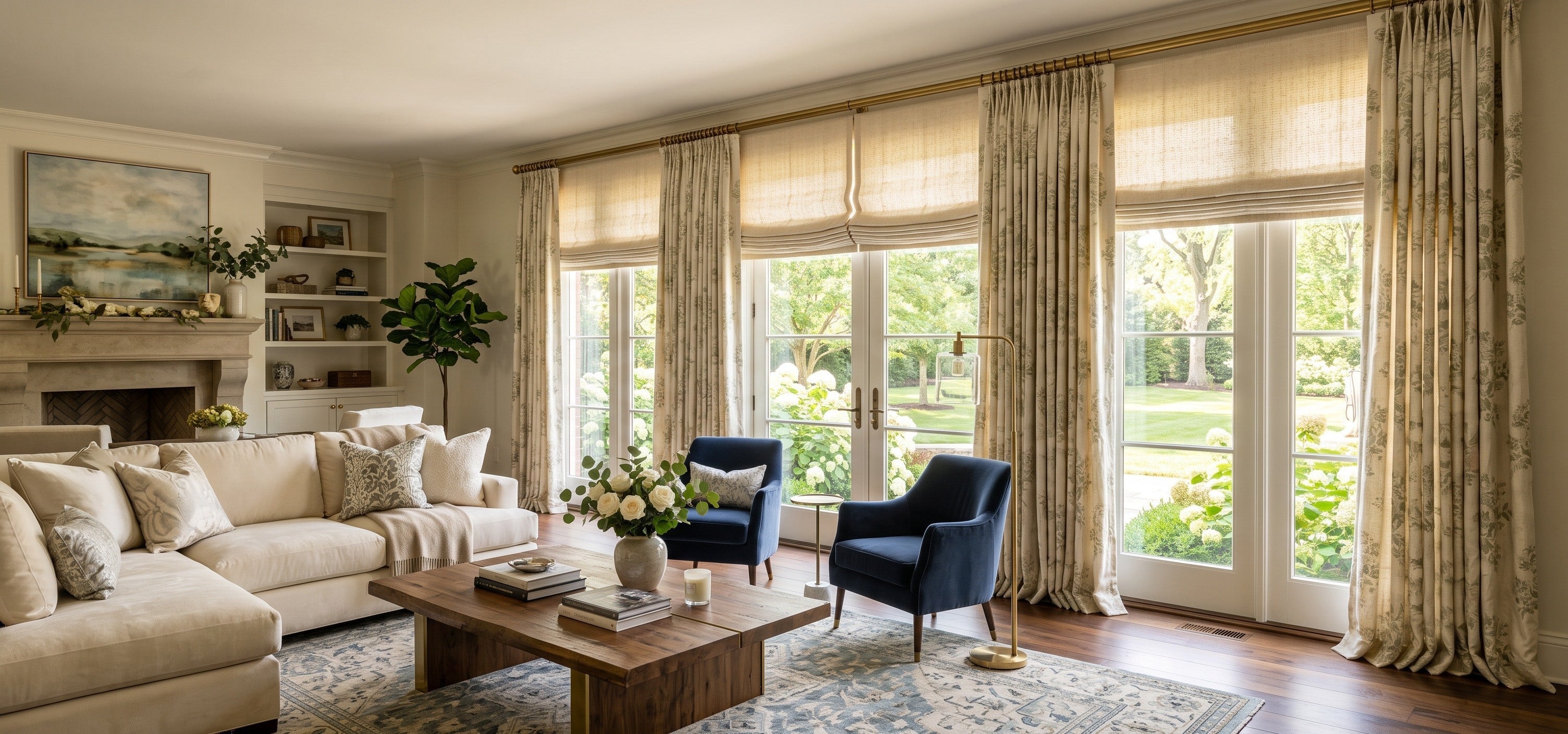

Searching for smart curtains turns up two categories of product. One is a retrofit motor that clips onto the curtain rod you already have. The other is a complete system where fabric, motor, and hardware are measured and made together, which is the category SmartWings works in.
The names sit close to each other, but the two differ in budget, installation, reliability, and how far automation can be taken. Choosing the wrong one rarely costs extra money. It usually means discovering after installation that the product cannot do the thing you bought it for.
The first step is therefore not comparing prices but identifying which situation you are in. The sections below set out what a smart curtain system consists of, then match each category to the households and window types it suits.

What a Smart Curtain System Consists Of
Whichever category you choose, a functioning smart curtain system is built from the same parts:
Motor: drives the opening and closing action, and determines how smoothly the system runs, how much torque is available, and how heavy a fabric it can handle
Power method: battery, hardwired, or PoE, which determines how much routine maintenance the system needs
Communication protocol: Matter over Thread, Zigbee, Z-Wave, and others, which determines the platforms the system can join
Fabric or shade body: a retrofit uses your existing curtains, while a complete system includes fabric made to your specification
Control methods: remote, voice, scheduling, and platform automation
The central difference between the two categories is whether the fabric and the motor are designed as one unit. That single point carries through to everything else, including precise positioning, how visible the hardware is, and which window shapes can be covered.

How Retrofit Motors and Complete Systems Differ
|
Retrofit curtain motor |
Complete motorized shade |
|
|
Installation |
Clips or mounts onto an existing rod or track |
Fabric, motor, and brackets measured and made to order |
|
Existing curtains |
Kept |
Replaced |
|
Motor and fabric match |
Universal component; you confirm it can drive the load |
Torque specified to fabric weight and size |
|
Appearance |
Motor sits exposed on the rod |
Motor housed inside the headrail or cassette |
|
Window types covered |
Standard windows with straight tracks |
Standard windows plus specialty shapes and wide spans |
|
Automation ceiling |
Open and close, with partial support for intermediate positions |
Precise positioning, layered control, scheduled automation |
|
Service life |
Shorter, as a removable device |
Matches the life of the window treatment |
Put simply: a retrofit makes existing curtains move on their own, while a complete system rebuilds the window from light control through to automation.

When a Retrofit Motor Makes Sense
Retrofits are the more sensible choice under certain conditions and do not deserve blanket dismissal.
A retrofit suits you when:
You rent and cannot drill into walls or window frames: retrofits detach and can move with you
Your existing curtains already work and you only want automatic opening: no need to reselect fabric and color
Your budget is limited and you want to test whether automation earns its place: the outlay is small and removal is straightforward
You only need open and closed: precise positioning and layered control are not requirements
A retrofit falls short when:
The fabric is heavy or the window spans wide: a universal motor may not supply enough torque, and long-term use tends to produce hesitation and stalling
You need the shade to stop at a specific height: retrofits are generally inconsistent here
The window is an irregular shape: arched, trapezoid, and skylight openings offer no standard straight track to clip onto
You want the hardware out of sight: a retrofit sits exposed on the rod and is difficult to conceal
If your requirements cluster in the second group, a retrofit stands a good chance of being replaced within a few months. Going straight to a complete system usually costs less overall in that case.

Matching a System to Your Smart Home Platform
Platform compatibility is where buyers most often misjudge this category. Plenty of products carry a "works with Alexa" or "HomeKit compatible" label, but the integration method and day-to-day reliability behind those labels vary considerably.
Apple Home: requires a Thread Border Router such as a HomePod mini or Apple TV 4K. SmartWings Matter over Thread motors join that environment without any brand-specific gateway.
Amazon Alexa and Google Home: also connect through Matter over Thread and also require a Thread Border Router to be present.
Home Assistant: users who prefer local control generally choose the Zigbee or Z-Wave version for a more direct integration path. SmartWings was the first brand in the category to release a Z-Wave 800 chip, which extends signal distance compared with earlier generations. Actual range still depends on your home layout, wall construction, and the other devices sharing the network.
Hubitat and Homey: the Zigbee and Z-Wave versions apply here as well, following much the same selection logic as Home Assistant.
One question is worth settling before you order: if you change platforms later, will these shades still work? If that matters to you, the Matter over Thread version is the safer choice. For how the platforms differ on setup, see the smart shade platform selection guide. If you are building on Home Assistant, see the local control configuration guide.
For the wider set of criteria worth checking at the brand level, see the guide to evaluating smart curtain brands.

Do Smart Curtains Need a Hub
The answer depends on the protocol rather than the brand.
Matter over Thread: requires a Thread Border Router in the home, such as a HomePod mini or Apple TV 4K
Matter over Ethernet (PoE): carries power and data over a single network cable into a switch. This removes the need for a Thread Border Router, since the shade communicates over the wired network rather than Thread, though a Matter controller is still required to bring it onto a smart home platform
Zigbee: requires a Zigbee coordinator or hub
Z-Wave: requires a Z-Wave hub of the matching generation, and the range advantage of Z-Wave 800 depends on the hub supporting 800 as well
One point deserves stating plainly: no platform connects directly. Every route needs a controlling device of some kind, and the protocol only changes which kind. Matter over Thread needs a Thread Border Router, Matter over Ethernet needs a Matter controller, and Zigbee and Z-Wave need their own hubs. Confirming this in advance avoids discovering after the order that a necessary piece of equipment is missing.
For what the protocol solves in a window covering context, see the plain-English guide to Matter for smart shades.
Battery, Hardwired, and PoE Power
The power method determines how much routine attention the system needs.
Battery: the simplest to install, with no wiring to run in advance. A full charge lasts roughly 4 to 6 months depending on how often the shades cycle and how heavy the fabric is, and recharges by Type-C cable or solar panel
Hardwired (DC/AC): runs consistently with nothing to recharge, well suited to renovation projects and to windows mounted too high to reach easily
PoE: a single network cable carries both power and data into a PoE switch for centralized management. SmartWings was the first brand worldwide to bring PoE power together with Matter over Ethernet in window coverings
PoE currently applies to roller shades and zebra shades. If the home is under renovation or already has network points in place, this route carries the lowest long-term maintenance burden. For wiring requirements and coverage, see the complete guide to PoE motorized shades.
Windows a Retrofit Cannot Cover
Several window types are structurally unsuited to a retrofit because they offer no standard straight track to clip onto.
Arched windows: a semicircular or curved head requires a custom curved track
Trapezoid and slanted windows: set into a pitched roofline, with tracks made to the angle
Skylights: mounted high and hard to reach, which makes remote or scheduled operation far more practical than any manual approach
Extra-wide windows: fabric weight and drape scale with width, and universal motors frequently lack the torque
Many brands decline these openings outright. SmartWings offers a complete specialty window program covering measurement method, custom track fabrication, and motor torque matching. For measuring points and workable approaches, see the guide to specialty-shaped window treatments.
If your home includes windows like these, plan the whole house as one system at the selection stage rather than sourcing standard windows from one supplier and specialty shapes from another.
What Each Route Costs
Retrofit motors: low unit price, but multiplied across every window, and possibly a hub on top. Because the existing fabric stays, light control and insulation performance stay exactly as they are.
Complete motorized shades: measured and made per window, with fabric, motor, and hardware included in the price. SmartWings roller shades start at $159.99, cellular shades at $179, and zebra shades at $189.99, with the final figure set by size, fabric, and motor protocol.
One factor gets overlooked in these comparisons: a retrofit quote contains no fabric. If your current curtains fall short on light control or are approaching replacement anyway, that spending arrives eventually, and the real gap between the two routes narrows accordingly.
For the full cost structure, see the breakdown of motorized shade pricing
FAQ About Smart Curtain Systems
Q1. Do smart curtains need a hub?
It depends on the protocol. Matter over Thread requires a Thread Border Router, Zigbee and Z-Wave require their respective hubs, and PoE connects over a network cable to a switch, which removes the Thread Border Router but not the need for a Matter controller. Every route relies on a controlling device of some kind, so confirm what you already own before ordering.
Q2. Do smart curtains work with Apple Home, Alexa, and Google Home?
Yes, and they also work with Home Assistant and Hubitat. SmartWings motors are available in Matter over Thread, Zigbee, and Z-Wave 800 versions, so the protocol can be matched to the platform already running in your home. The platform selection guide covers how each one differs on setup.
Q3. Are retrofit motors as reliable as a complete motorized shade?
For lighter fabrics, standard sizes, and situations where open and closed are the only states you need, a retrofit handles everyday use. Where the fabric is heavy, the window spans wide, or precise positioning matters, a complete system with torque specified to the shade performs more consistently.
Q4. Do smart curtains work with Home Assistant?
Yes. Users who prefer local control generally choose the Zigbee or Z-Wave version for a more direct integration path. SmartWings was the first brand in the category to release a Z-Wave 800 chip, which extends signal distance over earlier generations, though actual coverage still depends on home layout and wall construction. The local control guide sets out the configuration.
Q5. How long does the battery version last?
Roughly 4 to 6 months on a full charge, depending on how often the shades cycle and how heavy the fabric is, with recharging by Type-C cable or solar panel. For anyone who would rather not recharge periodically, the hardwired or PoE version is the better fit.
Q6. Can smart curtains open and close at sunrise and sunset?
Yes. Once a time or a sunrise and sunset trigger is set through a compatible platform, the shades follow that schedule without any manual input. Each window can carry its own timing, so a bedroom can open later than a living room.
Q7. Can any window be retrofitted?
No. Arched windows, trapezoid windows, skylights, and extra-wide openings generally offer no standard straight track to clip onto, which leaves retrofits difficult to fit. These need tracks and motors made to the angle and dimensions involved, and the specialty-shaped window guide covers what is possible.


