
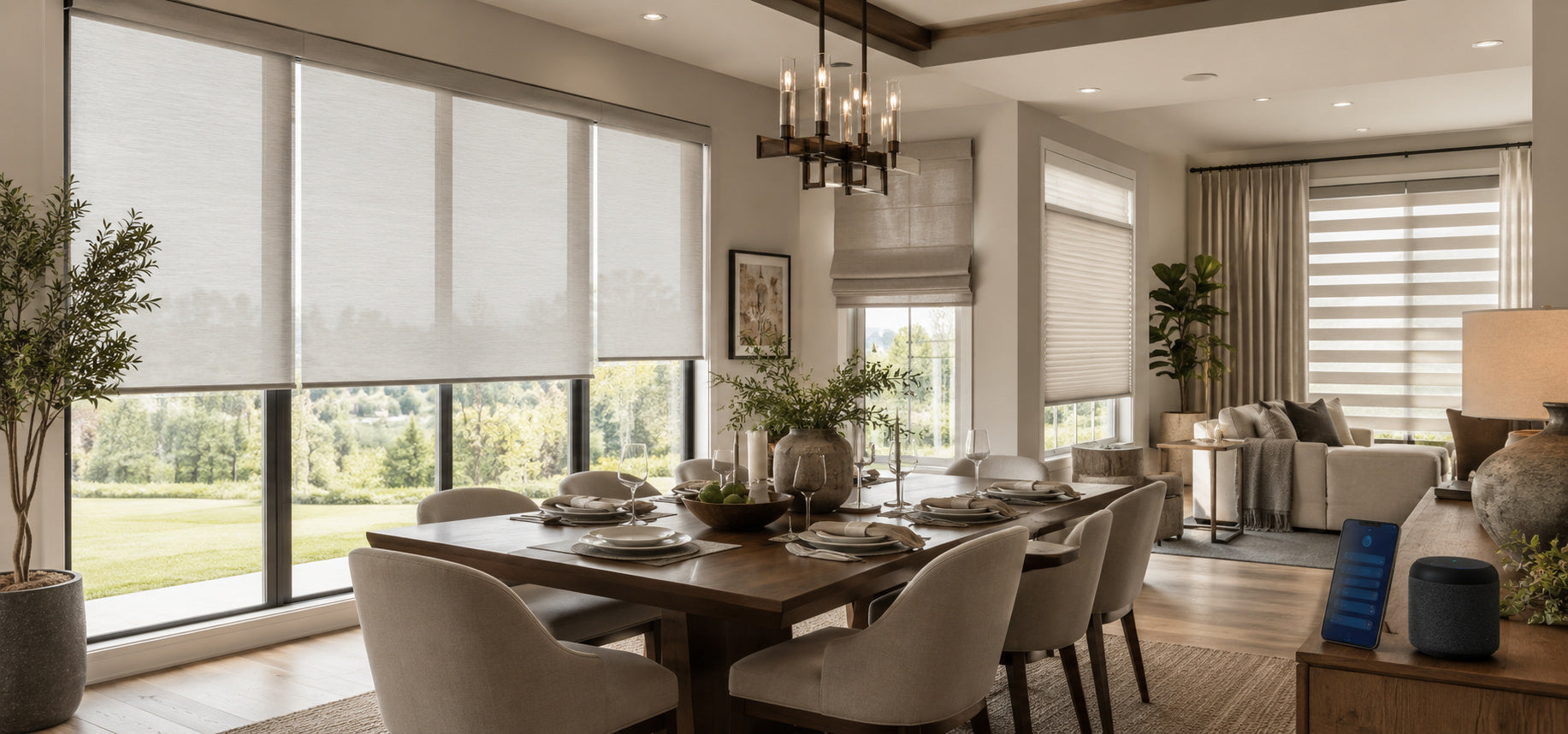

Motorized window treatments come in more variety than most people expect — six main product styles, three power options, and several smart integration protocols. The combinations add up quickly, so how do you narrow down what fits your home?
This guide breaks it down by three core dimensions: product styles, power options, and smart integration — covering the full landscape of motorized window treatments.

1. By Style: 6 Main Product Categories
Motorized window treatments split into 6 main product types by style, each with different visual effects and ideal use cases. Roller and Cellular are the broadest and most commonly used categories, so they're covered in more depth first.
1. Roller Shades — The Most Versatile Category
A single fabric panel rolls onto a top headrail — the simplest structure, the most direct operation, the easiest maintenance. Roller is the broadest category in motorized window treatments.
By fabric, it splits into three directions:
Blackout Roller — full light blocking, suited to bedrooms, media rooms, home theaters
Light Filtering Roller — preserves natural light while softening glare, suited to living rooms, home offices, studies
Sunscreen Roller — UV protection while preserving the view, suited to settings that need glare control without losing visibility
Roller sits at the entry price point among SmartWings' main lines — Blackout Roller Shades start at $159.99 (Vinyl model), with 7 fabric options covering most household scenarios. For a detailed breakdown, see the 12 types of roller blinds guide.

2. Cellular Shades — The Core Category for Insulation
The fabric folds into hexagonal honeycomb cells, with trapped air inside providing structural insulation — this is what sets Cellular apart from other categories, and the reason it's frequently recommended for west-facing windows and insulation-focused rooms.
By structure, it splits into:
Single Cell — single-layer honeycomb, for standard insulation needs
Double Cell — double-layer honeycomb, with stronger insulation performance
Blackout Cellular Shades start at $179. SmartWings also offers cellular for specialty shapes — Trapezoid, Arched, Skylight — covering windows beyond the standard rectangular format. For details, see the honeycomb blackout buying guide.

3. Zebra Shades
Alternating sheer and solid stripes — light passes through when offset and blocks more when aligned.
The defining feature is flexible daytime light control, well-suited to living rooms and home offices. The structure includes transparent stripes, so it cannot reach blackout-level darkness.
4. Woven Wood Shades
Natural bamboo, reed, or rattan materials with organic texture, suited to spaces leaning toward natural, bohemian, or Japanese-inspired styles.
5. Outdoor Shades
Fabrics treated for UV resistance and weather durability, built to handle sun and rain. Suited to patios, balconies, porches. For details, see the outdoor patio shades buying guide.
6. Drapery & Curtain
The traditional fabric drape format, with motorized open/close replacing manual pulling. The softest visual presence, suited to living rooms, dining rooms, and bedrooms. For details, see the smart curtain brands comparison guide.
2. By Power: 3 Power Source Options
Power source affects installation difficulty, long-term operating stability, and maintenance frequency — an often-overlooked but practically important factor.
1. Battery-Powered
The most common option — rechargeable lithium-ion batteries built into the headrail. The easiest to install with no wiring required, making it the go-to for retrofit installations in finished homes.
SmartWings battery models typically run on a 4–6 month charge cycle with 6–10 hours per full charge, depending on usage frequency and window size. Best suited to mid- and small-sized windows, rental properties, and homes where renovation is already complete.
2. Hardwired
The motor connects directly to the home's electrical system, with wiring completed by a licensed electrician at a junction box.
Stable power delivery, no recharging required — best suited to large windows, high-frequency daily use, and new construction or renovation phases where wiring can be pre-planned.
SmartWings Hardwired Shades cover roller, cellular, and several other categories. For oversized windows, floor-to-ceiling glass, or large dining room windows, hardwired is the more reliable choice.

3. PoE Matter over Ethernet — SmartWings' Industry First
A single Ethernet cable delivers both power and data through a PoE switch, with built-in lithium-ion battery backup. SmartWings is the world's first brand to release PoE Matter motors — one of the brand's core differentiators.
PoE Matter applies to roller shades, 45 cellular (Nowa & Helios), zebra, woven wood, dual shades (base model), and Roman shades. For details, see the PoE Matter over Ethernet introduction.
3. By Smart Integration: Main Protocols and Platforms
The core of smart integration is the protocol — picking the right protocol determines platform compatibility and future expansion options.
1. Matter over Thread
A cross-platform universal protocol and the main direction of today's smart home industry. SmartWings standard Matter motors cover the main platforms — Apple HomeKit, Amazon Alexa, Google Assistant, Samsung SmartThings, and Homey.
Worth noting: platform support varies slightly across product lines. The Matter motors for some specialty lines (Levitate, Day & Night) currently don't support Samsung SmartThings or Homey — confirm specific models with customer service before ordering.
Also, Apple Home integration requires a Thread Border Router such as HomePod mini or Apple TV 4K. For details, see the Matter over Thread introduction.
2. Z-Wave 800 LR — SmartWings' First-to-Market Release
Z-Wave 800 is the latest generation Z-Wave standard, with longer range and lower power draw. SmartWings is the first brand to release Z-Wave 800 LR motors, mainly targeting users on open ecosystems like Home Assistant and Hubitat. For details, see the Z-Wave 800 LR introduction.
3. Zigbee
A mature mesh protocol requiring a Zigbee Hub for integration.
4. Platform Compatibility Overview
SmartWings motorized shades are compatible with Apple Home, Google Home, Alexa, SmartThings, Home Assistant, Hubitat, and Homey. For platform-specific setup details:
How to Choose Based on Your Situation
With three dimensions in play, the combinations get many — working through them in the order below makes the decision more direct.
1. Start with Style — Based on Room Needs
Bedrooms and theaters lean toward Blackout Roller or Blackout Cellular. Living rooms and home offices lean toward Zebra or Light Filtering Roller. Outdoor balconies use Outdoor Shades. Social spaces lean toward Drapery.
2. Then Choose Power — Based on Renovation Phase
For new construction or major renovations, prioritize Hardwired or PoE Matter for long-term stability. For finished homes adding shades after the fact, Battery is the most convenient option.
3. Finally Pick Smart Integration — Based on Your Smart Home Ecosystem
If you already use Apple Home, Google Home, or Alexa, prioritize Matter motors. For open ecosystems like Home Assistant or Hubitat, Z-Wave 800 LR is worth considering.
For broader buying logic, see the motorized window blinds smart home guide and the motorized window shade features guide.
FAQ About Motorized Window Treatment Types
Q1: What are the main types of motorized window treatments?
By style, there are 6 categories: roller, cellular, zebra, woven wood, outdoor, drapery. By power, three options: battery, hardwired, PoE Matter. By smart integration, protocols include Matter, Z-Wave, and Zigbee.
Q2: For new construction, battery or hardwired?
Hardwired or PoE Matter is the better fit for new construction — more stable long-term, no recharging needed. Battery is more suitable for finished homes adding shades afterward.
Q3: What makes SmartWings PoE Matter special?
SmartWings is the world's first brand to release PoE Matter over Ethernet motors — a single Ethernet cable handles both power and data, with built-in lithium-ion battery backup. Best suited to homes that can plan wiring during renovation.
Q4: Can motorized shades connect to multiple smart home platforms?
SmartWings Matter motors cover Apple HomeKit, Alexa, Google Assistant, SmartThings, and Homey. Platform support varies slightly by product line — confirm specific models with customer service before ordering.
Q5: Which SmartWings motor should Apple Home users choose?
For Apple Home, choose Matter over Thread motors paired with a HomePod mini or Apple TV 4K as the Thread Border Router.
Q6: Do SmartWings' main product lines all support custom sizing?
Main product lines support custom sizing, and specialty windows — arched, trapezoidal, stairwell — are one of SmartWings' differentiated capabilities. For dimensions exceeding the standard ranges listed online, customer service can provide a custom quote.


