
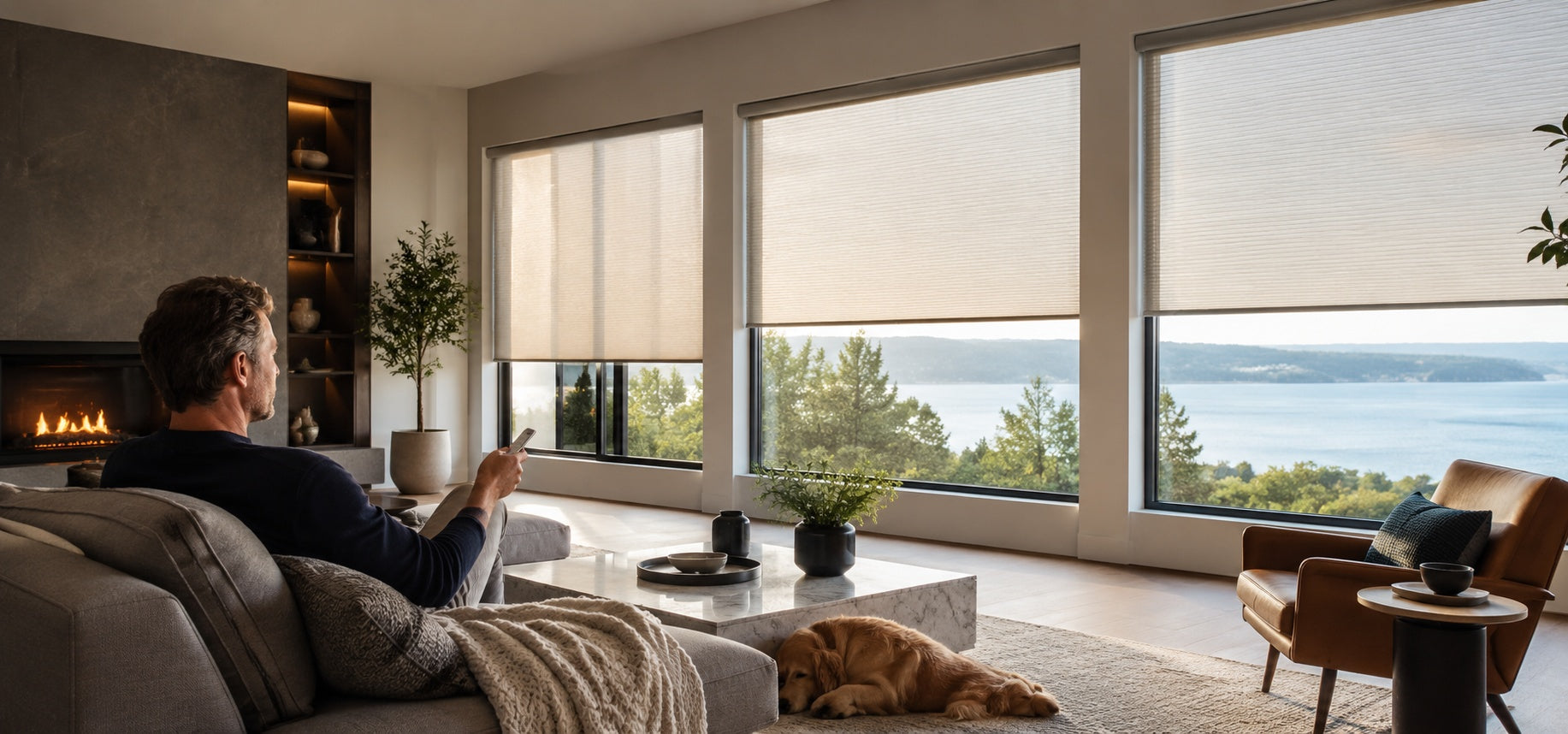

You have probably been there — lying in bed at night realizing the living room blinds are still open, rushing out the door in the morning with the shades untouched, or noticing your blinds are crooked only when guests arrive.
None of these are big problems on their own, but when they happen every day, they add up to a quiet frustration you just live with.
Does switching from manual to motorized actually make these small frictions go away?
Here is what SmartWings customers and tech reviewers mention most about the real changes after making the upgrade.

Everyday Convenience: Remote, Voice, and Scheduled Control
The most immediate change after switching to motorized blinds is how you interact with them.
Traditional blinds require walking to each window, pulling a cord or twisting a rod. Motorized blinds respond to a remote press, a voice command, or a pre-set schedule.
This sounds like a small upgrade until you live with it.
Tech With Brett noted after installing SmartWings roller shades: "I love how easy it is to get these installed, and I love how they look. The quality is really nice."
The convenience gap widens in homes with multiple windows or hard-to-reach spots — high ceilings, skylights, windows behind furniture. In these cases, manual adjustment is not just inconvenient, it often does not happen at all.
The blinds stay in one position because reaching them is a hassle.
SmartWings shades support voice control through Apple Home, Alexa, and Google Home, and also work with a remote control.
Automation That Runs Without You
Traditional blinds depend on your memory and your presence. Forget to close them before bed — you wake up to streetlight glare.
Forget to open them in the morning — the room stays dark until you get around to it.
Motorized blinds with scheduling take this off your plate. Set a time, and the blinds open or close on their own — every day, whether you are home or not.
This also has a security benefit. When you are away on vacation, scheduled blinds simulate normal activity patterns.
Traditional blinds stay in whatever position you left them, which can signal an empty home.
SmartWings supports timer and schedule controls across its product line.
For more on automation features, see the Motorized Window Shade Features Guide.

Child and Pet Safety: No Cords, No Risk
This is not a convenience upgrade — it is a safety one. Traditional blinds with cords pose a documented strangulation risk for young children. It is one of the most recognized home safety hazards in the U.S.
Motorized blinds eliminate cords from the equation.
SmartWings uses a cordless design across its product line — operation happens through the motor, remote, or smart platform. For families with young children or pets, this is often the deciding factor.
Cleaner Look, Less Wear
Without dangling cords, chains, or pull mechanisms, motorized blinds have a visually cleaner profile. The shade fabric sits flat against the window frame with minimal hardware visible.
Apartment Therapy described SmartWings shades as "so functional and aligned with the aesthetic I'm trying to achieve in my bedroom too." Customer Veronica L. added: "My bedroom looks like a magazine! The fabrics are beautiful, luxurious looking and quality feeling."
There is also a durability angle. Manual blinds experience wear from daily pulling and tugging — cords fray, mechanisms jam, fabric gets unevenly stressed.
Motorized operation distributes force more evenly, which can extend the product's usable life.
Energy Efficiency Through Consistent Use
Cellular shades with honeycomb structures can help reduce heat transfer at the window. But this only works if the blinds are actually in the right position at the right time — closed during peak sun, open when passive solar gain is welcome.
With traditional blinds, this depends on you adjusting them throughout the day. With motorized blinds, scheduling handles it automatically.
SmartWings cellular shades (starting at $179) feature a honeycomb structure.
Paired with scheduled automation, the shades can be positioned to help manage heat gain and loss without manual intervention.
For more on energy efficiency, see the Energy Efficient Motorized Shades Guide.

Accessibility for Every Household Member
For people with limited mobility, traditional blinds can be genuinely difficult to operate — pulling cords, reaching high windows, or applying enough force to move heavy shades.
Motorized blinds make window coverings accessible to everyone in the household, regardless of physical ability.
A remote or voice command replaces physical effort entirely.
This benefit is often overlooked in product marketing, but for households with elderly family members or anyone with mobility challenges, it can be the most meaningful upgrade of all.
What to Consider Before Switching
Motorized blinds are not the right fit for every window or every budget. A few things worth thinking through:
Cost. Motorized shades cost more than manual equivalents. SmartWings blackout roller shades start at $159.99, cellular shades at $179. AuthenTech (Ben Schmanke) called SmartWings "super budget friendly smart shades for your entire house" — but it is still a higher upfront investment than basic manual blinds.
Power. Battery-powered models (USB-C charging) are the simplest to install. Hardwired (DC 12V) and PoE options suit new construction or commercial projects.
Start small. You do not have to motorize every window at once. Many homeowners begin with one or two high-use windows — a bedroom or living room — and expand from there.
For a full product comparison, see the 2026 Smart Blinds Practical Buying Guide.

Find the Right SmartWings Solution for Your Home
Whether you are looking for blackout shades for a bedroom, light filtering options for a living room, or a full smart home setup across multiple windows, SmartWings has a range of motorized shades to fit different rooms and budgets.
Browse the full collection and find the option that works for your space at smartwingshome.com.
FAQ About Benefits of Motorized Blinds
Q1: What is the biggest everyday change after switching to motorized blinds?
Not having to walk to the window to adjust — a remote press or voice command handles it. This is the change SmartWings customers mention most often in their reviews.
Q2: What SmartWings motorized shade options are available?
SmartWings offers several series to match different needs: blackout roller shades (from $159.99) or cellular shades (from $179) for bedroom darkness, zebra shades or light filtering roller shades for living room daylight, woven wood shades for a natural texture, outdoor shades for patios, and motorized drapery for added decorative layering
Q3: Are motorized blinds safer for homes with kids?
SmartWings uses a cordless design, removing the cord-related hazards associated with traditional manual blinds. For families with young children or pets, this is one of the key reasons for choosing motorized.
Q4: Which room is best to start with when trying motorized blinds?
A bedroom or living room main window is a good starting point — these are the rooms you use most and where you will feel the convenience difference right away. Many homeowners expand to other rooms after experiencing it firsthand.
Q5: What smart home platforms does SmartWings work with?
Compatible with Apple Home, Alexa, Google Home, SmartThings, Home Assistant, Hubitat, and Homey. Setup guides are available for Apple Home, Alexa, and Google Home.


