
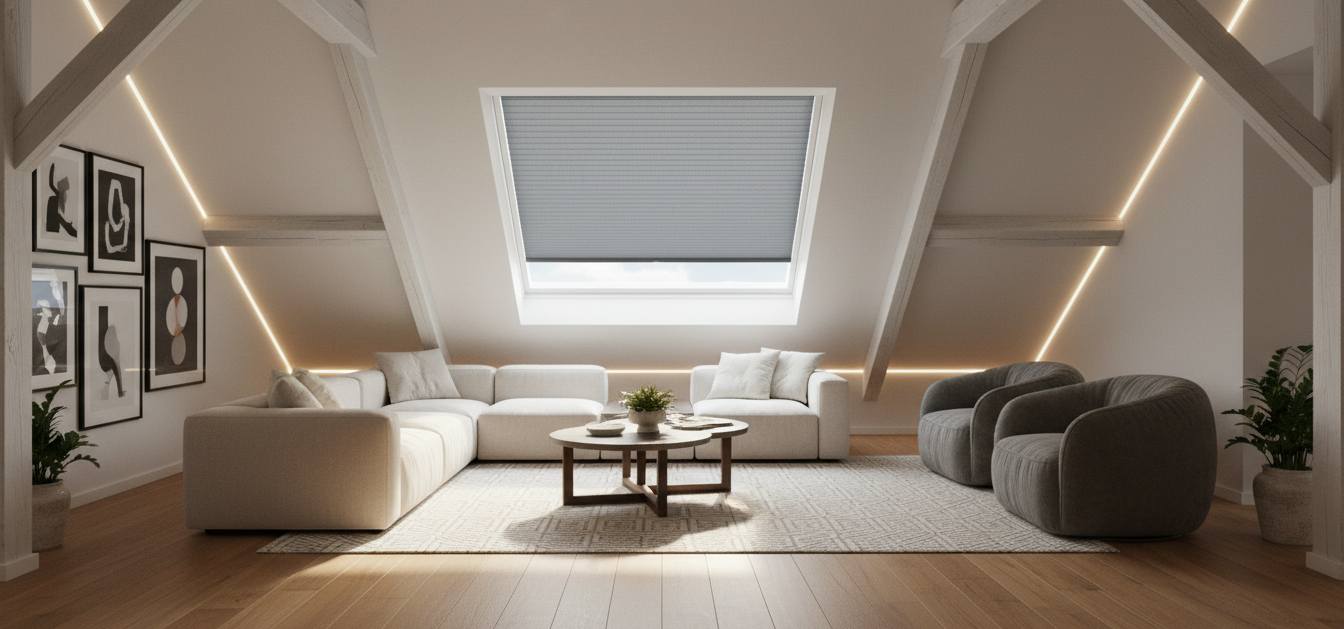

Many homeowners install skylights to bring in more natural light, but skylights sit high on the ceiling at tilted or horizontal angles, making everyday light adjustment inconvenient — manual operation usually requires a ladder.
Over time, issues like summer overheating, UV damage to furniture, and harsh overhead glare tend to build up.
SmartWings Skylight Shades address these challenges with motorized control and smart automation, so skylight light management is no longer limited by height or position.

The Unique Challenges of Skylight Shading
Standard windows are relatively simple to shade, but skylights present a few additional challenges due to their position and angle.
Manual adjustment isn't practical
Skylights are mounted on the roof or high walls — you can't reach them from the floor, and every adjustment means pulling out a ladder.
Most households end up leaving skylight shades either fully open or fully closed after installation, which defeats the purpose of having adjustable coverings in the first place.
Overhead sunlight delivers more concentrated heat
Unlike side windows, where sunlight enters at an angle, skylights let the sun beam straight down.
The heat transfer is more direct and more intense — during summer midday, the area beneath a skylight runs noticeably warmer than the rest of the room, putting extra strain on the air conditioning.
UV exposure accelerates furniture aging
Overhead UV rays are stronger than what comes through side windows, and prolonged exposure gradually fades flooring, furniture, and artwork. Without a shade on the skylight, this kind of damage is difficult to mitigate.
Overhead glare disrupts daily activities.
Working, reading, or looking at a screen beneath a skylight means dealing with harsh light from directly above — a type of glare that's harder to avoid than light from a side window, since adjusting your seating position or closing a nearby curtain won't help.

Motorized Shading: A Better Way to Manage Skylight Light
For the skylight challenges described above, motorized shading provides a practical set of solutions.
Remote and voice commands replace the ladder.
You can control the skylight shade's position from the floor — remote control, voice commands, and smart home platforms all work.
SmartWings skylight cellular shades are compatible with Apple Home (requires a HomePod mini or Apple TV 4K as a Thread Border Router), Alexa, and Google Home, making daily adjustments effortless.
For detailed Apple Home configuration with SmartWings, see our Apple Home Smart Shades Setup Guide.
Automation takes care of daily routines.
With Schedule settings, skylight shades can open automatically at dawn, close at midday, and adjust again at sunset. SmartWings automation tracks sunrise and sunset times, adapting automatically throughout the year with no need for manual changes.
This "set it and forget it" experience reflects what SmartWings has always aimed for with smart automation.
For more smart automation tips, see our Google Home Smart Blinds: 5 Key Factors and Alexa Voice Control Guide.
Honeycomb structure helps with insulation.
The cellular air pockets inside the shade create an insulating barrier between the skylight glass and your interior, helping reduce heat transfer through the skylight.
Since skylights sit on the roof where heat transfer is more direct than through side windows, the honeycomb structure's insulation is especially useful in this position.
No cords — safer and cleaner.
Motorized control means no dangling pull cords or chains around the skylight area. For households with children or pets, this eliminates the safety concern of high-mounted cords. The skylight area stays clean with just the shade and aluminum frame visible.

SmartWings Skylight Shades: Three Options for Different Needs
When developing the Skylight Shades series, SmartWings designed it around the specific demands of skylight installations — high mounting positions, multiple angle compatibility, and edge light sealing. Three models cover different levels of need.
Hazel Skylight — Single-Layer Cellular Shade (from $399)
Single-layer honeycomb construction that balances insulation and light filtering.
The four-sided aluminum frame sits flush against the window frame, sealing edges to reduce light leakage — a design specifically addressing the common problem of light seeping around skylight shade edges.
For homeowners whose main priorities are basic shading and insulation, the Hazel offers solid value as the entry point in SmartWings' skylight lineup.
Levitate Skylight — Double-Layer Cellular Shade (from $509)
Double-layer honeycomb construction delivers stronger insulation performance. The dual air pocket layers block heat transfer more effectively than a single layer, helping reduce temperature fluctuations around the skylight.
If your area experiences significant summer heat or winter cold, the Levitate provides added peace of mind on the insulation front.
Day/Night Skylight — Dual Independent Control (from $559)
The upper layer uses light-filtering fabric, the lower layer uses blackout fabric, and both operate independently. During the day, use the light filtering layer for soft natural light; at night, switch to the blackout layer to block light.
One shade system covers your skylight's lighting needs throughout the entire day — this is the most comprehensive option in SmartWings' skylight series, suited for users who want full control over their skylight lighting.
Core design features shared across all three models:
Four-sided aluminum frame sealing to reduce edge light leakage. Three installation angles — vertical windows, sloped skylights, and horizontal skylights. Motorized control compatible with remote and smart home platforms. Custom sizing to fit various skylight dimensions.

Seasonal Smart Control: Getting the Most Out of Your Skylight Shades
Choosing the right product is one part of the equation — getting the most out of it matters just as much. SmartWings skylight shades paired with smart automation can follow different control strategies based on season and personal routines.
Summer: close before sunrise, open in the evening.
Schedule settings let the skylight shade close automatically before the sun reaches the skylight angle, blocking overhead heat all day. Once temperatures drop in the evening, the shade opens again to let cooler natural light back in.
SmartWings supports automatic sunrise/sunset tracking that adjusts with the seasons — no need to manually update the timing each month.
Winter: open during the day, close before sunset.
Winter sunlight is free heating. Let sunlight warm the interior through the skylight during the day, then close the shade before sunset to retain the accumulated warmth — the honeycomb insulation layer helps reduce heat loss overnight.
The winter strategy is the reverse of summer, but both only need to be set up once.
Favorite Positions: one tap to your preferred setting.
SmartWings' Favorite Positions feature lets you save commonly used shade positions — for example, a "half-open" state where the shade covers only the upper portion of the skylight, where direct sun is strongest, while the lower portion lets natural light through.
Call it up instantly with a voice command or remote tap, no manual fine-tuning needed.
Scene integration.
Skylight shades can also be part of larger smart home scenes. Set up a reading scene, for example, where the skylight shade adjusts to a soft light filtering position while indoor lighting adjusts simultaneously.
SmartWings supports the Matter protocol and works with other smart devices across Apple Home, Alexa, and Google Home platforms.
Planning Your Skylight Shade Installation
Skylights are in unique positions, so planning the installation and power setup ahead of time makes a real difference in long-term usability.
Installation angles.
SmartWings skylight shades support three angles: vertical (Vertical Window), tilted (Sloped Skylight), and flat (Horizontal Skylight). Skylights come in many configurations, and SmartWings are designed for the most common installation scenarios.
The four-sided aluminum frame keeps the shade flush with the window frame at any angle, preventing the fabric from sagging or shifting due to gravity.
Power options.
Skylights are high up, and running wires isn't always convenient. SmartWings skylight shades offer a battery-powered option with 4–6 months of battery life, avoiding the hassle of wiring at hard-to-reach heights.
If there's a power source near the skylight, a hardwired setup provides continuous power without the need for periodic recharging.
For new construction or renovations, it's worth having an electrician run power to the skylight area — it makes the long-term experience much smoother.
Custom sizing.
Skylight dimensions aren't as standardized as regular windows, and SmartWings offers custom sizing to fit a range of skylight specifications. Custom solutions for specialty and irregular windows have always been a core strength for SmartWings.
For measurement guidance and tailored recommendations, contact the SmartWings team.
If you're planning a whole-home smart shade setup beyond just skylights, our 2026 Smart Blinds Practical Buying Guide covers room-by-room recommendations.
For more on the insulation and energy benefits of cellular shades, see our Cellular Shades Energy Efficiency Guide.
For additional cellular shade selection guidance, visit our Honeycomb Blackout Shades Buying Guide.

FAQ About SmartWings Skylight Shades
Q1: Can skylight shades be installed on a tilted skylight?
SmartWings Skylight Shades (from $399) support vertical, tilted, and horizontal angles. The four-sided aluminum frame helps the shade stay secure at different mounting positions.
Q2: How often does the battery need recharging?
4–6 months under normal use. Hardwired power is also available if recharging at height isn't convenient.
Q3: Can the two layers on the Day/Night model be controlled separately?
SmartWings Day/Night Skylight (from $559) has fully independent light filtering and blackout layers, each controlled via remote or smart home platform.
Q4: My skylight is a non-standard size — is custom sizing available?
SmartWings offers custom sizing for specialty windows. Contact the SmartWings team with your measurements for a tailored solution.
Q5: Which smart home platforms are compatible?
SmartWings skylight shades support Matter protocol, compatible with Apple Home (requires HomePod mini or Apple TV 4K as Thread Border Router), Alexa, and Google Home. Also works with Home Assistant and Hubitat.


