
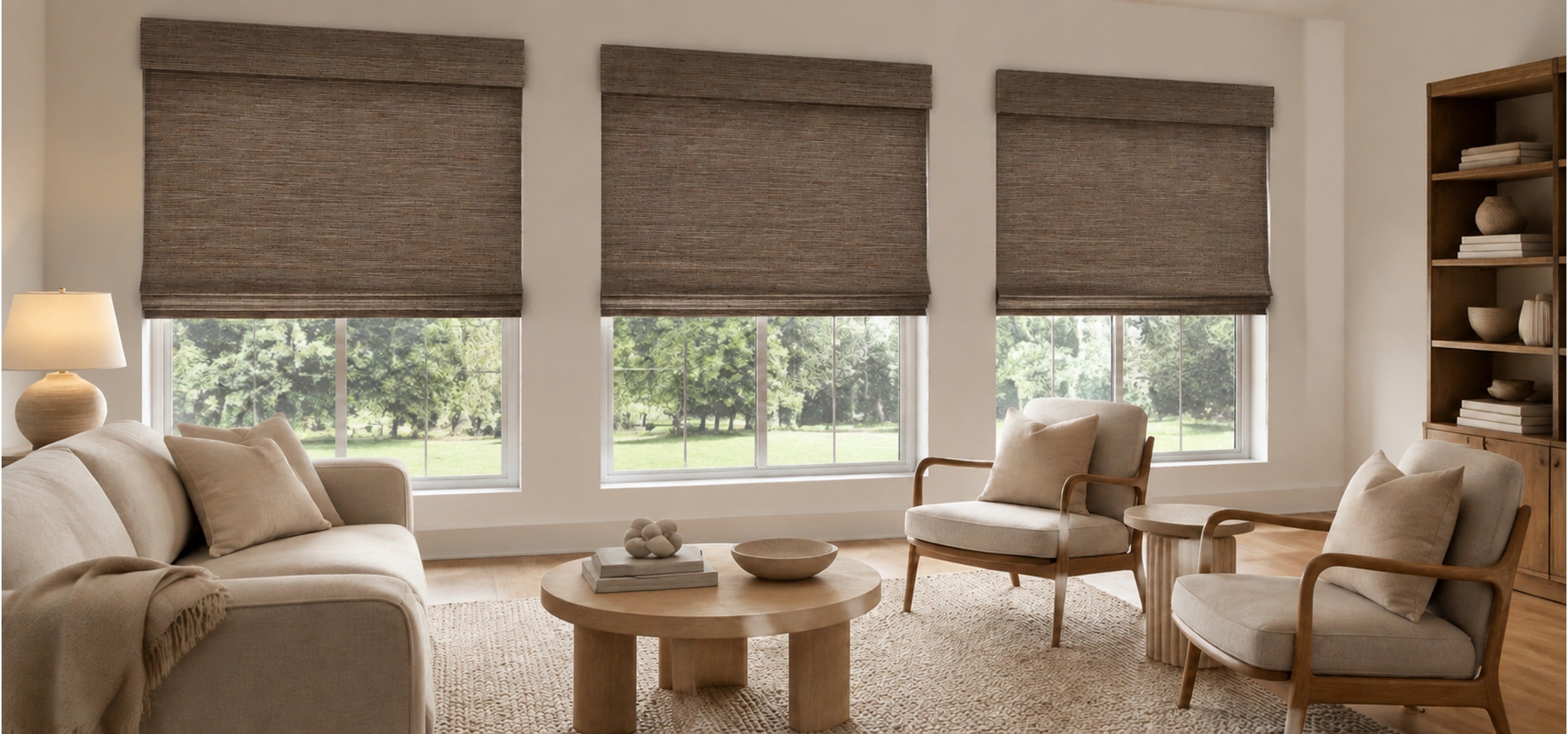

Two shades can look nearly identical on a screen, sit in the same room, and carry different names — one labelled bamboo, the other woven wood. The prices rarely match either.
Then there is the second surprise, the one that arrives after installation: the light comes straight through. The room is softer, but it is not dark.
Both come from the same misunderstanding, and it clears up as soon as you know what these shades are actually made of.

Bamboo Is a Material, Woven Wood Is the Category
Here is the whole answer in one line: a bamboo shade is a type of woven wood shade, not a separate product.
Woven wood shades are hand-woven from natural materials — bamboo, jute, grasses, and linen blends among them. Bamboo is one of those materials. So nearly every bamboo shade is a woven wood shade, while plenty of woven wood shades contain no bamboo at all.
The two words survive side by side because they come from different places. "Bamboo shades" is what homeowners say. "Woven wood shades" is the trade term the industry prints on its product pages.

What Woven Wood Shades Are Actually Woven From
The clearest way to see how little of this category is bamboo is to lay the material list out. These are the four SmartWings woven wood collections:
|
Collection |
Starting price |
Fibers used |
|
Woven Wood Shades |
$219.00 |
Hand-woven straw and bamboo |
|
Orithyia |
$229.00 |
Bamboo; Bamboo + Jute; kenaf, jute, and ramie yarn |
|
Aphrodite |
$252.99 |
100% Ramie; Bamboo + Paper; Linen-Ramie |
|
Persephone |
$257.99 |
Ramie-Paper; Bamboo-Ramie; Wood Veneer; Bamboo-Kenaf-Paper |
Eight fibers appear across the four collections, and bamboo is one of them. Ramie, kenaf, jute, paper, linen, straw, and wood veneer make up the rest.
Every panel is woven by hand, so colour and texture shift slightly across a run. Two shades in the same fabric will not be identical — that variation is the material, not a defect, and it is the reason a natural weave reads differently from a printed one. How the weaving itself is done is covered in how woven wood blinds are made.

Why a Woven Shade on Its Own Won't Darken a Room
This is the part worth understanding before ordering.
Natural fibers are woven with gaps between them. Light passes through those gaps — that is the structure doing what it was built to do, not a quality problem. A bare woven shade lowered over a window gives you warm, filtered daylight, not darkness.
Darkness comes from a cloth liner added behind the weave. SmartWings offers three:
50% Blackout Cloth Liner — keeps a good deal of daylight, and the weave still reads from inside
70% Blackout Cloth Liner — takes the room down noticeably for naps and screens
100% Blackout Cloth Liner — the strongest of the three, specified for bedrooms and nurseries
One distinction saves disappointment: a liner governs light through the fabric. The gap between the shade and the window frame is a separate matter, and an outside mount handles it — the trade-off is set out in the inside vs outside mount guide. If you are still deciding how dark you want a room at all, start with light filtering vs blackout.
Breathability, and Why a Natural Weave Feels Different
A woven wood shade is not a sealed surface. Air moves through the weave, which is why a sunroom or a porch stays fresh behind one instead of turning stale and warm the way it does behind a solid panel.
SmartWings weaves its woven wood fabrics from natural straw. The material is non-toxic and eco-friendly, and its breathability keeps interiors cool and fresh — the practical reason these shades end up in the rooms people actually sit in during the day.
Straw is also more resilient than it looks. It holds up to long use without wearing through or fading quickly, which is what makes a hand-woven panel a reasonable thing to put on a window that gets sun every afternoon.

Natural Materials and What That Means in a Child's Room
Every SmartWings woven wood shade is motorized, so nothing hangs beside the window.
There is no pull cord to reach for, no continuous bead chain running down the side of the frame, and no cleat or tension device to install on the wall. The lift cords that raise and lower the panel sit behind the weave, out of the way of the room.
The material itself is the other half of the answer. These panels are hand-woven from natural straw and plant fibers rather than printed synthetics, which is part of why they end up in nurseries and playrooms.
Why motorized operation matters in rooms children use is laid out in the motorized shades and child safety guide.
The motor is quiet, too. A shade that opens on a schedule in a sleeping house is audible, and a quiet one is the difference between an automation you keep and one you switch off — the detail is in the motorized shade noise guide.
Where Bamboo and Woven Wood Shades Look Best
|
Room |
Liner |
Why |
|
Living room, study |
None or 50% |
Texture and warm light are the point, not darkness |
|
Sunroom, porch |
None or 50% |
Breathability matters most here |
|
Dining room, entry |
50% |
Largely a decorative decision |
|
Bedroom |
70% or 100% |
Sleep needs the room taken down |
|
Nursery |
100% |
Daytime naps |
Colour is the one thing that cannot be judged on a screen. Natural fibers shift against backlight, and a weave that looks warm in a photograph can read grey at four in the afternoon. SmartWings fabric samples are $3.50 — tape one to the actual window and leave it there for a full day before choosing. Seasonal palettes and pairings are covered in the woven wood decor guide.

Ordering SmartWings Motorized Woven Wood Shades
Every collection is motorized and made to measure, from $219.00. The four collections share the same hardware and features, so the choice between them comes down to fiber and budget — go back to the material table above.
What arrives. Each order includes the user manual, charging cable, mounting screws, and brackets, and the shades carry a 3-year warranty.
Power. The rechargeable motor runs about 4 to 6 months on a full charge over a Type-C cable. Where recharging would mean a ladder, hardwired power is the better specification — the power options guide covers the trade-off.
Control. Zigbee and Z-Wave motors work with Samsung SmartThings, Home Assistant, and Hubitat. The Matter motor uses Matter over Thread and requires a Thread Border Router in the home, such as a HomePod mini or Apple TV 4K; it is compatible with Apple Home, Amazon Alexa, and Google Home. Schedules, sunrise and sunset triggers, and scene control are set in the platform, and a multi-channel remote can be added where a physical control is easier. Matter itself is explained in the plain-English Matter guide.
The full range is at SmartWings woven wood shades.
FAQ About Bamboo and Woven Wood Shades
Q1: Are bamboo shades and woven wood shades the same thing?
Close to it. Woven wood is the category; bamboo is one material inside it. SmartWings woven wood collections also use ramie, kenaf, jute, paper, linen, straw, and wood veneer.
Q2: Will a woven wood shade make a room dark?
Not on its own — light passes between the natural fibers. Darkness comes from the liner behind the weave, and SmartWings offers 50%, 70%, and 100% blackout cloth liners.
Q3: Which liner should I choose?
50% for living rooms and sunrooms, 70% where naps and screens are involved, 100% for bedrooms and nurseries. The liner is specified with the SmartWings order rather than added afterwards.
Q4: Are woven wood shades a good choice for a child's room?
Yes. The shades are motorized, so there is no pull cord or bead chain at the side of the window, and the motor runs quietly enough for a nursery. Every panel is hand-woven from natural straw and plant fibers.
Q5: Will natural fibers fade?
Natural materials change tone over years of direct sun. SmartWings straw weaves are chosen for resilience, and a $3.50 fabric sample left on the real window for a day is the reliable way to judge colour first.
Q6: Are SmartWings woven wood shades motorized?
The entire range is motorized, cordless, and made to measure from $219.00, with Zigbee, Z-Wave, and Matter motor options.


