
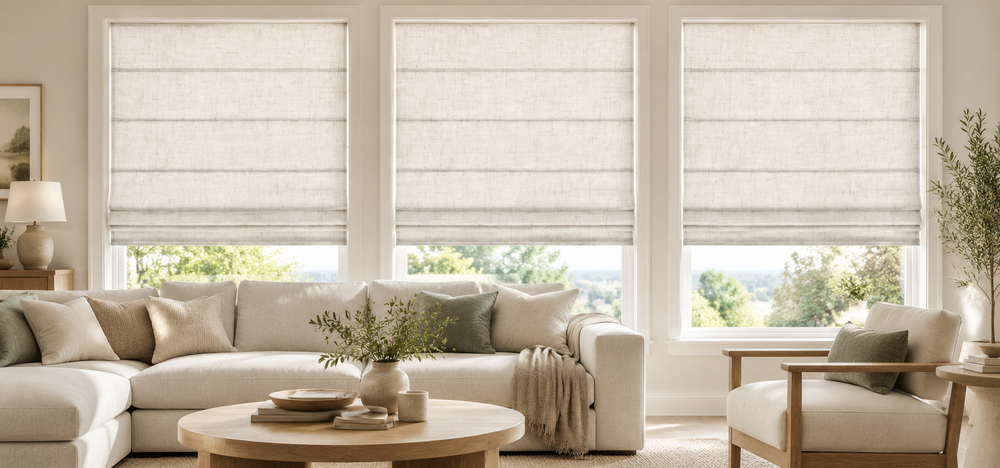

Roman shades bring fabric texture to your windows without the floor-length coverage of drapery. Their folds add depth and a tailored finish, while your fabric and lining choices determine how much daylight enters the room. With motorization, you can also adjust your shades by remote or include them in a daily routine through a compatible smart home system.
The right choice starts with how you use the room. Think about when you need daylight, where privacy matters, and whether you want the shade to stand alone or pair with curtains. Then choose the fabric, light control, mounting style, and operation that support those needs.
Start with the room and your daily routine
Living rooms and dining rooms
If you want to soften sunlight while keeping the room bright, start with a light-filtering fabric. Consider how the shade looks both lowered and raised: the fabric becomes part of the room’s color palette, and the folds add detail at the top of the window. For windows facing a sidewalk or neighboring home, think about privacy after dark as well as during the day.
Bedrooms
Prioritize how dark you want the room to feel when you sleep. A blackout option helps block light through the fabric, while the mounting position and window coverage affect light around the edges. If you enjoy daylight during the day, motorized control makes it convenient to raise the shade in the morning and lower it at bedtime.
Home offices and street-facing rooms
Look at where sunlight falls on your screen and where people outside can see in. A Standard shade can cover the window from the top down. A Levitate design gives you another option: leave an opening above the fabric for daylight while keeping the lower portion of the window covered.
Choose a fabric that works with your interior
Roman shades sit close to the window, so their texture and color remain visible even in rooms with limited space. Ivory, oatmeal, and soft beige work well with warm wood and neutral upholstery. A deeper color can create contrast against light walls, while a fabric with visible texture adds interest to a simple palette.
Our bestselling Daphne linen Roman shades offer a textured linen-blend fabric and a broad color selection. The collection works across relaxed, traditional, and contemporary interiors, making it a useful starting point when you want fabric texture without a bold pattern.
Order samples before choosing a color. View them beside your wall paint and furniture in daylight and under evening lighting. If several windows share one room, compare the fabric at each window; light exposure can change how the same color appears.

Compare light filtering and blackout options
SmartWings Roman shades offer 50%, 60%, 70%, and 100% light-blocking options across selected collections. The backing is an important part of that choice: 50% and 60% options are unlined, while 70% and 100% options include a lining.
|
Light blocking |
Backing |
A useful starting point |
|
50% |
Unlined |
A brighter daytime look with natural light filtering through the fabric |
|
60% |
Unlined |
Filtered daylight with more light reduction than the 50% option |
|
70% |
Lined |
Greater light reduction when you still want some daylight |
|
100% |
Lined |
Blocking light through the fabric for bedrooms or media spaces |
These percentages describe light blocking through the fabric, rather than a guarantee of complete room darkness. Light may still enter around the shade’s edges. Nighttime privacy also depends on the fabric, lighting, and viewing angle; light filtering should not automatically be treated as full privacy.
Availability varies by collection. Standard Daphne Roman shades offer 50%, 70%, and 100% options; Levitate Daphne Roman shades currently offer 50% and 70%. Clio provides a 60% option, while Iris and Astraea offer 100% blackout options.
Decide between Standard and Levitate Roman shades
Both designs bring fabric to the window, but their appearance and movement serve different needs.
|
Design |
How it works |
Choose it when |
|
Standard Roman Shades |
Classic folds stack at the top as the shade rises from the bottom. |
You prefer the traditional layered Roman shade look and straightforward up-and-down operation. |
|
Levitate Roman Shades |
A top-down bottom-up structure with independently adjustable upper and lower rails. Its overall form is closer to Levitate Cellular Shades. |
You want daylight above the fabric while maintaining coverage below, or more control over where the window is uncovered. |
Choose Levitate Roman shades for flexible positioning at street-facing windows or in rooms where daytime privacy matters. Choose Standard Roman shades when classic folds are the main decorative feature you want to emphasize.

Choose an inside or outside mount
An inside mount places the shade within the window opening for a fitted look that keeps the surrounding trim visible. Check the required mounting depth and allow room for handles or other obstructions. Also consider the fabric stack when the shade is raised, since it occupies space near the top of the window.
An outside mount places the shade beyond the opening, on the wall or trim. Additional coverage can help reduce light at the edges. Mounting above the opening may also keep more of the raised fabric stack clear of the glass, provided there is enough room for the hardware and shade to operate.
Follow the measuring instructions for the exact product and mounting method. For a layered arrangement, plan the shade brackets and curtain track together so the two treatments can move freely.

Use Roman shades alone or layer them with curtains
Used alone, Roman shades give a window a finished look while leaving the space beneath it clear. This makes them an appealing choice above a desk, bench, or other furniture where full-length drapery would be difficult to accommodate.
Layering Roman shades with drapery is also a popular way to add depth. The shade handles everyday light adjustment, while side panels frame the window and introduce longer lines. Classic folds paired with full-length curtains can suit both a relaxed living room and a more formal bedroom.
For a coordinated combination, pair Daphne Roman shades with Daphne Drapery & Curtains. Use the same fabric color for continuity, or select complementary colors within the collection. You can also use Roman shades on smaller windows and matching drapery on larger openings in the same room.
Check samples together before ordering. Different lining choices and the way light passes through each treatment can affect how closely the finished colors appear to match.

Make motorized control part of the plan
Motorized Roman shades are especially convenient when you have several windows to adjust or a window behind furniture. A remote provides an easy way to operate the shades; app control, voice commands, and automation depend on the motor and smart home setup you choose.
If you are considering Apple's recently announced Apple HomeView, HomePod mini 2, and Apple TV 4K for your home, plan your shade motor and hub setup together. A compatible SmartWings motor lets your Roman shades become part of your Apple Home routines.
For Matter over Thread shades, your setup needs a compatible Matter controller and a Thread border router. Confirm the requirements for your selected motor and Apple hub model before ordering.
Once connected, choose routines that reflect how you actually use the room:
- Morning schedules can raise bedroom shades at your weekday wake-up time, with a later schedule on weekends.
- A sunset automation can lower living room shades as daylight fades, helping you maintain evening privacy.
- A Movie Night scene can lower shades and dim compatible lights together when you activate the scene.
- A scheduled afternoon adjustment can lower shades before direct sunlight reaches your desk or seating area.
Find your Roman shades
Explore SmartWings Roman Shades to compare fabric collections, blackout levels, and Standard or Levitate designs. If you are coordinating several window types, consider Daphne shades and matching drapery together.
Frequently asked questions
Q1: What should I look for when buying Roman shades?
Consider your room’s light and privacy needs, fabric, shade design, and mounting space. For motorized options, also check control methods and smart home compatibility.
Q2: What light control and lining options do SmartWings Roman shades offer?
Selected collections offer 50%, 60%, 70%, and 100% light blocking. The 50% and 60% options are unlined; 70% and 100% include a lining. Blackout fabric blocks light through the material, but edge gaps may still let light in.
Q3: What is the difference between Standard and Levitate Roman shades?
Standard shades feature classic folds that stack at the top. Levitate shades have independently adjustable upper and lower rails for flexible daylight and privacy control. Levitate Daphne offers 50% and 70% options.
Q4: Can I pair Roman shades with curtains?
Yes. Pair Roman shades with curtains for added depth and coordinated light control. Daphne Roman shades and Daphne Drapery & Curtains share the same fabric collection for easy matching.
Q5: Can motorized Roman shades work with Apple Home and schedules?
Yes, with a compatible motor and hub setup. Use Apple Home for schedules and scenes. Matter over Thread models require a compatible Matter controller and Thread border router.


