

Apple's iPhone Duo brings two ways of using a phone into one foldable design: a compact screen for quick tasks and a larger display when you want more room. That idea of adapting one product to different moments feels familiar at home, too.
Consider your living room window. In the morning, you want daylight without harsh glare. After sunset, you want privacy with the lights on. A single fabric may leave you choosing which need matters most.
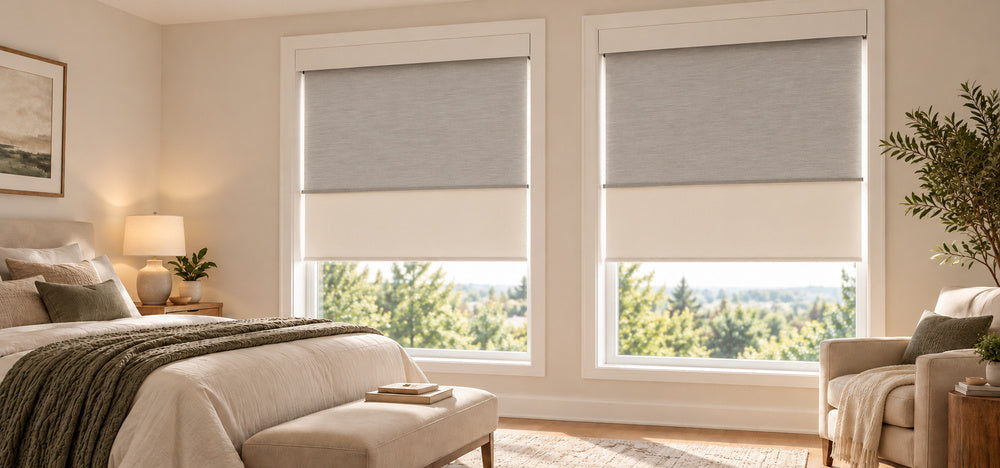
Motorized dual roller shades combine light-filtering and blackout fabrics in one window treatment. You can change which layer covers the glass as your day changes, without installing two separate shade systems.
How dual roller shades work
Dual roller shades use two fabric panels, each on its own roller tube. A typical combination pairs a light-filtering fabric with a blackout fabric. Raise the blackout layer and lower the light-filtering layer for softer daylight. When you want more darkness or nighttime privacy, lower the blackout layer. Raise both to uncover the window.
The two fabrics give you more flexibility than a single roller shade. You can choose daylight control for everyday activities and stronger light blocking when the room needs it, while keeping both functions together at the window.

A window that works from morning to night
Daylight for breakfast and work
A bright room does not always need an uncovered window. Lowering the light-filtering layer softens incoming daylight while keeping the room inviting. In a home office, it can help reduce glare on a monitor without making the space feel closed off. The result depends on the fabric you choose and the direction your window faces.
More light control for movies and rest
When the same room becomes a movie space or a bedroom needs daytime darkness, lower the blackout layer. You keep the daytime fabric you enjoy and have a second option ready when stronger light blocking matters.
Blackout describes the fabric's ability to block light through the panel. Some light can still enter around the edges of an installed shade, so mounting and coverage matter when darkness is a priority.
Privacy when the lights come on
A fabric that feels private during the day may allow more visibility after dark, when the room is brighter than outdoors. Switching to an opaque blackout layer helps shield the interior from view. This is especially useful for street-facing living rooms and bedrooms near neighboring homes.

Choosing between the two SmartWings designs
Both designs provide two fabric layers. The main differences are how the roller tubes are mounted, how they are covered, and where the motor can be positioned.
Explore SmartWings Motorized Dual Shades and SmartWings Motorized Dual Shade Harmony Duo Plus using the comparison below.
|
Feature |
Dual Shades |
Harmony Duo Plus |
|
Structure |
Optional valance with components assembled during installation |
Integrated assembly |
|
Installation |
Larger brackets secure both sides of the shade and support top or wall mounting |
Installs with brackets similar to a standard roller shade |
|
Width adjustment |
Three-position adjustment wheel on one side allows a small finished-width adjustment |
No finished-width adjustment |
|
Top cover |
Cassette covers the upper tube; oversized fabric-wrapped cover conceals both tubes |
Metal square valance encloses both tubes |
|
Motor position |
Left or right |
Right only |
|
Roll direction |
Fixed by the two-tube structure |
Fixed by the two-tube structure |
Choose Dual Shades if you need a left-side motor position or prefer the available fabric-wrapped cover. The small width adjustment can help with installation fit, but accurate measurements are still essential.
Choose Harmony Duo Plus if you prefer an integrated assembly with a metal square valance that conceals both tubes. Plan for a right-side motor position and check the ordered width carefully.
Making both layers part of your routine
Motorization makes it easier to use each fabric when you need it, especially across several windows or behind furniture. With a compatible smart motor and the required smart home equipment, the shades can also become part of schedules and scenes.
For example, a morning routine could raise the blackout layer while leaving the light-filtering layer down. An evening routine could lower the blackout layer as the room’s lights come on. A movie scene could combine shade positions with your preferred lighting.
Choose the motor for the platform you use, whether that is Apple Home or another supported system. Available controls and automation depend on the selected motor, compatible hub, and platform. Confirm how both layers will be controlled before ordering.

What to check before ordering
Fabric pairing. Choose a light-filtering fabric for the daylight effect you want and a blackout fabric for stronger light blocking and nighttime privacy. Compare samples in your room during the day and with the lights on after dark.
Mounting space. Check the depth required for the complete two-tube assembly and your chosen cover. For inside mounts, account for window handles and locks. For outside mounts, plan fabric coverage around the opening.
Motor position and power access. Make sure the motor position works with your window, charging access, or planned wiring. Harmony Duo Plus requires right-side placement.
Fixed roll direction. Both designs use a preset roll configuration. Standard-roll and reverse-roll changes are not available, so confirm clearance around the window before ordering.
Start with the room's daytime and nighttime needs, then compare the two designs in our Dual Shades collection. If you are unsure about mounting space or the right configuration, contact our team before placing your order.
Frequently asked questions
Q1: Are dual roller shades the same as zebra shades?
No. Dual roller shades use two separate fabric panels on two roller tubes, typically pairing light-filtering and blackout fabrics. Zebra shades use alternating sheer and solid bands, adjusting light by changing how those bands align.
Q2: Do I need to lower both layers at the same time?
No. You can lower the light-filtering layer while keeping the blackout layer raised, then lower the blackout layer when you want more privacy or darkness. You can also raise both to uncover the window.
Q3: Will blackout dual shades make my room completely dark?
Blackout fabric blocks light through the panel, but light can still enter around the edges. The final result depends on the mounting position and how fully the fabric covers the window.
Q4: Can I customize the fabric combination?
Yes. Both SmartWings designs offer fabric pairing options, with a standard combination of light-filtering and blackout fabrics. For a different pairing, follow the Custom Fabric instructions on the product page or contact our team before ordering.
Q5: Can I change the roll direction or motor side?
The roll direction is fixed on both designs because of the two-tube structure. SmartWings Motorized Dual Shades supports left- or right-side motor placement, while Harmony Duo Plus supports right-side placement only.
Q6: Can I control dual shades with Apple Home?
Yes, with a compatible SmartWings motor and the required Apple Home equipment. Before ordering, confirm the motor's compatibility, any hub requirements, and how each fabric layer will be controlled.


