
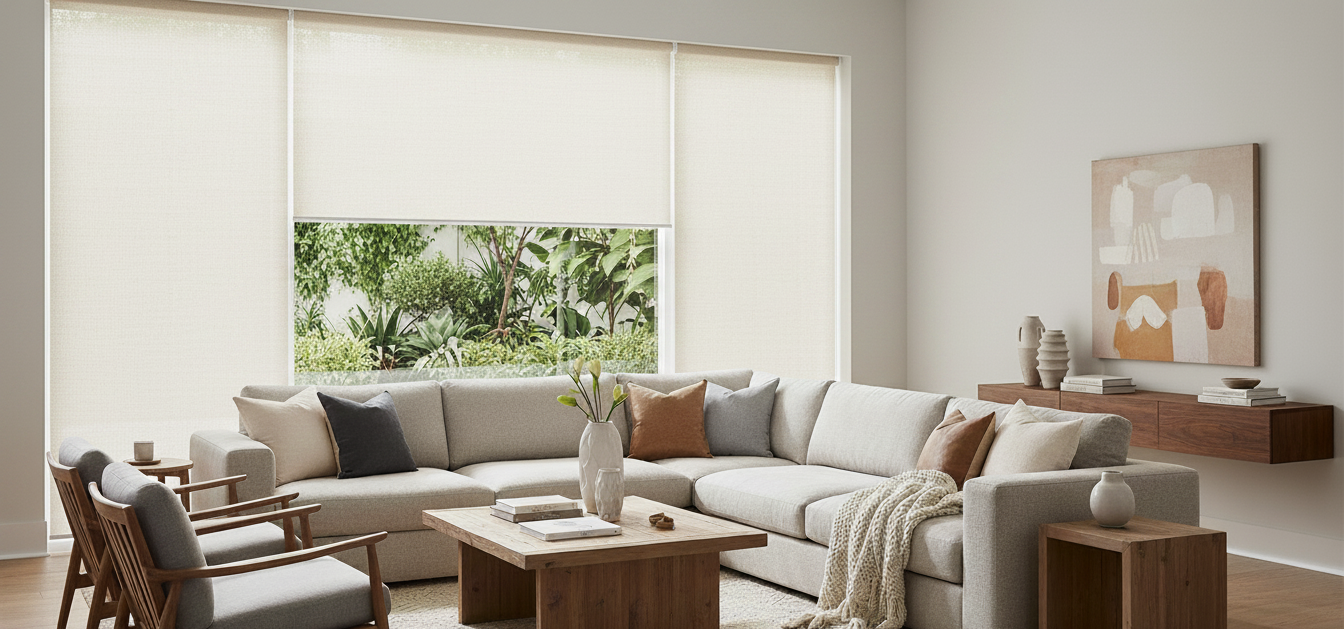

Many households share a common experience: during the day, you want soft natural light coming through the window, but at night, you need the light blocked out for privacy.
The traditional approach is to hang two separate layers — a sheer curtain plus a blackout curtain — but over time, operating and maintaining two independent layers gets inconvenient, and the overall look can feel bulky.
SmartWings dual shade solutions integrate two fabric types into a single system, allowing daytime light filtering and nighttime blackout to switch on the same window while keeping the installation clean and streamlined.
The following guide helps you determine whether a dual setup is right for your home, and which option best fits your needs.

Dual Shades or Single: Which Setup Fits Your Room
Not every window needs a dual shade setup. Before deciding, consider whether your actual needs match the following scenarios.
Situations where dual shades make sense:
The bedroom is the most typical dual shade scenario — natural light during the day, blackout for sleeping at night.
One light filtering layer handles daytime, one blackout layer handles nighttime, both switching on the same window.
Living rooms with movie or projection setups also benefit. Dual shades let you switch between everyday natural light and temporary blackout quickly.
Street-facing windows need daytime privacy (light filtering layer blocks outside views) and stronger nighttime coverage (blackout layer for full privacy).
Situations where you may not need dual shades:
If a room's lighting needs are relatively simple — a storage room that only needs blackout, or a north-facing window where light is already soft — a single shade can handle it without the added cost of a dual setup.
Bathrooms, kitchens, and other small windows usually work fine with one shade. The cost-to-benefit ratio of dual shades in these spaces isn't as strong.

Two Dual Shade Options Compared
Once you've decided dual shades are a good fit, the next step is choosing how to set them up. SmartWings offers two approaches, each with its own advantages.
Option 1: Two Independent Roller Shades Combined
Install two SmartWings roller shades on the same window — light filtering in front, blackout in back, each controlled independently.
Price: from $159.99 × 2 (two shades purchased separately)
Fabric and color can be selected independently, offering high customization flexibility
Each shade operates on its own — raise, lower, or stop individually
Well-suited for users with specific fabric and color matching preferences
Outside mount installation provides more room for both shades

Option 2: Day/Night Cellular Shades ($385)
The SmartWings Day/Night Cellular Shade integrates a light filtering layer and a blackout layer into one shade body, with each layer controlled independently.
Standard window version: $385
Skylight version: from $559
Single-unit installation — takes up only one mounting position, saving space
Simpler installation process (one setup covers both layers)
Honeycomb structure provides additional insulation
Well-suited for users who value clean installation and energy efficiency
Worth noting: fabric and color options are more limited compared to two independent roller shades.

Quick comparison:
Feature |
Two Independent Roller Shades |
Day/Night Cellular Shade |
Starting price |
$319.98 ($159.99 × 2) |
$385 |
Installation |
Two separate installs |
One install |
Space required |
Larger (two roller systems) |
Smaller (single unit) |
Fabric flexibility |
High (choose separately) |
More limited |
Insulation |
No |
Yes (honeycomb structure) |
Matching Dual Shades to Your Interior Style
After choosing your setup, fabric and color pairing determines the final visual effect. Here are some matching directions for common interior styles.
Modern Minimalist
Keep the light filtering and blackout layers in the same color family — white, light gray, or off-white. When raised, the fabric rolls up into the mechanism, leaving the window frame clean and minimal.
Inside mount installation lets the shades blend into the wall without drawing attention.
Best for: open-plan living rooms, modern bedrooms.
Warm & Natural
Choose cream or warm white for the light filtering layer to create soft indoor lighting. Pair with a deeper tone from the same color family for the blackout layer, adding visual depth.
For a more organic feel, SmartWings woven wood shades ($219 and up) can serve as an alternative light filtering layer, combined with a blackout roller shade.
Best for: dining rooms, family rooms.
Scandinavian Minimal
White or light-colored light-filtering layers take center stage, maximizing natural light. The blackout layer stays rolled up most of the time, deployed only when needed.
Day/Night cellular shades work especially well in this style — the single-unit design is cleaner, and the honeycomb insulation aligns with the Scandinavian emphasis on energy efficiency.
Best for: spaces that prioritize natural light and energy efficiency.
Industrial / Loft
Dark gray, charcoal, or deep brown fabrics that echo metal and concrete elements. Outside mount installation lets the shades cover the full window frame, creating a bold, large-scale color block effect.
For oversized windows, SmartWings custom sizing can accommodate the dimensions.
Best for: lofts, studios, open-plan spaces.

Budget Planning for Dual Shade Setups
Your dual shade budget depends on which setup you choose and how many windows you're covering. Here are three common approaches.
Entry-level: Day/Night Cellular Shade ($385)
One window, one shade — straightforward installation with light filtering, blackout, and honeycomb insulation in a single unit. A solid starting point if you want dual-layer functionality with minimal setup.
Flexible: Two Independent Roller Shades (from $159.99 × 2)
Better suited for users with specific fabric and color matching needs. If your preferences change later, you can replace one layer independently without swapping the entire setup.
Gradual upgrade: Start single, add later
Not sure if you need dual shades? Start with a single SmartWings light filtering roller shade ($159.99) and live with it for a while. If you find you need blackout capability, add a second shade later.
SmartWings products support flexible combinations — you don't have to commit to a full dual setup from the start.
For a more comprehensive smart blinds buying guide, see our 2026 Smart Blinds Practical Buying Guide.
For detailed blackout comparisons, see our Blackout Blinds Guide for Bedroom, Living Room & Home Theater.
For cellular shade insulation and energy benefits, see our Cellular Shades Energy Efficiency Guide.
Contact the SmartWings team for custom sizing and style matching advice.
FAQ About SmartWings Dual Shades
Q1: Two independent roller shades or Day/Night cellular — how do I decide?
It depends on your priority. For more flexibility in fabric and color matching, go with two independent roller shades (from $159.99 × 2). For a cleaner single-unit installation with added insulation, the Day/Night cellular shade ($385) is the way to go.
Q2: Which rooms benefit most from dual shades?
Bedrooms are the most natural fit — light filtering by day, blackout at night. Living rooms with media setups are also a strong use case. If a room only has one lighting need, a single shade is sufficient.
Q3: Can I start with one layer and add the second later?
SmartWings roller shades support flexible combinations. Start with a light-filtering shade, and add a blackout shade when you're ready — the two operate independently without affecting each other.
Q4: Do dual shade setups support smart control?
Each layer in a SmartWings dual setup is independently controlled and supports Matter protocol, compatible with Apple Home (requires HomePod mini or Apple TV 4K as Thread Border Router), Alexa, and Google Home. You can set up scenes for one-tap switching between layers, or pair them with sunrise/sunset automation.
Q5: Is there a skylight version of the Day/Night cellular shade?
Yes. The SmartWings Day/Night Skylight Cellular Shade (from $559) uses the same dual independent control design, supporting vertical, tilted, and horizontal installation with a four-sided aluminum frame. View Skylight Series


